
The Tariff Tectonic Shift: How Trump's Trade Policies Are Reshaping Tech Giants' Supply Chains and Stock Valuations
 Aime Summary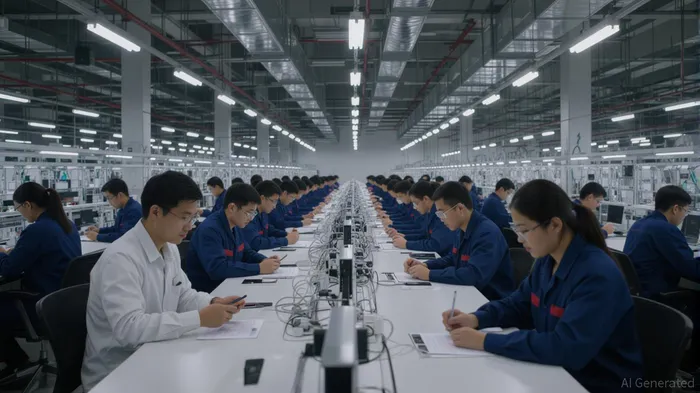
In the wake of Trump's 2025 tariff regime, the semiconductor and consumer electronics sectors are experiencing seismic shifts. What began as a bold bid to “Make America Great Again” through protectionist policies has morphed into a complex web of supply chain disruptions, valuation volatility, and geopolitical chess. For tech giants like AppleAAPL--, BroadcomAVGO--, and NvidiaNVDA--, the stakes are high. These companies, once insulated by the mystique of innovation, now find themselves at the mercy of a trade war that's reshaping global manufacturing and investor sentiment.
The Supply Chain Conundrum: When Globalization Meets Tariffs
The Trump administration's tariffs—averaging 18.3% on goods and reaching as high as 39% on certain imports—have turned the once-efficient global supply chain into a minefield of costs and delays. For Apple, the pain is visceral. The iPhone, its cash cow, relies on a network of suppliers in China, Taiwan, and South Korea—regions now subject to tariffs ranging from 15% to 25%. The company's supply chain, optimized for scale and speed, is now under siege.
Consider this: Apple's gross margin in 2024 was 43.3%. A 15% tariff on key components could erode 2-3 percentage points of that margin, assuming no price hikes. But price hikes risk alienating customers in a market already reeling from inflation. The company's recent Q2 guidance, which projected a 4% revenue drop year-over-year, underscores the fragility of its business model. Morningstar analysts, who already flagged Apple as overvalued, now face a steeper uphill battle to justify its $3.5 trillion market cap.
Broadcom, a semiconductor titan, fares slightly better. Its chips are technically exempt from certain tariffs, but the end products they power—like 5G infrastructure and data-center gear—are not. This creates a “tariff by proxy” effect, where higher costs for customers (e.g., telecom providers) could reduce demand for Broadcom's offerings. Yet, the company's strong cash flow (over $12 billion in operating cash flow in 2024) and dominant position in the semiconductor market (22% of global revenue) provide a buffer. Analysts remain cautiously optimistic, with 88% of brokerage houses still rating it as a “Strong Buy.”
Nvidia, meanwhile, is caught in a paradox. Its Blackwell AI chips, the crown jewels of its product line, are exempt from tariffs, but the servers and GPUs that house them are not. The company's stock plummeted 15% in early July 2025 after Trump's tariff announcement, only to recover 8% the following week as markets digested the news. This volatility reflects the sector's uncertainty. Nvidia's reliance on Asian manufacturing hubs (60% of its supply chain is in China and South Korea) makes it a prime candidate for reshoring costs, which could eat into its 58% gross margin.
The Valuation Quandary: Growth vs. Risk
The tariffs have also forced a reevaluation of tech stock valuations. The “Magnificent Seven” once commanded sky-high multiples, but the new reality is far less forgiving. Apple's P/E ratio, which peaked at 35x in early 2024, has since fallen to 28x. Broadcom's PEG ratio (1.2x) remains attractive relative to its peers, but Nvidia's 15x forward P/E suggests investors are pricing in significant risk.
The key question for investors is whether these valuations reflect the true cost of reshoring and supply chain diversification. For Apple, the cost of moving production to Vietnam or India could add 10-15% to manufacturing expenses—a non-trivial sum for a company with razor-thin margins. Broadcom and Nvidia, with more flexible supply chains, may avoid the worst of these costs, but they're not immune to the broader economic drag of a trade war.
Strategic Implications for Investors
For those navigating this turbulent landscape, the lesson is clear: diversification and flexibility are paramountPARA--. Here's where the rubber meets the road:
- Apple: A “Hold” recommendation for now. The company's ecosystem and brand loyalty remain strong, but the tariffs could force painful concessions. Watch for a potential 10-15% drop in gross margins by 2026.
- Broadcom: A “Buy” for its resilience. Its semiconductor exemptions and robust cash flow position it to outperform in a downturn.
- Nvidia: A “Market Outperform” if it can navigate the AI hype cycle. The company's Blackwell launch in 2025 could offset short-term pain, but near-term volatility is likely.
The Bigger Picture: Trade Wars and Market Psychology
The Trump tariffs are not just a policy shift—they're a psychological event. Investors now price in the risk of retaliatory tariffs, supply chain bottlenecks, and inflationary pressures. The Swiss-American Chamber of Commerce's lament over a 39% tariff on pharmaceuticals is a case in point: no sector is truly safe.
For tech investors, the takeaway is simple: the era of “growth at any cost” is over. The new playbook requires a balance between innovation and operational resilience. Companies that can adapt—by diversifying suppliers, leveraging automation, or renegotiating contracts—will thrive. Those clinging to outdated models? They'll be left in the dust.
Final Thoughts
Trump's tariff policies have created a perfect storm for the tech sector. While the immediate pain is palpable, the long-term winners will be those that embrace changeEMCG--. For Apple, Broadcom, and Nvidia, the path forward is fraught but not impossible. Investors, meanwhile, must weigh the risks of a fractured global supply chain against the potential for innovation-driven recovery.
In the end, the market is a mirror of reality—and right now, reality is messy. But as every investor knows, opportunity often lurks in the shadows of uncertainty.

Delivering real-time insights and analysis on emerging financial trends and market movements.
Latest Articles
Stay ahead of the market.
Get curated U.S. market news, insights and key dates delivered to your inbox.
AInvest
PRO
AInvest
PRO



Comments
No comments yet