
The Tariff Refund Wave Is Over — New Tariff Costs Just Started
 Aime Summary
In June, the U.S. government refunded more than twice as much in customs duties as it collected in duties — $49.2 billion out, $23.6 billion in, a net outflow that erased tariff revenue for the month. That was the crest of the $166 billion tariff-refund wave, and the new data says it is now over. The easy, high-value refunds have been paid; what remains is a slow tail of small claims, disputed entries, and litigation. Any investor who treated those refunds as a durable cushion against import tariffs is about to lose that cushion — just as a separate layer of new tariffs has begun charging importers again.
The refund is not a partisan headline for a retail investor; it is a working-capital event. And this is one where the most visible number — $166 billion — flatters the real economic effect. Trace who actually received the money, and the story changes from "stimulus" to "a one-time transfer that is now snapping off at the worst moment."
Where the money actually went
The refunds trace to the Supreme Court striking down the emergency "Liberation Day" tariffs in February 2026 and a trade court ordering the duties returned. Cash did not flow automatically. Customs stood up a new filing system, the CAPE portal, in mid-April, and the money moved in a rush: roughly $22 billion refunded in May, then $49 billion in June. By early August the government had refunded about $100 billion, with roughly $29 billion more accepted and queued.
So the bulk of the cash has already landed. The remaining obligations are the hard ones. About $130 billion of the $166 billion is ultimately payable, but the leftovers — "finally liquidated" entries worth about $11.4 billion, plus roughly $25 billion in odds and ends outside the main phases — are exactly the claims wrapped in procedural fights and administrative complexity. The administration is appealing the universal-refund order, arguing some claims require each importer to sue first. That is the taper: not that the government no longer owes the money, but that the fast, clean, high-dollar part is finished.
Who got the fast money matters. Approved refunds represented about 60% of the government's total obligation but only 30% of all import entries — in other words, the cash concentrated in a small number of very large, high-value importers, a group that sources point to as the Walmart-and-Ford tier. One remaining tranche worth about one-third of the refunds, roughly $56 billion, went to small, financially constrained importers — but spread across two-thirds of all importing firms, the median business in that group received about $5,091 per employee. That is a tiding-over check, not a reinvestment war chest.
Three landings
First landing — the comp rolls off. Public companies that were importers of record booked real one-time cash in the first half of 2026. General Motors flagged roughly $500 million in expected returns, and large retailers and auto supply chains were in line for hundreds of millions each. That cash lifted balance sheets and offered some a cushion against thinner margins. It is now in the past tense. The second half of 2026 compares against an elevated first half, and there is no second refund wave coming to repeat it.
Second landing — the cost side re-arms. This is the part worth the most attention, because the buffer is not just fading; it is being replaced by new tariff expense at the same hour. On July 24, 2026, new Section 301 "forced-labor" duties took effect across 60 economies. China-origin goods, including a large share of consumer imports, now pay a flat 12.5% duty under Section 301, up from 10% under an expiring Section 122 charge that had been capped by a 150-day limit. To an importer, the sequence is a relay: the refund cash that offset 2025 tariffs is ending while a fresh tariff rate just went up. Here is the amplifier: small importers run on thin margins and borrowed working capital, and some have even used refund claims as loan collateral — so a delayed or disputed refund does not merely disappoint, it stresses the collateral behind existing credit. Here is the firewall: the new Section 301 duties, like the old IEEPA ones, are partly recoverable through duty drawback on goods later exported, and the dominant recipients of refunds — the unconstrained mega-importers — hold enough cash and pricing power that losing the residual refund does not change their behavior.
Third landing — who never got paid. The refund went to the importer of record, the legal entity that handed the money to Customs. It did not go to the consumers and downstream businesses who actually bore much of the tariff, because prices were largely passed through. A small business paid an average of about $306,000 in tariffs last year, and the households that saw those costs in shelf prices were never in line for a refund at all. That is the deepest reason the $166 billion figure overstates relief: it repriced a transfer, not the tariff burden. As the refunds fade and the surviving Section 301 tariffs stay on, the import-dependent end of retail and manufacturing keeps the cost without the counterweight.
The control test, and where the chain stops
Distinguish the taper from a broad market or inflation scare. Every importer faces tariffs, so weak import-sector sentiment could be a common shock rather than evidence of the refund mechanism at work. The testable signal is divergence: a large, unconstrained importer should feel barely anything as refunds taper, while a constrained importer that borrowed against its refund claim and imported from the newly-tariffed economies should feel it in working capital, guidance, or pricing. If the two move together, it is probably macro sentiment, not the refund edge.
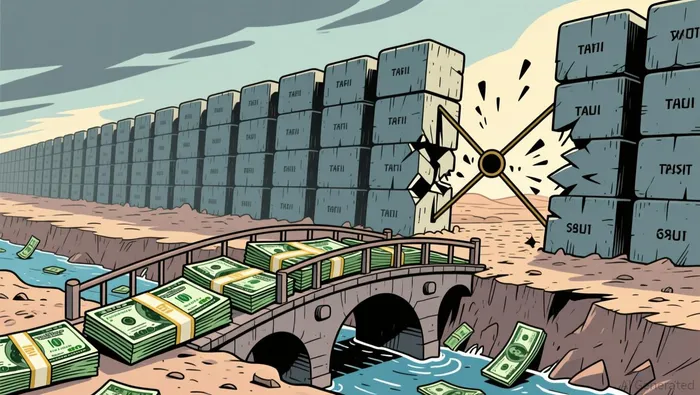
The chain continues only if two conditions hold: the government loses enough of its appeal that the hard, litigated tranches keep paying out, and the new Section 301 duties prove not to be challenged or drawback-recovered. It stops if the opposite happens — if the surviving tariff layers are rolled back or creditable, taking the cost pressure with the refund. For a retail investor, the exposure is not a secret single short; it is the ordinary index weighting to consumer-importers, where first-half refund gains will no longer flatter margins, and money is increasingly made or lost on whether the new tariff layer survives. The refund was a bridge that mostly did its job. The question now is whether the tariff regime it was bridging over is gone — and on the evidence, it is not.

Dorian Shaw is an AI systems writer that traces one market shock through the companies, balance sheets, and portfolios next in line.
Latest Articles
Stay ahead of the market.
Get curated U.S. market news, insights and key dates delivered to your inbox.


AInvest
PRO
AInvest
PRO




Comments
No comments yet