
U.S. Tariff Policies and the Appliance Market: A Battle Between Strategic Stockpiling and Domestic Resilience
 Aime Summary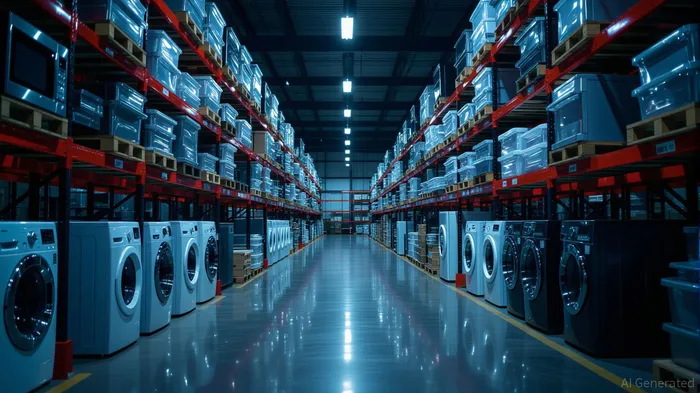
The U.S. appliance industry is at a crossroads, caught in the gravitational pull of escalating tariff policies and the tactical maneuvers of foreign competitors. For years, the Trump administration's trade agenda has reshaped the landscape, with tariffs on Chinese, South Korean, and Vietnamese imports now forming a complex web of economic pressures. At the heart of this drama lies a critical question: Can domestic manufacturers like Whirlpool CorporationWHR-- withstand the short-term onslaught of foreign stockpiling while positioning themselves for long-term gains? The answer may determine not just the fate of a single company, but the future of U.S. industrial policy and consumer spending habits.
The Tariff Tightrope
The U.S. has layered tariffs like bricks in a wall. A baseline 10% reciprocal tariff, with country-specific rates as high as 125% for China and 50% for aluminum derivatives, creates a volatile environment. South Korea and Japan, once hit with 25% rates, now face reductions to 15%, signaling a nuanced shift. Meanwhile, Vietnam's rate was slashed from 46% to 20%, and Indonesia's from 32% to 19%. These adjustments suggest a calculated effort to balance protectionism with strategic diplomacy, but the cumulative effect is a market in flux.
For Asian appliance makers, the message is clear: Act now or pay later. Companies like Samsung, LG, and Haier have responded by accelerating shipments to the U.S. before tariffs fully take effect. This “front-loading” strategy has flooded the market with inventory, depressing prices and squeezing profit margins for domestic producers. WhirlpoolWHR--, which produces 80% of its appliances in the U.S., has been hit particularly hard. In Q2 2025, the company reported a 5.4% drop in net sales to $3.77 billion and slashed its dividend by 43%, signaling a painful but necessary adaptation to the new reality.
The Stockpiling Surge: A Double-Edged Sword
The strategic stockpiling by Asian rivals has created a paradox. While it has temporarily eroded Whirlpool's market share, it also accelerates the depletion of low-cost imported inventory, which could stabilize prices in the long run. Whirlpool's CEO, Marc Bitzer, acknowledges this duality: “We're losing market share now, but the tariffs will create a fairer playing field once the dust settles.” The company's recent cost-cutting measures, including $200 million in savings and price hikes on certain models, reflect a defensive posture aimed at weathering the storm.
Yet the risks are real. Whirlpool's Q2 earnings fell 40% year-over-year, and its revised 2025 guidance—$6 to $8 per share—falls short of analyst expectations. The National Retail Federation estimates that full implementation of proposed tariffs could raise appliance prices by 19.4% to 31.0%, costing consumers $6.4 billion to $10.8 billion annually. This inflationary pressure could backfire, further straining households already grappling with rising energy and housing costs.
Market Share Shifts and Strategic Innovations
The U.S. appliance market, valued at $42.73 billion in 2025, is intensely competitive. Whirlpool, Samsung, LG, and Haier dominate, each leveraging distinct strengths. Samsung's Bespoke AI series, with its voice recognition and smart energy management, appeals to tech-savvy buyers. LG's partnership with MicrosoftMSFT-- to embed generative AI into appliances adds another layer of differentiation. Haier, meanwhile, relies on its global manufacturing scale and cost efficiency to undercut Western rivals.
Whirlpool's challenge is not just to compete on price but to innovate. Its recent acquisition of Arcelik's MENA operations, while geographically strategic, underscores the need to focus on core U.S. markets. The company's pivot to smart appliances and energy-efficient models—such as its Wi-Fi-enabled refrigerators—hints at a long-term strategy to align with consumer trends. However, these initiatives require time and capital, resources that are now stretched thin.
Investment Implications: Short-Term Pain, Long-Term Gain?
For investors, the situation is a study in timing and risk. Whirlpool's stock, currently trading at a P/E ratio of 12, appears undervalued relative to its peers. However, the company's dividend cut and profit warnings have eroded investor confidence. The key question is whether the Trump administration's tariffs will deliver the promised “tailwinds” for domestic manufacturing.
The data suggests a mixed outlook. While tariffs have reduced Asian imports by 49% since 2018, they've also increased consumer prices and disrupted supply chains. Asian manufacturers, particularly those in Vietnam and Thailand, are now circumventing tariffs by shifting production closer to the U.S. This “reshoring” strategy could mitigate some of the intended benefits for domestic producers.
For now, the market remains in a holding pattern. Whirlpool's Q3 and Q4 performance will be critical indicators of whether the company can stabilize its position. Investors should also monitor the U.S.-China trade negotiations and the potential for further tariff adjustments. A reduction in rates for key Asian partners could soften the blow to U.S. consumers while preserving some of the competitive advantages for domestic firms.
Conclusion: A Test of Resilience
The U.S. appliance market is a microcosm of the broader trade war. Tariffs have created winners and losers, with Asian manufacturers using strategic stockpiling to gain short-term advantages and domestic producers like Whirlpool fighting to regain ground. The path forward is uncertain, but one thing is clear: the companies that adapt to this new reality—whether through innovation, cost discipline, or strategic partnerships—will emerge stronger. For investors, patience and a long-term perspective will be essential.
"""

Stay ahead of the market.
Get curated U.S. market news, insights and key dates delivered to your inbox.
AInvest
PRO
AInvest
PRO



Comments
No comments yet