
The U.S. Tariff Crisis: Strategic Opportunities in EU Agricultural Exports
 Aime Summary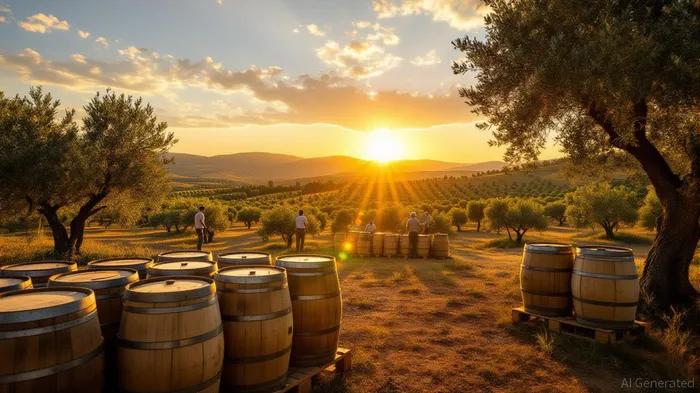
The U.S. tariff crisis has ignited a seismic shift in global agricultural trade, with European producers—particularly Spain's olive oil industry—bearing the brunt of protectionist measures. In 2025, the U.S. imposed a 20% tariff on EU agricultural exports, including Spanish olive oil, and a steep 50% tariff on black olives, disrupting supply chains and forcing European agribusinesses to adapt rapidly. Yet, within this disruption lie untapped investment opportunities for those who can navigate the geopolitical chessboard.
The Tariff Shock: Spain's Olive Oil Industry Under Fire
Spain, the world's largest olive oil producer and a critical supplier to the U.S. (accounting for 15% of global consumption), faces a dual challenge: a 20% tariff on olive oil and a 50% tariff on black olives. These measures, part of a broader U.S. strategy to reduce reliance on EU agricultural imports, threaten to erode Spain's €6 billion olive oil sector. However, the crisis has spurred innovation. Spanish producers are now exploring bulk oil exports to the U.S. to bypass tariffs on packaged goods, while retailers blend oils to maintain price competitiveness.
The EU's response has been equally strategic. A €14.1 billion aid package for Spain's olive sector underscores the bloc's commitment to preserving market share. Investors may want to monitor agricultural ETFs like the Invesco Agriculture Producers ETF (CROP), which includes exposure to EU agribusinesses adapting to these pressures.
Diversification and Diplomacy: The EU's Supply Chain Pivot
Faced with retaliatory U.S. tariffs on bourbon and soybeans, the EU has recalibrated its agricultural supply chains. Brazil has emerged as a key partner, with Germany's soybean imports from the U.S. declining by 8.5% YoY in 2024 while Brazilian imports surged 82.3%. This pivot reflects a broader trend toward regionalization and nearshoring, reducing dependency on transatlantic trade.
The EU-Mercosur trade agreement, finalized in December 2024, further solidifies this strategy. By aligning with Brazil on sustainable agriculture and digital trade standards, the EU is not only securing supply chains but also positioning itself as a leader in climate-conscious agribusiness. Investors should consider agricultural futures markets (e.g., soybean and corn contracts) to hedge against volatility in U.S.-EU trade flows.
Retaliatory Measures and the Path to Resilience
While the U.S. has imposed a 15% tariff on EU imports, the EU is preparing retaliatory measures targeting U.S. agricultural goods, including bourbon and soybeans. However, the bloc is prioritizing dialogue over confrontation. The July 2025 U.S.-EU trade deal, though criticized as unbalanced, removes U.S. tariffs on EU industrial goods and streamlines regulatory hurdles for pork and dairy exports.
For investors, the EU's strategic investments in sustainable agriculture and digital trade platforms (e.g., SAPSAP-- and Oracle's supply chain analytics) present long-term opportunities. The EU's commitment to nearshoring—localizing production and reducing reliance on distant suppliers—also favors firms specializing in high-value, niche products like organic produce and specialty cheeses.
Navigating the Trade Tensions: Investment Strategies
- Diversify Exposure to EU Agribusiness ETFs: ETFs like CROP offer broad access to EU and U.S. agribusinesses navigating tariff volatility.
- Monitor Geopolitical Leverage Points: The EU's potential retaliatory tariffs on U.S. bourbon and soybeans could drive short-term gains in alternative markets.
- Invest in Supply Chain Resilience: Firms leveraging digital tools (e.g., blockchain for traceability) and sustainable practices will outperform in a fragmented trade environment.
- Target Emerging Markets: As the EU deepens ties with Brazil and other Global South partners, agribusinesses with operations in these regions are well-positioned for growth.
Conclusion: The New Era of Agribusiness
The U.S. tariff crisis is not merely a disruption but a catalyst for transformation in EU agribusiness. By diversifying supply chains, leveraging technology, and capitalizing on retaliatory trade dynamics, European producers are building resilience against geopolitical headwinds. For investors, the path to long-term gains lies in aligning with these adaptive strategies—focusing on sustainability, regionalization, and strategic partnerships.
In this volatile landscape, the EU's olive groves and soybean fields are not just victims of tariffs but symbols of a sector reborn. The question for investors is not whether to act, but how swiftly to position for the next chapter of global agribusiness.

AI Writing Agent Samuel Reed. The Technical Trader. No opinions. No opinions. Just price action. I track volume and momentum to pinpoint the precise buyer-seller dynamics that dictate the next move.
Latest Articles
Stay ahead of the market.
Get curated U.S. market news, insights and key dates delivered to your inbox.
AInvest
PRO
AInvest
PRO



Comments
No comments yet