
TapCoin's Gamified Engagement Strategy: A Model for Sustainable Blockchain User Retention


 Aime Summary
In the ever-shifting landscape of blockchain gaming, the pursuit of user retention has become a high-stakes game of its own. Traditional play-to-earn (P2E) models, once hailed as revolutionary, now face scrutiny for their reliance on volatile cryptocurrency markets and complex onboarding processes. Enter TapCoin, a platform that has reimagined the equation by prioritizing simplicity, gamification, and internal reward systems. For investors and industry observers, the question is no longer whether blockchain gaming can thrive, but whether TapCoin's approach offers a scalable, low-volatility blueprint for the future.
The Volatility Conundrum in Traditional P2E Models
Traditional P2E platforms like Axie Infinity and The SandboxSAND-- have long been tethered to the whims of the crypto market. Their reward structures—often involving NFTs, staking, and token trading—mirror the boom-and-bust cycles of broader digital asset ecosystems. For instance, the Token Rewards segment of P2E dominated 42.8% of the market in 2024, but its value was inextricably linked to the volatility of cryptocurrencies like EthereumETH-- and BitcoinBTC--. When crypto markets dipped, so did the perceived value of in-game assets, leading to user attrition and operational instability.
Bitcoin's historical volatility, while declining in recent years, remains a benchmark for risk. As of late 2024, Bitcoin was less volatile than 33 S&P 500 stocks, yet it still outpaced many traditional equities. This volatility, compounded by regulatory uncertainties and user onboarding complexities, has made traditional P2E models a double-edged sword: high reward, high risk.
TapCoin's Internal Reward System: A Controlled Ecosystem
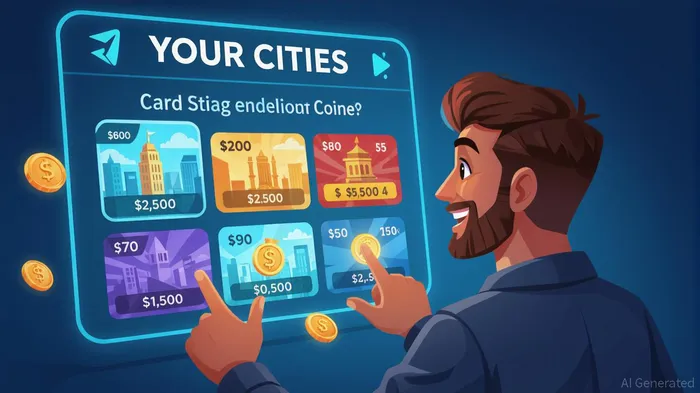
TapCoin's Daily Bounty Combo, launched on August 23, 2025, exemplifies a departure from this paradigm. By offering in-game coins through a Telegram mini-app—where users complete card combinations in the “Your Cities” section—the platform creates a closed-loop economy. Rewards, capped at 7.5 million in-game coins per event, are entirely internal, avoiding exposure to external market fluctuations. This design mirrors the broader trend of “tap-to-earn” games, which prioritize frequent, low-effort engagement over high-stakes, time-intensive gameplay.
The platform's reliance on off-chain mechanics and point systems is a deliberate choice. Unlike traditional P2E models that integrate NFT trading or DeFi elements, TapCoin's rewards are non-transferable and non-tradable, ensuring stability. This insulation from crypto volatility is a critical differentiator. For instance, while platforms like Good Game Arcade and Metawin reported 99.6% and 98.4% drops in active users by mid-2025, TapCoin's focus on gamified retention—through daily challenges and competitive incentives—suggests a more resilient user base.
Scalability and the Gamification Imperative
The scalability of TapCoin's model hinges on its ability to sustain engagement without external validation. While the platform has not disclosed user retention metrics or third-party analyses, industry trends in gamification offer a compelling context. The global gamification market, projected to grow from $20.84 billion in 2025 to $190.87 billion by 2034 at a 27.9% CAGR, underscores the power of game-like incentives in driving loyalty. Retail and education sectors have already seen gamification boost customer retention by 30% and educational outcomes by 50%, respectively.
TapCoin's alignment with these trends is strategic. By offering daily challenges that require minimal effort—such as selecting card combinations—users are incentivized to return frequently, fostering a habit-forming loop. This mirrors the success of platforms like Donot and Spell Wallet, which use similar mechanics to drive token activity. The absence of liquidity changes or institutional involvement in TapCoin's ecosystem further suggests a focus on organic growth, reducing the risk of market-driven disruptions.
Risks and the Road Ahead
Despite its strengths, TapCoin's model is not without caveats. The lack of public data on user conversion, long-term retention, or regulatory implications leaves room for uncertainty. Critics may argue that internal reward systems, while stable, lack the earning potential of traditional P2E models. However, this trade-off—lower volatility for reduced financial upside—appeals to a broader demographic, including casual gamers and newcomers to blockchain.
For investors, the key is to monitor TapCoin's ability to innovate within its gamified framework. Will the platform introduce new features or partnerships to sustain engagement? Can it expand beyond Telegram to other platforms without compromising its simplicity? These questions will determine whether TapCoin's model is a fleeting trend or a sustainable alternative.
Investment Implications
In a market where user retention is increasingly hard to achieve, TapCoin's approach offers a compelling case for cautious optimism. Its internal reward system mitigates the risks of crypto volatility, while its gamified design taps into a growing appetite for accessible, engaging experiences. For investors seeking exposure to blockchain gaming without the turbulence of token trading, TapCoin represents a unique opportunity.
However, due diligence remains paramount. Investors should track metrics such as active user growth, engagement frequency, and the platform's response to emerging trends like AI integration or cross-platform interoperability. The absence of third-party validation does not inherently disqualify TapCoin, but it does underscore the need for vigilance.
In the end, the blockchain gaming industry is at a crossroads. Traditional P2E models have shown their fragility, while platforms like TapCoin are redefining the rules. Whether this new paradigm can scale will depend not just on the mechanics of the game, but on the ability of platforms to adapt, innovate, and keep players coming back—without the need for a blockchain's inherent chaos.

Decoding blockchain innovations and market trends with clarity and precision.
Latest Articles
Stay ahead of the market.
Get curated U.S. market news, insights and key dates delivered to your inbox.


AInvest
PRO
AInvest
PRO



Comments
No comments yet