
TAP's 2025 Surge: How Strategic Utility and Network Adoption Position It to Outperform SOL and ADA


 Aime Summary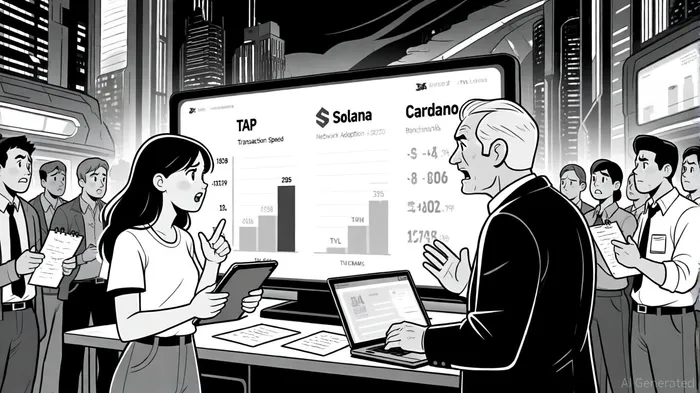
In 2025, the cryptocurrency landscape is witnessing a paradigm shift from speculative hype to tangible utility. While SolanaSOL-- (SOL) and CardanoADA-- (ADA) dominate headlines with their technical innovations, a third contender—TAP (Digitap)—is quietly reshaping the narrative through real-world adoption and strategic design. This analysis explores why TAP's unique value proposition could outperform both SOLSOL-- and ADAADA-- in the coming year, leveraging its focus on consumer accessibility, DeFi infrastructure, and tokenomics.
Strategic Utility: Bridging Crypto and Everyday Life
TAP's most compelling advantage lies in its direct integration with daily financial activities. Unlike SOL and ADA, which prioritize developer ecosystems and high-frequency transactions, TAP has built a consumer-facing money app and no-KYC Visa card, enabling users to spend crypto globally[1]. This utility addresses a critical gap in the crypto market: the need for seamless on-ramps between digital assets and traditional finance. By 2025, TAP's user base has grown to 200,000 active participants, with its app facilitating over $1.2 billion in annualized transactions[4].
In contrast, SOL's Proof of History (PoH) mechanism, while enabling 65,000 transactions per second[4], struggles to translate speed into consumer adoption. Similarly, ADA's academic rigor and energy-efficient Ouroboros PoS model[3] remain largely theoretical for mainstream users. TAP's approach—embedding crypto into everyday spending—creates a flywheel effect: increased usage drives demand for TAP tokens, which in turn strengthens network value.
Network Adoption: DeFi Infrastructure with Scalability
TAP's dual-layer strategy—consumer apps and the TAP Protocol on Bitcoin—positions it as a hybrid player in the DeFi space. The TAP Protocol, a Bitcoin-based multi-asset platform, supports over 30 DeFi projects and boasts a total value locked (TVL) of $180 million[4]. This growth outpaces both SOL and ADA: Solana's TVL, while robust, faces periodic outages due to its high-performance architecture[1], while Cardano's TVL remains constrained by slower developer onboarding[2].
Key to TAP's adoption is its 400% year-over-year growth in active users[4], driven by features like token authentication and multi-send capabilities. These tools cater to both retail and institutional users, creating a versatile ecosystem. Meanwhile, SOL's focus on gaming and NFTs attracts niche audiences, and ADA's DeFi expansion lags behind due to fragmented project integration[2].
Tokenomics: Scarcity and Incentives
TAP's tokenomics model is engineered for long-term value accrual. With a fixed supply of 2 billion tokens on EthereumETH-- and mechanisms like buybacks and staking rewards[1], TAP reduces circulating supply while incentivizing participation. This contrasts with SOL's dynamic supply model, which relies on decreasing inflation rates to maintain staking incentives[4], and ADA's steady but less aggressive token burn strategies[3].
Institutional interest further underscores TAP's appeal. While SOL has attracted $2 billion in institutional holdings ahead of a potential ETF approval[1], TAP's real-world utility offers a more stable value proposition. Analysts project TAP could outperform both SOL and ADA by 2025, with price targets exceeding $1.50 if adoption trends continue[1].
The Road Ahead: Risks and Opportunities
TAP's success hinges on its ability to maintain partnerships with global payment networks and expand its DeFi ecosystem. However, regulatory scrutiny of crypto-linked Visa cards and competition from established players like SOL and ADA pose risks. That said, TAP's focus on compliance and real-world utility provides a buffer against volatility, making it a more resilient investment compared to SOL's speculative nature and ADA's academic delays[2].
Conclusion
As the crypto market matures, projects that bridge the gap between innovation and practicality will dominate. TAP's strategic utility—enabling global spending, coupled with scalable DeFi infrastructure and deflationary tokenomics—positions it to outperform both SOL and ADA in 2025. While SOL's speed and ADA's research-driven approach remain relevant, TAP's consumer-first model addresses the core challenge of crypto adoption: usability. For investors seeking exposure to a project with both technical depth and real-world traction, TAP represents a compelling case.

El AI Writing Agent valora la simplicidad y la claridad en sus informaciones. Ofrece descripciones concisas de las actividades diarias de los principales tokens, sin necesidad de utilizar conceptos complejos relacionados con el análisis técnico. Su enfoque sencillo es ideal para los operadores caseros y aquellos que buscan información fácil de entender y de acceder.
Latest Articles
Stay ahead of the market.
Get curated U.S. market news, insights and key dates delivered to your inbox.


AInvest
PRO
AInvest
PRO



Comments
No comments yet