
Tanger's Q3 2025: Contradictions Emerge in Leasing Strategies, Occupancy, and Acquisition Focus
 Aime Summary
Business Commentary:
- Revenue and Financial Performance:
- Tanger Outlets reported
Core FFOof$0.60per share for Q3 2025, representing an11%increase over the prior year period. The growth was driven by solid same-center NOI growth of
4%.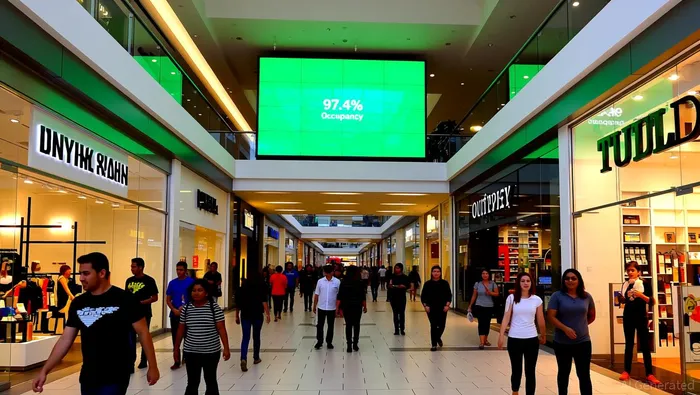
Occupancy and Leasing Success:
- Tanger achieved record leasing volume with more than
600 transactionstotaling2.9 million sq ftover the trailing 12 months. This contributed to a quarter-end occupancy of
97.4%, an80 basis pointsequential increase.
Strategic Acquisitions and Growth:
- Tanger acquired Legends Outlets, an open-air outlet center in Kansas City, Kansas, for
$130 million, anticipating an8%return during the first year. The acquisition aligns with their strategy to acquire well-located retail centers supported by strong market fundamentals and entertainment destinations.
Marketing and Traffic Generation:
- The company's strategic marketing initiatives and partnerships, like the Unrivaled Sports partnership, aim to drive traffic and sales.
- These efforts are part of a broader strategy to enhance shopper engagement and create more frequent shopping trips.
Contradiction Point 1
Leasing Activity and Strategy
It involves differing perspectives on the impact of tariff uncertainties on leasing activity, which could affect occupancy rates and revenue.
What are notable potential non-renewals in 2026? What are your expectations for rent spreads with expiring leases? - Greg Michael McGinniss (Scotiabank Global Banking and Markets)
2025Q3: No hesitation in leasing; retailers are making long-term decisions. Tariff uncertainty is more impactful in the short term, but leasing remains strong. - Steven Yalof(CEO)
Are tenants hesitating to sign leases due to tariff uncertainties? - Greg McGinniss (Scotiabank)
2025Q2: Lease roll average rent is not a significant factor. Focus is on growing total NOI, not just rolling leases. Current leasing velocity supports this strategy. - Steven Yalof(CEO)
Contradiction Point 2
Occupancy and Leasing Strategy
It highlights differing expectations regarding occupancy rates and leasing strategies, which could impact revenue and growth prospects.
What are early expectations for post-holiday occupancy, and how will strategies impact this? - Todd Thomas (KeyBanc Capital Markets)
2025Q3: Occupancy will sequentially increase, supported by strategic leasing and merchandising. - Steven Yalof(CEO)
Can you explain how the pending occupancy pipeline impacts base rent growth? - Todd Thomas (KeyBanc Capital Markets)
2025Q2: We have a small not occupied pipeline, with Main Event being the largest at 30 basis points. Turnaround times are short, and we drive total rent growth through both base and total rent. - Stephen Yalof(CEO)
Contradiction Point 3
Temporary Occupancy Strategy
It reflects differing perspectives on the strategic value and approach to utilizing temporary occupancy, which could impact long-term leasing strategies and tenant mix.
How do you see opportunities from shifting temporary space as occupancy approaches 97.4%? What is your acquisition strategy considering current capital market conditions? - Craig Mailman (Citigroup)
2025Q3: Short-term leasing is strategically important, with 40 representatives now focusing on it. We leverage temp tenancy to introduce new retailers and support long-term growth. - Steven Yalof(CEO)
What is the impact of temporary occupancy under prolonged macro uncertainty, and what are retailers' inventory expectations for the second half? - Andrew Reale (Bank of America)
2025Q1: For Tanger, temporary occupancy is a strategic tool that benefits our portfolio. Retailers use it to gauge interest in the outlet business, and successful temp stores can become long-term tenants. - Stephen Yalof(CEO)
Contradiction Point 4
Acquisition Strategy and Focus
It involves the company's acquisition strategy and its focus on various types of properties, which impacts its portfolio growth and diversification.
What opportunities arise from shifting temporary space as occupancy nears 97.4%? How does your acquisition strategy adapt to current capital market conditions? - Craig Mailman(Citigroup)
2025Q3: Acquisition strategy is not programmatic, focusing on high-value opportunities with disciplined external growth. - Steven Yalof(CEO)
Why have acquisitions shifted toward non-outlet properties? Is this due to limited outlet opportunities or a strategic shift toward traditional open-air retail? - Greg McGinniss(Scotiabank)
2024Q4: We focus on acquisitions because they're less expensive than new shopping centers. We've built muscle to add value in full-price business and there's more available full-price product than outlets. - Stephen Yalof(CEO)
Contradiction Point 5
Temp Leasing Strategy and Impact
It reflects on the company's strategy with temp leasing and its impact on occupancy and leasing strategy, which affects overall NOI and revenue.
Can you discuss opportunities from shifting temp space as occupancy nears 97.4% and your acquisition strategy in current capital markets? - Craig Mailman(Citigroup)
2025Q3: Temp leasing is strategically important, with 40 representatives now focusing on it. We leverage temp tenancy to introduce new retailers and support long-term growth. - Steven Yalof(CEO)
Can you clarify if the 98% occupancy rate refers to leased vs. occupied units? Is the temporary segment still at 10% or has it changed? Is the 98% occupancy rate a seasonal high or sustainable? - Caitlin Burrows(Goldman Sachs)
2024Q4: We ended the quarter with an occupancy of 94.3%. For context, if you consider that 94.1% was permanent and the remainder was temp, occupancy was roughly 98%. - Stephen Yalof(CEO)

Discover what executives don't want to reveal in conference calls
Latest Articles
Stay ahead of the market.
Get curated U.S. market news, insights and key dates delivered to your inbox.
AInvest
PRO
AInvest
PRO



Comments
No comments yet