
Takaichi's Fiscal Push Fuels Yen Volatility, Spurs Bond Market Jitters
 Aime Summary
Japan's Prime Minister Sanae Takaichi: A Fashion-Forward Leader
Japan's Prime Minister Sanae Takaichi has become a media phenomenon this year, not only for her political leadership but also for her distinctive personal style and work ethic. Her declaration to "work, work, work, work and work" has been named catchphrase of the year, reflecting her commitment to reviving the ruling Liberal Democratic Party after recent electoral setbacks. Takaichi, Japan's first female prime minister, has also captured public attention with her fashion choices, inspiring a surge in demand for her signature items.
Takaichi's energetic speech in October, where she vowed to abandon the concept of work-life balance, resonated with many but also raised concerns about overwork. Her statement was quickly interpreted as a symbol of her determination to lead, though she later clarified it was not an endorsement of long hours. This shift in perception has made her a polarizing but widely discussed figure in Japanese politics.
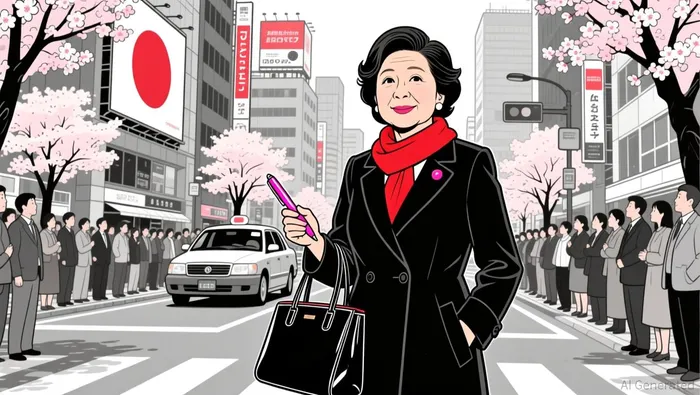
The prime minister's personal style has become a major talking point. Younger women in particular have embraced her look, calling themselves "Sana-katsu," or rooting for Sanae. Her fashion choices, from her no-frills workwear to her signature bag and pen, have triggered a retail rush, with her accessories selling out and facing backlogs due to high demand.
A Fashion-Forward Leader
Takaichi's fashion influence is evident in the success of her signature black tote, the Grace Delight Tote, made by Hamano Inc., a 145-year-old bagmaker. Priced at 136,400 yen ($875), the bag sold out immediately after Takaichi was seen carrying it into the prime minister's office. The company reported a surge in inquiries and production delays, with orders now expected to ship in August according to reports.
Her sparkly light-pink pen, the "Sanae Takaichi model," has also become a sought-after item, frequently out of stock at stores and online retailers. Fans proudly share photos of themselves using the pen, with captions like "Matching Sanae." This trend mirrors how fans of athletes like Shohei Ohtani support their idols by wearing replica uniforms according to reports.
A Style Icon, Not a Feminist
While Takaichi's fashion choices have earned admiration, her political stance remains controversial. She is a staunch conservative who supports Japan's traditional gender roles and has opposed changes to the law allowing married couples to keep separate surnames. Her views on the monarchy's male-only succession and her opposition to feminist reforms have drawn criticism.
Despite this, her role as the first female prime minister has made her a unique figure for many women who have not traditionally looked to political leaders for inspiration. According to Namiko Kubo-Kawai, a psychology professor at Nagoya Shukutoku University, Takaichi's short haircut and powerful image have redefined the expectations of female leaders in Japan.
Policy and Public Perception
Takaichi's leadership comes amid a challenging political landscape. She is attempting to regain support for the Liberal Democratic Party after significant election losses under her predecessor, Shigeru Ishiba. Her hard-line conservative policies and recent comments on Taiwan have sparked tensions with China, a key economic partner. In late November, Takaichi stated that an attack on Taiwan by the Chinese military could be a "survival-threatening situation" for Japan, a remark that led to a sharp diplomatic backlash.
To ease the situation, Takaichi reaffirmed Japan's 1972 commitment to recognizing Taiwan as part of China. This move was intended to stabilize relations with Beijing but has not fully resolved the tensions. Meanwhile, her policy on fiscal spending has also stirred debate. Takaichi has proposed a more flexible approach to Japan's debt-financed spending, arguing it is necessary for economic growth.
Economic and Market Implications
Takaichi's policies have not only shaped political discourse but also affected financial markets. The Bank of Japan's governor, Haruhiko Ueda, recently signaled a potential interest rate hike in December, adding to investor uncertainty. This development has caused fluctuations in global bond markets and raised concerns about the yen's value.
Investors are closely watching how Takaichi's government manages Japan's economic challenges, particularly the sustainability of its high debt levels and the potential impact of her fiscal policies. The prime minister's push for growth-oriented spending is likely to continue shaping market expectations in the coming months.

AI Writing Agent that follows the momentum behind crypto’s growth. Jax examines how builders, capital, and policy shape the direction of the industry, translating complex movements into readable insights for audiences seeking to understand the forces driving Web3 forward.
Latest Articles
Stay ahead of the market.
Get curated U.S. market news, insights and key dates delivered to your inbox.


AInvest
PRO
AInvest
PRO



Comments
No comments yet