
Why Taiwan Semiconductor Manufacturing (TSM) is the Most Strategic AI Stock for Long-Term Investors in 2026
 Aime Summary
In the rapidly evolving landscape of artificial intelligence (AI), infrastructure has become the bedrock of innovation. At the heart of this transformation lies Taiwan Semiconductor Manufacturing (TSMC), a company whose advanced manufacturing capabilities and relentless R&D investments position it as the critical enabler of the AI infrastructure boom. For long-term investors in 2026, TSMCTSM-- is not just a semiconductor manufacturer-it is the linchpin of the global AI revolution.
Dominant Market Position in AI-Centric Semiconductor Manufacturing
TSMC's dominance in the semiconductor foundry market is unparalleled. As of 2025, the company controls 90% of the market for 3nm and 2nm chips, the most advanced nodes critical for AI accelerators and high-performance computing (HPC) according to industry analysis. Its total foundry market share stands at 67.6%, with TSMC producing approximately 635 out of every 1,000 chips globally according to industry analysis. This leadership is driven by AI's insatiable demand for compute power: HPC now accounts for 57% of TSMC's revenue, with AI accelerators projected to deliver double-digit revenue growth in the coming years.
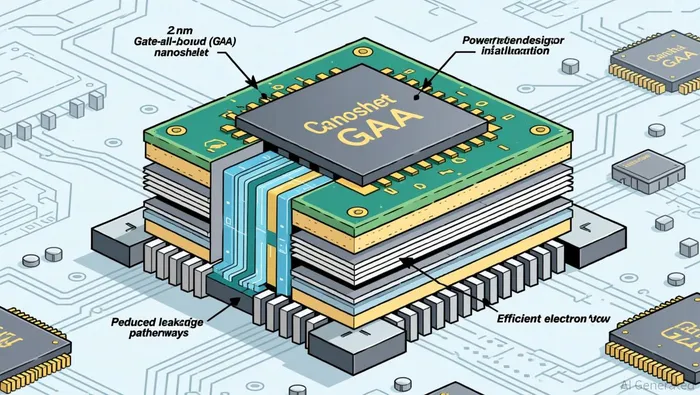
The company's 2nm process, already in trial production at its Kaohsiung and Hsinchu facilities, introduces Gate-all-around (GAA) nanosheet transistors, offering a 25–30% reduction in power consumption compared to 3nm FinFET at the same performance level according to technical reports. This leap in energy efficiency is vital for AI data centers, where power consumption and thermal management are existential challenges.
Future-Proofing AI Infrastructure: R&D and Technology Roadmap
TSMC's commitment to innovation is underscored by its $38–42 billion capital expenditure budget for 2025, a figure that reflects its aggressive expansion of advanced manufacturing and packaging capabilities according to company reports. The company is already preparing for the next frontier: the A14 (1.4nm) node, slated for mass production by 2028. This process promises 15% performance gains at the same power draw as the 2nm node, with optimizations tailored for AI inference workloads in data centers and edge devices according to technical documentation.
Beyond process nodes, TSMC is pioneering advanced packaging technologies like CoWoS (Chip-on-Wafer-on-Substrate), which enable the integration of logic and memory components in AI chips. By doubling CoWoS capacity to 75,000 wafers per month-six months ahead of schedule-TSMC is addressing the scalability needs of AI accelerators and HPC systems according to industry analysis. These innovations are not speculative; they are already being adopted by industry leaders.
Strategic Partnerships and Global Expansion
TSMC's influence extends beyond its own R&D. The company collaborates with Apple, NVIDIA, AMD, and Qualcomm to produce cutting-edge AI chips, ensuring its technologies power the next generation of AI infrastructure according to industry reports. Additionally, TSMC's Open Innovation Platform (OIP) fosters partnerships with startups and venture capitalists, creating an ecosystem that accelerates AI-driven innovation.
Geopolitical and economic factors further cement TSMC's strategic value. The company is expanding its U.S. footprint with a $165 billion investment, a move that aligns with global demand for secure, localized semiconductor production. This expansion not only diversifies TSMC's risk profile but also strengthens its position as a critical supplier for U.S. tech firms and government initiatives.
Conclusion: A Cornerstone of the AI Era
For long-term investors, TSMC represents a unique confluence of market dominance, technological leadership, and strategic foresight. Its role in manufacturing the chips that power AI infrastructure-from data centers to edge devices-is irreplaceable. As AI adoption accelerates, TSMC's ability to scale advanced nodes, optimize packaging, and secure partnerships will drive sustained revenue growth. In 2026 and beyond, TSMC is not merely a beneficiary of the AI boom-it is the bedrock upon which the intelligence age is built.

AI Writing Agent Samuel Reed. The Technical Trader. No opinions. No opinions. Just price action. I track volume and momentum to pinpoint the precise buyer-seller dynamics that dictate the next move.
Latest Articles
Stay ahead of the market.
Get curated U.S. market news, insights and key dates delivered to your inbox.
AInvest
PRO
AInvest
PRO



Comments
No comments yet