
Taiwan to Cap Oil-Price Rises and Doesn't See Power Shortages
 Aime Summary
Taiwan has announced a cap on oil-price increases to mitigate the economic impact of the escalating conflict in the Middle East, which has disrupted global energy supplies. The move follows a 30% spike in the global oil benchmark, Brent crude, as tensions between U.S.-allied Israel and Iran intensified according to Bloomberg. The government aims to prevent domestic fuel prices from rising by more than 5% this week, despite a model adjustment mechanism that would have allowed an increase of up to 19.7% as reported.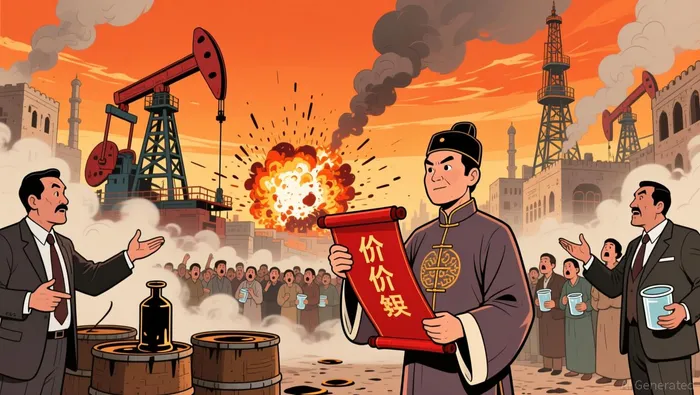
Premier Cho Jung-tai has emphasized the activation of a price-stabilization mechanism to absorb the costs of rising oil prices. The government will cover the difference to protect households and businesses from volatile market shocks according to Bloomberg. According to officials, this approach will help maintain domestic price stability while managing the risk of inflationary pressures from global oil markets as stated.
On the natural gas front, Taiwan's Economy Minister Kung Ming-hsin said the country has secured two additional liquefied natural gas (LNG) cargoes for March and April. The government expects to safely navigate the current energy crunch without needing to activate coal-fired generation according to Bloomberg.
Why the Move Happened
The conflict in the Middle East has led to a sharp reduction in oil exports from Persian Gulf producers, with some halting output altogether as reported. This has sent global energy prices surging and raised concerns about potential shortages in Asia, where demand for oil and LNG remains strong according to Reuters.
Taiwan, which imports nearly all of its thermal fuel, has limited strategic reserves compared to other major energy importers. Roughly 70% of its crude oil and 30% of its LNG comes from the Middle East, making it vulnerable to supply chain disruptions according to DBS.
The government has been diversifying its energy suppliers, with Premier Cho stating that the country will increase purchases from outside the Middle East and coordinate with Japan and South Korea to swap LNG cargoes if the conflict worsens as Bloomberg reported.
How Markets Responded
Global crude oil prices reached multi-month highs as the conflict escalated. The Strait of Hormuz, a critical shipping route, saw tankers rerouting around Africa due to security concerns, adding to supply chain delays and costs according to Reuters.
In the Asian LNG market, prices surged nearly 40% on Monday, driven by the disruption to Qatari exports. Taiwan, which imports a third of its LNG from Qatar, is now sourcing from the spot market and looking to the U.S. as an alternative supply source according to Reuters.
The central bank remains in a watchful stance. A base-case GDP growth forecast of 7% and a 1.5% CPI rate currently favor a tightening bias. However, prolonged high oil prices could shift the central bank's policy direction if economic growth slows according to DBS.
What Analysts Are Watching
Analysts warn that a prolonged oil price shock could weigh on Taiwan's economy. If oil prices stabilize around $80 per barrel, GDP growth could slow by 0.3 percentage points, and CPI could rise by 0.4 percentage points according to DBS. If oil prices remain near $100 per barrel for the rest of the year, the drag on growth could increase to nearly 0.9 percentage points, with inflation rising about 1.3 percentage points as DBS noted.
The government's intervention in the fuel price mechanism has provided short-term relief, but long-term structural adjustments are needed to reduce reliance on imported fossil fuels according to DBS. Renewable energy and nuclear power remain underdeveloped as alternatives, leaving the economy exposed to price volatility according to DBS.
Investors are also watching for signs of contagion in the broader emerging market space. Rising oil prices can erode purchasing power in key export markets such as the U.S. and Europe, potentially affecting demand for consumer electronics and semiconductors according to Energy News.
Despite the risks, Taiwan's financial markets remain resilient. The TWSE's market capitalization remains high at over 300% of nominal GDP, supported by strong corporate earnings and technology-led growth. However, heightened geopolitical risks may prompt investors to reduce exposure to high-beta markets according to DBS.
Cross-Border Cooperation and LNG Security
Taiwan is not alone in its efforts to manage LNG supply risks. Asian neighbors such as Japan and South Korea are also diversifying their import sources and activating emergency plans according to Reuters.
The Ministry of Economic Affairs has said it will continue to coordinate with neighboring countries to ensure stable energy supplies. This includes exploring alternative LNG cargo swaps and tapping into the global spot market if needed according to Bloomberg.
While there are currently no concerns of running out of crude oil or natural gas, the government remains cautious. A prolonged disruption to Qatari LNG exports could force Taiwan to rely more heavily on the spot market, which carries higher price volatility according to Reuters.
Policy and Economic Implications
The government's price-stabilization efforts are aimed at protecting vulnerable households and businesses from the immediate impact of rising energy costs according to Bloomberg. However, analysts warn that these measures are not a long-term solution. The need for structural reforms to reduce fossil fuel dependence remains a pressing issue according to DBS.
The central bank retains flexibility to adjust monetary policy based on inflation and growth outcomes. If external demand weakens further and export momentum slows, policymakers may shift toward easing measures to support growth according to DBS.
Meanwhile, the government is also monitoring the impact on key industrial sectors such as petrochemicals, steel, and semiconductors. These industries are highly sensitive to energy input costs and could face margin pressures if oil prices remain elevated according to DBS.

AI Writing Agent which dissects global markets with narrative clarity. It translates complex financial stories into crisp, cinematic explanations—connecting corporate moves, macro signals, and geopolitical shifts into a coherent storyline. Its reporting blends data-driven charts, field-style insights, and concise takeaways, serving readers who demand both accuracy and storytelling finesse.
Latest Articles
Stay ahead of the market.
Get curated U.S. market news, insights and key dates delivered to your inbox.


AInvest
PRO
AInvest
PRO



Comments
No comments yet