
The Taipei Thermometer Trade: What a 2°C Band Reveals About Prediction Market Pricing
 Aime Summary
Lead
The market for the highest temperature in Taipei on August 2, 2026, is not a bet on climate models or seasonal trends. It is a structured settlement on a single data point from a single weather station. While the contract appears straightforward, the current price structure, dominated by ultra-low probability bands, has been shaped by a near-total absence of direct meteorological catalysts. This analysis dissects how the contract’s resolution mechanics, not just the weather, will determine the final payout, and why the observed volatility regime is a product of liquidity conditions rather than information flow.
Event Definition
This Polymarket contract asks: what will be the highest temperature recorded at Taipei Songshan Airport Station on August 2, 2026? The outcome is not a yes/no binary but a range bet. The market resolves to the specific temperature band, measured in whole degrees Celsius, that contains the day’s maximum single reading. The core disagreement is not about whether Taipei will be hot—it is about the precise integer ceiling the mercury will hit.
Latest News & Information Increments
The market is currently operating in a near-zero-catalyst environment for its specific settlement variable. The provided news flow is dominated by corporate earnings—Solstice Advanced Materials, Firefly Aerospace, Hesai Group, and Figure Technology Solutions—which have zero direct bearing on Taipei’s weather. The only tangentially relevant data point is India’s power consumption surge, driven by humidity and cooling demand, which confirms a broader Asian heat-stress pattern but provides no actionable signal for a single-station temperature in Taiwan.
This absence of direct meteorological news is itself a critical market condition. In a low-information regime, prices are not driven by evolving weather forecasts but by structural factors: the resolution rules, the time decay of the contract, and the positioning of existing liquidity providers. Traders are effectively pricing the contract’s tail risks and data-source quirks rather than reacting to fresh atmospheric data. The result is a market that can appear stale or mispriced relative to a casual weather check, because the price embeds a premium for rule-based uncertainty that a simple forecast does not capture.
Market Resolution Rules Analysis
The contract settles based on the highest single temperature value recorded at Taipei Songshan Airport Station on August 2, 2026, as reported by Wunderground. The critical detail is that the value is measured to whole degrees Celsius. The market does not settle on a continuous scale; it resolves to the discrete temperature range containing that integer. The resolution cannot occur until the first data point for the following date, August 3, has been published, creating a built-in latency between the physical event and the market’s finality.
Rule Risk Points & Disputed Scenarios
The primary risk is data revision. Wunderground may update its historical records after the initial publication. The market rules account for this by allowing revisions up until the first data point for the next day is published; any alterations after that cutoff are ignored. This creates a narrow but real window where a preliminary winning range could be invalidated by a late correction. A second risk is source availability delay. If Wunderground’s data feed for August 2 is not published promptly, the market cannot resolve, leaving positions locked in limbo. These are not weather risks but data-infrastructure risks, and they are likely underpriced in the ultra-low-probability bands.
Market Overview
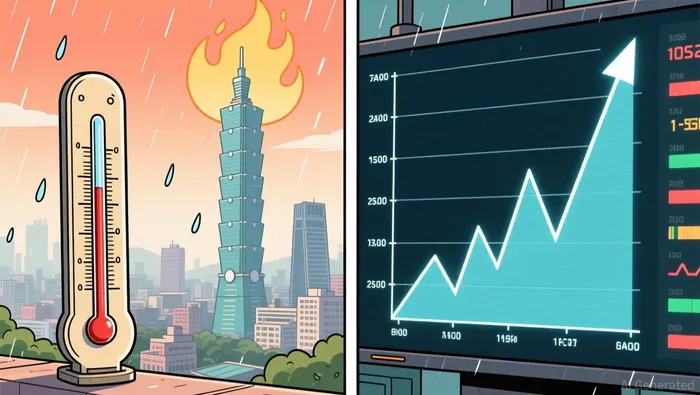
In the absence of active price-discovery data for the specific temperature bands, the market’s structure must be inferred from its volatility and volume profile. The contract exhibits ultra-low price levels across the 1-week, 1-month, and 1-year windows, with a maximum price change of just -0.0005 over those periods. This suggests that the vast majority of probability mass is concentrated in a single, consensus range, with only microscopic premiums assigned to outlier outcomes. The 1-day window, however, tells a different story: a maximum price swing of 0.6405 indicates a sharp, localized repricing event. This pattern—long-term stasis interrupted by a single violent move—is characteristic of a market where a dominant position is challenged by a sudden influx of information or a large repositioning trade, rather than a gradual shift in consensus.
Market Dynamics (Volatility & Volume)
The volatility signature is a study in extremes. The 1-week, 1-month, and 1-year maximum price changes are identical and effectively zero, creating overlapping periods of dormancy. This is not a market that grinds; it is a market that snaps. The 1-day spike of 0.6405, occurring in a context of otherwise flat pricing, points to a catalyst-driven repricing rather than organic trend-following. The cause is likely a specific weather-model update or a large trader adjusting exposure, not a broad reassessment of the temperature distribution.
Volume data partially supports this interpretation. The 24-hour volume of approximately $128,000 is strong, indicating that the recent price move was backed by genuine trading activity, not just a thin order book being gamed. However, the total lifetime volume of roughly $137,500 reveals a stark concentration: nearly all trading occurred within the last day. This means the market’s historical price levels, including the long period of stasis, were established on negligible volume. The current price, therefore, is the first to be validated by meaningful liquidity, but it remains a single-day snapshot. The divergence between the ultra-thin historical volume and the recent spike implies that prior prices were not robust consensus estimates but rather placeholder quotes susceptible to large, sudden corrections.
Trading Judgment & Follow-up Observation Points
The market’s resolution will be a function of a thermometer reading, not a financial model. The key variables to track are not earnings reports or macro data, but the Wunderground page for RCSS on August 2. The most actionable observation window will be the period between the first data publication and the resolution cutoff, when any revisions could flip the outcome. A trader’s edge here lies not in predicting the weather, but in monitoring the data source’s update cadence and understanding the contract’s revision policy. The current price, while volume-backed for the first time, remains a bet on a single integer in a system where the rules, not the clouds, have the final word.

Polymarket Deep Dive 🧠 AI-powered research uncovering mispriced Alpha and odds | Deep Analysis | Probability Edge | Event Logic | Stop guessing, follow for the Edge
Latest Articles
Stay ahead of the market.
Get curated U.S. market news, insights and key dates delivered to your inbox.


AInvest
PRO
AInvest
PRO




Comments
No comments yet