
The TACO Trade's Fragility: Why Overextended Market Optimism Spells Risk for Investors
The stock market's relentless climb to record highs in 2025 has been fueled in part by the TACO Trade—a speculative strategy built on the assumption that President Trump's tariff threats are mere negotiating tactics, not serious policy actions. While this trade has delivered gains in the short term, its foundations are now showing cracks. Beneath the surface of soaring indices lies a market overly reliant on a single, reversible catalyst, stretched valuations, and complacent sentiment. Investors who ignore these warning signs risk severe losses as the TACO Trade's overextension reaches a critical inflection point.
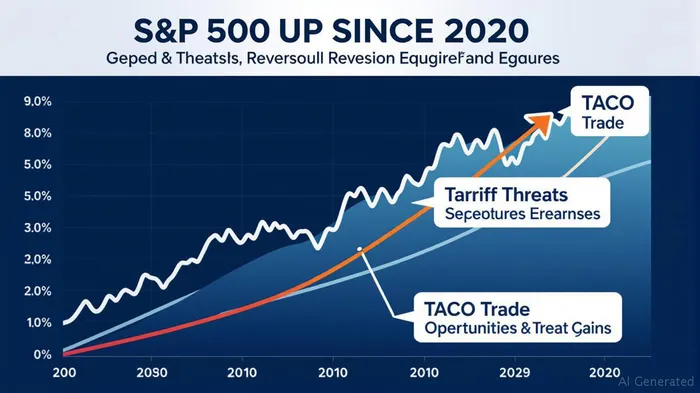
The TACO Trade: A Pattern of Overconfidence
The TACO Trade hinges on the belief that markets can reliably profit from buying dips triggered by Trump's tariff announcements. For instance, when the administration delayed EU tariffs until July 9 after an initial 50% threat in April, the S&P 500 surged 2.5% in a single day. Similarly, reductions in China tariffs from 145% to 100% catalyzed further gains. These reactions, while predictable, have pushed the S&P 500 to an all-time high of 4,800 as of July 2025.
But this pattern is now overdone. Analysts at BCA Research warn that the TACO Trade is “overdone,” citing a market that has become conditioned to ignore risks entirely. The strategy's premise—that Trump will always “chicken out”—assumes an administration that prioritizes stock market stability over geopolitical leverage. Yet with the July 9 tariff deadline looming, markets face a critical test: Will this round of threats follow the same playbook, or will Trump finally follow through to prove a point?
Technical Overextension: Record Highs, Hidden Weaknesses
The market's valuation metrics now reflect a troubling disconnect between price and fundamentals. Consider the S&P 500's price-to-earnings (P/E) ratio, which has expanded to 35x trailing earnings—nearly double its historical average of 15-16x. This overvaluation is unsustainable unless earnings grow exponentially, which is unlikely amid slowing global trade and rising input costs.
Even more concerning is the market's momentum-driven structure. Over 80% of S&P 500 stocks are trading above their 200-day moving average—a metric signaling overbought conditions. Such extremes historically precede corrections, yet investors remain oblivious.
Sentiment Indicators: Bullish Extremes and the Risk of a Reversal
Market sentiment has reached euphoric levels, with bullishness concentrated in a narrow slice of investors. The CBOE Volatility Index (VIX), a gauge of fear, has plummeted to 12—the lowest since 2017—despite escalating geopolitical risks. Meanwhile, the American Association of Individual Investors (AAII) survey shows bullish sentiment at 54%, a level last seen during the dot-com bubble.
This complacency is misplaced. Extreme bullishness often precedes sharp reversals. Consider the 2000 tech crash or the 2008 financial crisis, both of which followed periods of similarly detached sentiment. Today's investors, overly reliant on the TACO Trade's predictability, are underestimating the potential for a policy misstep—or worse, a geopolitical shock—to shatter this illusion.
Geopolitical and Economic Shocks: The Vulnerability Factor
The TACO Trade's Achilles' heel is its assumption that tariff threats will never materialize. Yet with the July 9 EU tariff deadline approaching, markets face a pivotal moment. If Trump follows through, the S&P 500 could plummet 10% or more, wiping out months of gains. Even a delayed but eventual implementation of tariffs could destabilize trade-dependent sectors like industrials and tech.
Meanwhile, other risks loom. The Federal Reserve's delayed pivot to rate cuts, coupled with China's economic slowdown, adds fuel to the fire. A recent Goldman SachsGS-- report warns that a 1% GDP contraction in China could erase 5% of S&P 500 profits—a scenario the market has yet to price in.
Investment Implications: Prioritize Risk Management
The TACO Trade's fragility demands a defensive stance. Investors should:
1. Reduce equity exposure: Trim positions in cyclical sectors (e.g., industrials, materials) most vulnerable to trade shocks.
2. Hedge with defensive assets: Shift to utilities, healthcare, or gold, which historically perform well during volatility.
3. Use options for downside protection: Consider put options on the S&P 500 or inverse ETFs (e.g., SH) to offset losses if the July 9 tariff deadline triggers a sell-off.
4. Increase cash reserves: Allocate 15-20% of portfolios to cash to capitalize on potential dips.
Final Thoughts
The TACO Trade's overextension has created a market ripe for a reckoning. While the strategy has delivered gains thus far, its reliance on a single, reversible policy lever makes it dangerously fragile. With valuations stretched, sentiment at extremes, and geopolitical risks mounting, investors must prepare for a correction. The time to adopt a cautious, diversified approach is now—before the chickens come home to roost.
Stay vigilant. Stay resilient.

Stay ahead of the market.
Get curated U.S. market news, insights and key dates delivered to your inbox.


AInvest
PRO
AInvest
PRO



Comments
No comments yet