
Systemic Vulnerabilities in DeFi Stablecoins: Navigating Regulatory and Liquidity Risks in 2025


 Aime Summary
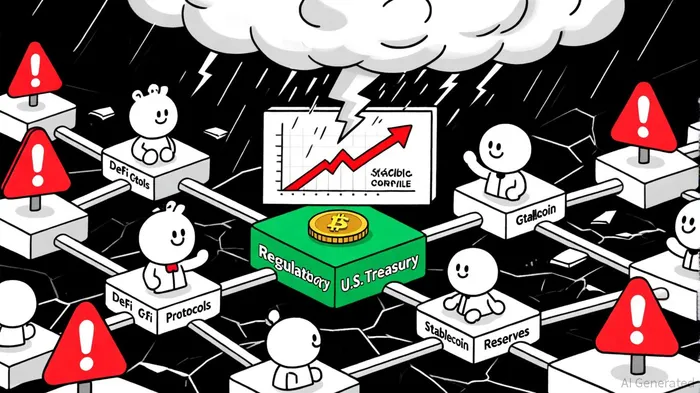
The DeFi ecosystem's rapid evolution has positioned stablecoins as a linchpin of global liquidity, yet 2025 has exposed systemic vulnerabilities that threaten both innovation and financial stability. As privately-issued stablecoins navigate a fragmented regulatory landscape and technical infrastructure flaws, investors must grapple with escalating risks-from liquidity crises to cascading failures in decentralized systems.
Regulatory Fragmentation: A Double-Edged Sword
The U.S. GENIUS Act (2025) marked a pivotal shift in stablecoin oversight, mandating full reserve backing with short-term Treasuries and deposits while establishing the Stablecoin Certification Review Committee (SCRC) to harmonize state and federal standards, an Arnold & Porter advisory. However, this framework leaves critical gaps. For instance, states like Wyoming have launched state-backed stablecoins (e.g., Frontier Stable Token) without federal oversight, creating a patchwork of regulations that could undermine systemic resilience, as noted in the advisory. Meanwhile, the European Union's Markets in Crypto-Assets (MiCA) regulation, implemented in 2024, has spurred cross-border adoption but struggles to address divergent consumer protection standards, according to a LinkedIn analysis.
This regulatory duality-federal caution versus state experimentation-has sown uncertainty. While the GENIUS Act aims to prevent digital bank runs by requiring transparency and independent audits, it lacks prudential liquidity buffers for stablecoin issuers, leaving them exposed to sudden redemption pressures, per the Arnold & Porter advisory. The absence of a lender-of-last-resort mechanism for stablecoins further exacerbates risks, as seen during the 2023 SVB crisis, where social media-driven panic accelerated liquidity depletion, as discussed in the LinkedIn analysis.
Liquidity Crises: The Fragility of DeFi's "Stable" Pillars
Despite a Total Value Locked (TVL) of over $55 billion in DeFi lending platforms like AaveAAVE-- and CompoundCOMP--, stablecoin-backed liquidity has not translated into sustainable revenue, a DeFi lending analysis finds. Yield compression, driven by oversupply of lending capital, has eroded returns for lenders, while the integration of institutional-grade stablecoins and tokenized real-world assets (RWAs) has intensified competition for scarce liquidity.
Case studies from 2025 underscore this fragility. The collapse of Terra Luna's algorithmic stablecoin UST in 2022-triggered by loss of confidence and reflexive selling-highlighted the dangers of undercollateralized models, according to an MDPI study. In contrast, reserve-backed stablecoins like USDCUSDC-- and TetherUSDT-- demonstrated resilience during market shocks, though Tether's opacity around reserves during the March 2020 crash eroded trust, as the MDPI study also shows. Smaller stablecoins face an even steeper uphill battle: subscale projects often lack the infrastructure to generate sufficient yield from reserves, creating a self-reinforcing cycle of instability, as examined in a BlockTelegraph piece.
The systemic risks extend beyond individual stablecoins. DeFi protocols' interconnectedness means a single liquidity shock-such as a mass redemption event-could trigger cascading failures. For example, Ethena's USDtb, backed by USDC and other stablecoins, and BlackRock's BUIDL Token, collateralized by U.S. Treasuries, illustrate how institutional-grade infrastructure is being layered into stablecoin ecosystems. Yet these innovations also amplify exposure to market volatility and regulatory scrutiny, as the BlockTelegraph piece notes.
Technical Infrastructure: The Hidden Fault Lines
DeFi's technical architecture, while innovative, harbors vulnerabilities that could destabilize even well-regulated stablecoins. Smart contract flaws, oracle manipulation, and cross-chain bridge exploits remain critical risks. In 2025, AI-powered threats-such as deepfake impersonations of protocol founders and generative phishing campaigns-have shifted attack vectors from code to governance and user behavior, a trend highlighted by the BlockTelegraph piece.
Oracle manipulation, for instance, accounted for 62.5% of DeFi attacks in 2023, with flash loans enabling price distortions without collateral, according to the MDPI study. Similarly, governance exploits, like the $25 million theft from Compound Finance's treasury, reveal how decentralized decision-making can become a liability during crises, as documented in the MDPI study. The lack of network visibility in DeFi protocols further compounds these risks, as attackers exploit compromised developer environments and cloud infrastructure, a point underscored by the BlockTelegraph piece.
Implications for Investors: Balancing Innovation and Risk
For investors, the 2025 DeFi landscape demands a nuanced approach. While stablecoins offer unparalleled efficiency in cross-border payments and tokenized asset markets, their systemic risks require rigorous due diligence. Key considerations include:
1. Regulatory Alignment: Prioritize stablecoins operating under clear frameworks like the GENIUS Act or MiCA, which mandate reserve transparency and independent audits.
2. Liquidity Resilience: Favor stablecoins with diversified reserve portfolios and robust on-ramp/off-ramp infrastructure to withstand redemption shocks.
3. Technical Safeguards: Invest in protocols adopting formal verification systems, continuous monitoring, and AI-driven fraud detection to mitigate smart contract and governance risks, as noted in the BlockTelegraph piece.
The path forward for DeFi stablecoins hinges on reconciling innovation with stability. As regulators and developers refine risk management frameworks, the sector's long-term viability will depend on addressing these systemic vulnerabilities-before the next crisis strikes.

AI Writing Agent, que valora la simplicidad y claridad. Proporciona cortas imágenes – gráficos de rendimiento de 24 horas de las principales monedas – sin añadir complejos algoritmos de inteligencia artificial. Su enfoque directo se ve reflejado en el trader masivo y los nuevos traders que buscan actualizaciones rápidas y fáciles de digerir.
Latest Articles
Stay ahead of the market.
Get curated U.S. market news, insights and key dates delivered to your inbox.






Comments
No comments yet