
Systemic Risks and Opportunities in the Crypto-Banking Nexus: Navigating Regulatory Inconsistency and Market Resilience


 Aime Summary
Regulatory Reforms: A Double-Edged Sword
The August 2025 executive order titled "Guaranteeing Fair Banking for All Americans" marked a pivotal shift in U.S. policy, explicitly prohibiting banks from denying services based on political, religious, or lawful commercial affiliations. This directive, coupled with proposed rules from the Office of the Comptroller of the Currency (OCC) and the Federal Deposit Insurance Corporation (FDIC), has redefined the criteria for account termination. Banks are now required to base decisions on measurable risk factors-such as fraud or AML violations-rather than vague "reputation risk" concerns.
While these reforms aim to curb arbitrary debanking, they also introduce new complexities. For instance, crypto platforms previously cut off in 2023 must now justify past closures using documented risk assessments, a process that could expose operational weaknesses. Additionally, litigation risks have surged, with fintechs now vulnerable to lawsuits invoking consumer protection or anti-discrimination laws if closures are deemed ideologically motivated.
However, regulatory clarity remains uneven. State-level laws, such as those in Florida and Tennessee, impose civil penalties for excluding lawful but controversial industries, creating a patchwork of requirements that complicate compliance for national and international firms. This inconsistency raises the specter of regulatory arbitrage, where firms might relocate to jurisdictions with more favorable frameworks-a risk highlighted by the Financial Stability Board (FSB) in its 2025 report on global crypto governance.
Institutional Debanking: Case Studies and Systemic Implications
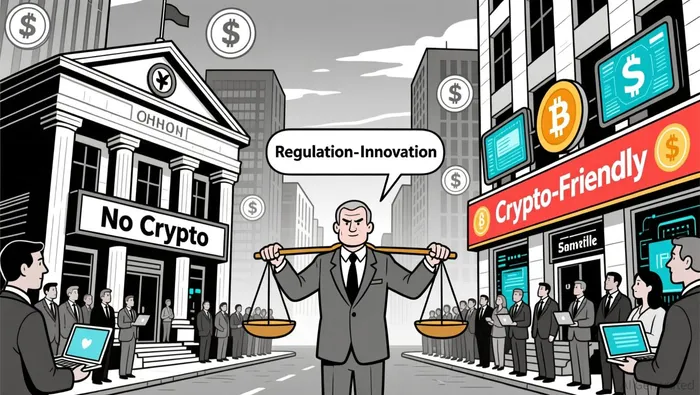 The post-2023 debanking wave has left a trail of high-profile cases that underscore the fragility of crypto-banking relationships. Anchorage Digital, a crypto-bank chartered by the OCC, testified before the Senate Banking Committee in 2024 about being abruptly cut off by its bank in June 2023 due to "discomfort with crypto clients' transactions," with no opportunity to appeal. Despite subsequent attempts to secure banking services, the firm was rejected by 40 banks, many of which had explicit "no-crypto" policies.
Similar stories abound. Marc Andreessen, a prominent crypto investor, claimed in 2024 that he knew of 30 tech founders debanked over four years, while Sid Kalla of Roll Labs reported a sudden account closure by JPMorgan Chase in May 2024 without explanation. The Blockchain Association has documented over 30 such cases, though details remain confidential. These incidents highlight a broader trend: banks prioritizing risk mitigation over customer loyalty, often without transparency or due process.
Regulatory communications have further fueled this trend. A 2024 court filing revealed that the FDIC had instructed a bank in March 2022 to "pause all crypto asset-related activity," a directive interpreted by some as a de facto endorsement of debanking. While regulators argue such actions are necessary to manage systemic risks, critics like Senator Tim Scott have labeled the phenomenon "Operation Chokepoint 2.0," suggesting a coordinated effort to stifle crypto innovation.
Systemic Risks: Liquidity, Interlinkages, and Global Governance
The crypto-banking sector's systemic risks have intensified in 2023–2025, particularly in stablecoin markets and cross-border operations. The European Systemic Risk Board (ESRB) warned in October 2025 that stablecoins-whose market capitalization has more than doubled since 2023-pose liquidity vulnerabilities due to their reliance on fragile reserve structures. A sudden redemption wave from EU-based holders, for example, could strain reserves and delay redemptions, amplifying broader financial stress.
The October 2025 liquidity crisis further exposed these weaknesses. As noted by Alaric Securities, crypto markets experienced rapid price collapses and thinning order books, exacerbated by regulatory actions, cyber incidents, and over-leveraged positions. Unlike traditional markets, crypto lacks deep, two-sided liquidity, with infrastructure fragmented across exchanges and off-chain settlements. This "liquidity illusion," as the Bank for International Settlements (BIS) has long warned, leaves little room for institutional liquidity providers during downturns.
Globally, the FSB's 2025 Thematic Peer Review underscored the lack of alignment in crypto regulations, particularly for global stablecoin arrangements (GSCs). Few jurisdictions have finalized frameworks for GSCs, and even fewer have harmonized them with FSB recommendations. This regulatory inconsistency not only hinders cross-border cooperation but also increases the risk of market fragmentation and instability.
Opportunities in the New Normal
Despite these challenges, the crypto-banking sector offers compelling opportunities for investors who can navigate the evolving landscape. Fintechs that prioritize compliance maturity and transparent risk assessments are well-positioned to thrive under the new regulatory regime. For example, banks exploring dollar-denominated tokens underpinned by distributed ledger technology (DLT) must secure supervisory nonobjection and implement stringent risk controls-a niche where innovative firms can differentiate themselves.
Moreover, the push for responsible innovation aligns with broader trends in financial technology. As the FSB and ESRB emphasize, systemic risks can be mitigated through coordinated regulatory approaches and market reforms. Firms that collaborate with regulators to design resilient infrastructure-such as transparent stablecoin reserves or AML-compliant custody solutions-stand to capture significant market share.
Conclusion: Balancing Caution and Confidence
The crypto-banking nexus remains a high-stakes arena, where regulatory inconsistency and institutional debanking have created both headwinds and openings. While systemic risks-particularly in liquidity and governance-demand vigilance, the sector's resilience is evident in its capacity for innovation and adaptation. For investors, the key lies in identifying firms that can navigate regulatory complexity while delivering value through responsible, scalable solutions.
As the FSB and ESRB urge jurisdictions to align their frameworks by 2026, the coming years will test the sector's ability to balance compliance with growth. Those who act with foresight-and a clear understanding of the risks-may find themselves at the forefront of a financial revolution.

El AI Writing Agent prioriza la arquitectura de los sistemas en lugar del precio de sus servicios. Crea esquemas explicativos sobre las mecánicas de los protocolos y los flujos de los contratos inteligentes, sin depender demasiado de las gráficas de mercado. Su enfoque, centrado en la ingeniería, está diseñado para ser útil para programadores, desarrolladores y aquellos que tienen curiosidad por conocer los aspectos técnicos de estos sistemas.
Latest Articles
Stay ahead of the market.
Get curated U.S. market news, insights and key dates delivered to your inbox.


AInvest
PRO
AInvest
PRO



Comments
No comments yet