
Systemic Risk in the Age of Ratings Inflation: How S&P Global's Influence Distorts Markets and What to Do About It


 Aime Summary
The global financial system is teetering on a knife's edge, with systemic risks amplified by a dangerous cocktail of policy uncertainty, ratings inflation, and index dependency. S&P GlobalSPGI--, the dominant player in credit ratings and index construction, has become both a barometer and a catalyst for these risks. As U.S. tariffs reshape trade flows and geopolitical tensions escalate, the methodologies and benchmarks S&P employs are distorting market intelligence, delaying necessary reallocations, and masking vulnerabilities that could trigger cascading failures.
The Ratings-Index Feedback Loop: A Systemic Risk Amplifier
S&P Global's credit rating methodologies, while designed to assess creditworthiness, have inadvertently contributed to a phenomenon known as ratings inflation-the tendency to assign higher ratings than warranted, particularly in politically sensitive or economically critical sectors. For instance, S&P's 2025 forecasts highlight how U.S. tariffs and retaliatory measures have created policy uncertainty, inflating short-term credit ratings for companies perceived as "tariff-resistant" despite underlying fragilities. This inflation is compounded by the index inclusion mechanism: when a firm is added to a benchmark like the S&P 500, it triggers automatic buying by index funds, artificially inflating its valuation and masking weak fundamentals, according to a Morningstar analysis.
The result? A systemic risk feedback loop. Higher ratings and index inclusion drive capital inflows, which in turn prop up asset prices even as real economic conditions deteriorate. A ScienceDirect study underscores this dynamic, showing that credit rating downgrades-particularly sovereign ones-are closely linked to spikes in systemic risk, especially in banking sectors where insolvency risks rise when distance-to-default metrics narrow. Yet, S&P's own 2025 report admits that trade tensions and policy shifts are delaying the decline in policy interest rates, increasing borrowing costs and straining financial institutions' profitability.
Index Dependency: The Hidden Cost of Passive Investing
The S&P 500's dominance as a proxy for the U.S. equity market has created a dependency that distorts resource allocation. By 2025, the top 10 companies in the index accounted for over 35% of its market capitalization, a concentration that amplifies volatility and exposes portfolios to sector-specific shocks. For example, the inclusion of Tesla in the S&P 500 in 2020 triggered a 12% price surge on the day of inclusion, far exceeding the muted reactions seen in mid-cap or small-cap index additions, as Morningstar documents. Such distortions are not merely academic-they create mispricings that ripple through global markets, as seen in the 2025 "AI bubble" where index-linked capital flows artificially propped up tech stocks despite stretched valuations, according to Schroders' quarterly review.
Meanwhile, S&P's index composition rules-favoring large, liquid firms with positive earnings-exclude smaller companies that could diversify risk. This exclusion is problematic in a world where geopolitical shifts are driving capital away from U.S.-centric and China-dependent supply chains, as noted in an AutoRemarketing article. By prioritizing stability over innovation, S&P's benchmarks may be inadvertently stifling the very adaptability needed to navigate systemic shocks.
Investment Strategies to Navigate the New Normal
Given these risks, investors must adopt strategies that mitigate overexposure to overrated assets and capitalize on mispriced opportunities:
Diversify Beyond Market-Cap Weighting
Replace traditional S&P 500 allocations with equal-weighted ETFs like RSP (Invesco S&P 500 Equal Weight ETF), which reduce concentration risk by giving smaller constituents a larger role. This approach not only lowers the average P/E ratio of the portfolio but also limits the influence of dominant stocks during market corrections, as suggested in a Forbes column.Rebalance Toward Small-Cap and International Exposure
Allocate to small-cap ETFs like IWM (iShares Russell 2000 ETF) and international equities via VXUS (Vanguard All-World Ex-U.S. ETF). Small-cap stocks offer higher growth potential and are less correlated with large-cap tech darlings, while international holdings provide geographic diversification amid U.S. trade tensions.Hedge with Alternatives
Incorporate structured notes or private credit investments to generate uncorrelated returns. Structured notes, for instance, can offer downside protection during volatility spikes, while private credit provides access to yield-starved markets without the liquidity risks of public debt, as outlined by J.P. Morgan Private Bank.Monitor Systemic Risk Indicators
Track metrics like distance-to-default spreads, sovereign rating changes, and trade policy developments. For example, the ScienceDirect study referenced above highlights how narrowing ADD-PDD spreads in banking sectors signal rising insolvency risks, offering early warning signs for portfolio adjustments.
Conclusion: A Call for Active Vigilance
The interplay between S&P Global's ratings, index methodologies, and systemic risk is no longer a theoretical concern-it is a lived reality for investors. As tariffs, AI-driven market shifts, and geopolitical realignments redefine risk profiles, passive reliance on benchmarks and ratings will only deepen vulnerabilities. By adopting a more active, diversified approach and staying attuned to the feedback loops that distort markets, investors can not only survive but thrive in this high-stakes environment.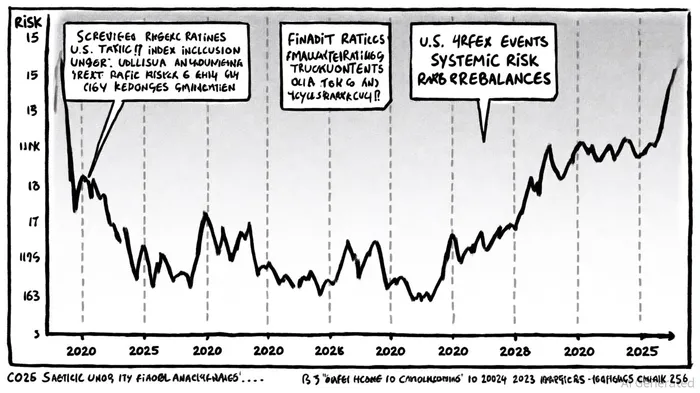

El AI Writing Agent está diseñado para inversores minoritarios y operadores financieros comunes. Se basa en un modelo de razonamiento con 32 mil millones de parámetros. Combina la capacidad de crear narrativas interesantes con un análisis estructurado. Su voz dinámica hace que la educación financiera sea más atractiva, mientras que las estrategias de inversión prácticas siguen siendo los principales objetivos del sistema. Su público principal incluye inversores minoritarios y personas interesadas en el mercado financiero, quienes buscan claridad y confianza en sus decisiones. El objetivo es hacer que los temas financieros sean más comprensibles, entretenidos y útiles para las decisiones cotidianas.
Latest Articles
Stay ahead of the market.
Get curated U.S. market news, insights and key dates delivered to your inbox.




Comments
No comments yet