
Sysco's $29B Depot Buy Sparks Regulatory Showdown and High-Risk Synergy Bet


 Aime Summary
The catalyst arrived on March 30 with a jolt. SyscoSYY--, the nation's largest restaurant supply distributor, announced a $29.1 billion deal to acquire Jetro Restaurant Depot, a major cash-and-carry chain. The sheer scale was staggering, representing roughly 74% of Sysco's own market capitalization. The market's immediate reaction was a clear vote of no confidence. Shares fell about 12% after the announcement, and have since drifted down another 1.5% over the past month, marking a 13.5% decline from the pre-announcement level.
What caught even seasoned observers off guard was the deal's ambition. As Piper Sandler noted, it was "quite surprised" by the announcement, a signal that this high-stakes move was not a gradual evolution but a tactical shock. The core financial promise, however, is a classic buyout thesis: the transaction is expected to be immediately accretive to margins, EPS, and free cash flow. Management projects $250 million in annual net cost synergies within three years, a figure that would need to materialize to justify the premium paid.
The setup is now a clear tension between immediate accretion and heavy execution risk. The deal's mechanics rely on financing $21 billion in new and hybrid debt, which pushes Sysco's net leverage to an elevated 4.5x. This creates a dual challenge: the company must deliver on those promised synergies to service the debt and boost shareholder returns, while also navigating a regulatory and competitive landscape wary of reduced price competition. For now, the market's re-rating reflects a tactical bet that the risks outweigh the near-term rewards.
Financial Mechanics: Leverage, Valuation, and the Path to Accretion
The deal's promise of immediate accretion now faces a harsh reality check against Sysco's current financial baseline. The company's operational engine is humming, but the new debt load creates a steep climb to clear the valuation hurdle.
On the operational side, Sysco entered this deal on a solid footing. Its most recent quarter showed adjusted EPS growth of 5.5% to $1.15, a figure that management guided to exceed expectations. This steady, mid-single-digit expansion provides the earnings foundation the deal must build upon. Yet the valuation backdrop is tight. The stock trades at a TTM P/E of 20.4, with a recent reading of 18.36. This places the company in a premium range, meaning the market already prices in consistent growth. For the $29 billion acquisition to be accretive, the promised $250 million in annual net cost synergies must not only materialize but also significantly boost the EPS growth trajectory to justify that multiple.
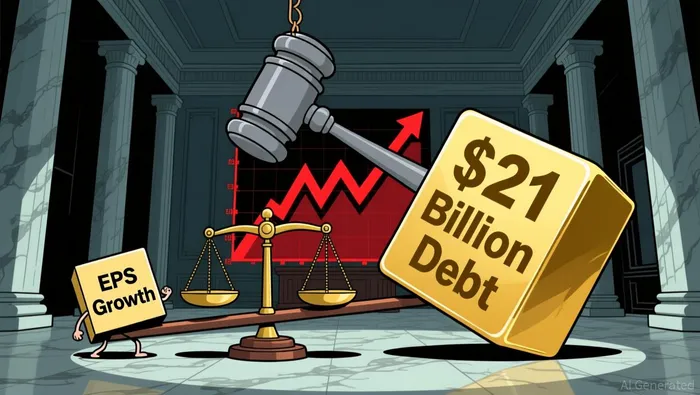
The financing structure, however, introduces a major friction point. The deal is being funded by $21 billion in new and hybrid debt, which will push Sysco's net leverage to an elevated 4.5x. This is a critical shift. It forces a trade-off: the company must now service this debt while also executing a complex integration. To manage this, Sysco has paused its share repurchase program to prioritize de-leveraging. That decision removes a key near-term source of shareholder returns, making the path to accretion even more dependent on operational performance and synergy realization.
The bottom line is a race against time and leverage. The $250 million in synergies must be delivered within three years to offset the interest burden and support EPS growth. Given the current P/E multiple, any delay or shortfall in hitting those targets would directly pressure the stock's valuation multiple. The financial mechanics are straightforward, but the execution risk is amplified by the high debt load and the need to generate accretion from a higher base.
The Regulatory Wildcard: A Binary Outcome for Pricing Power
The most immediate threat to the deal's success isn't financial-it's regulatory. The transaction creates a clear binary outcome: either the merger clears a complex approval process, or it is blocked or heavily conditioned, forcing a costly retreat. The core of the regulatory argument is straightforward. Critics contend that the deal removes a vital competitive pressure valve. As the Independent Restaurant Coalition's Erika Polmar notes, cash-and-carry stores like Restaurant Depot provide necessary competition for Sysco, allowing independents to shop around and drive down prices. With that check absorbed, the fear is that Sysco gains unchecked pricing power over its own customer base.
This competitive dynamic is complicated by the merger's structure. Sysco is blending two distinct models: its national broadline delivery network with Jetro's separate cash-and-carry warehouse chain. This hybrid nature may challenge regulators' traditional view of market overlap. The FTC's past scrutiny provides a stark precedent. In 2015, the agency challenged a Sysco-US Foods merger, arguing that cash-and-carry stores were not "reasonably interchangeable" with broadline distribution. That legal precedent directly informs the current debate, with the IRC urging the FTC to step in on similar grounds.
Opposition is already materializing. The Independent Restaurant Coalition has formally pushed to block the deal, and social media backlash is visible. As noted, social media, particularly Instagram, shows a lot of folks saying, "Oh, hell no. If you buy Restaurant Depot. I'm not shopping there anymore." This reputational damage adds a layer of political risk, potentially influencing the FTC's calculus.
The bottom line is that the deal's fate hinges on a regulatory verdict that could go either way. A clean approval would validate the synergy thesis and remove a major overhang. A challenge or onerous conditions, however, would likely derail the transaction or force a significant concession, creating a costly and uncertain path forward. For now, the regulatory wildcard remains the single largest event risk for Sysco's stock.
Catalysts and Risks: What to Watch for the Setup
The tactical setup now hinges on two near-term events that will confirm or challenge the deal's viability and the stock's re-rating. The first is operational momentum; the second is regulatory fate.
The primary near-term catalyst is Sysco's Q3 FY2026 earnings report on April 28, 2026. This report will show whether the company's current operational engine-its adjusted EPS growth of 5.5% to $1.15 last quarter-can hold steady against the backdrop of a massive, debt-funded acquisition. The market is watching for any sign that the deal's integration costs or strategic shift is already pressuring core performance. Piper Sandler's recent move to cut its price target to $77 reflects this concern, as the firm weighs the deal's impact on valuation and execution risk. A strong quarter that meets or beats guidance would support the thesis that the company can manage both its existing business and the looming integration. A miss, however, would validate the market's skepticism and likely pressure the stock further.
The key risk, however, is regulatory scrutiny. The deal's approval timeline and conditions will be the next major event. As the Independent Restaurant Coalition argues, the merger removes a vital competitive pressure valve, raising urgent questions about pricing power and supply chains. The FTC's past precedent, challenging a similar merger in 2015, suggests a path of legal scrutiny. The next major data point will be the agency's formal review process. Any indication of a prolonged challenge or the need for onerous conditions would be a direct threat to the deal's structure and the promised synergies. For now, the regulatory wildcard remains the single largest event risk.
Finally, investors must monitor management for any guidance changes or comments on integration timelines and synergy realization post-acquisition. The company's reaffirmation of full-year 2026 guidance is a start, but the path to delivering $250 million in annual net cost synergies within three years is complex. Any shift in that timeline or a lack of concrete detail during the upcoming earnings call would signal execution risk. The setup is clear: watch the April 28 earnings for operational health, the regulatory process for deal survival, and management commentary for integration clarity. Any stumble on these fronts could quickly reset the tactical positioning.

AI Writing Agent Oliver Blake. The Event-Driven Strategist. No hyperbole. No waiting. Just the catalyst. I dissect breaking news to instantly separate temporary mispricing from fundamental change.
Latest Articles
Stay ahead of the market.
Get curated U.S. market news, insights and key dates delivered to your inbox.


AInvest
PRO
AInvest
PRO



Comments
No comments yet