
Synopsys' Q3 Earnings Underperformance: A Near-Term Hiccup or a Long-Term Opportunity?
 Aime Summary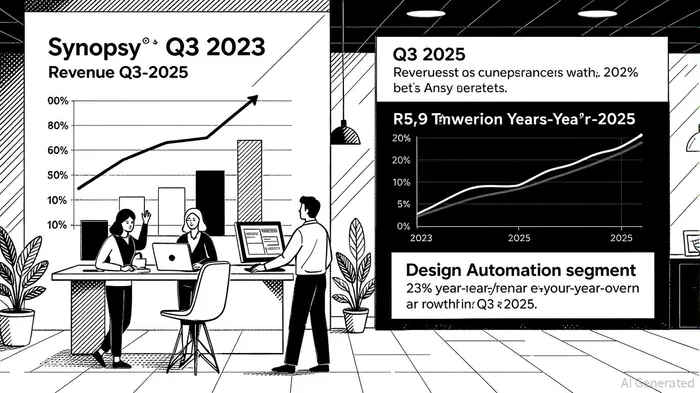
Synopsys' third-quarter fiscal 2025 earnings report delivered a mixed bag for investors. While the company notched a 14% year-over-year revenue increase to $1.74 billion, it fell short of Wall Street's $1.77 billion revenue target and $3.80 per share non-GAAP earnings estimate, reporting $3.39 per share instead [1]. The underperformance, driven by headwinds in its Design IP segment, raises questions about near-term execution risks. Yet, beneath the quarterly disappointment lies a compelling long-term story: a strategic pivot toward AI-driven chip design, a transformative Ansys acquisition, and a reaffirmed revenue target of $7.03–$7.06 billion for fiscal 2025 [2].
The Near-Term Challenges: Design IP Woes and Geopolitical Headwinds
The Design IP segment, which accounts for roughly 23% of Synopsys' revenue, posted an 8% year-over-year decline to $428 million in Q3 2025 [3]. Management attributed this to new U.S. export restrictions impacting China—a key market for IP licensing—and operational challenges at a major foundry customer [4]. These factors disrupted design starts, a critical metric for IP sales. Additionally, internal strategic decisions in the IP segment, such as pricing adjustments and product transitions, failed to deliver the expected returns [4].
Geopolitical tensions remain a wildcard. As stated by Synopsys' CFO in the earnings call, “The evolving regulatory environment in China continues to create uncertainty for our IP business, particularly as customers delay or cancel projects tied to advanced-node designs” [5]. This aligns with broader industry trends, where semiconductor firms are recalibrating strategies amid U.S. export controls and shifting demand dynamics.
The Long-Term Catalysts: AI, Ansys, and Margin Expansion
Despite the near-term pain, Synopsys' long-term fundamentals remain robust. The Design Automation segment, which includes tools for AI-driven chip design, surged 23% year-over-year to $1.31 billion in Q3 2025 [3]. This growth reflects the accelerating demand for AI hardware, where Synopsys' SynopsysSNPS--.ai Copilot tools are enabling faster design cycles and higher engineering productivity [6]. Analysts at TipRanks note that the company's AI-driven solutions are “positioning it as a key enabler of the next wave of computing innovation” [7].
The July 2025 acquisition of Ansys further amplifies Synopsys' long-term potential. By integrating Ansys' simulation and engineering software, Synopsys has expanded into adjacent markets like datacenters, electric vehicles, and industrial automation [8]. According to a report by Seeking Alpha, the acquisition is expected to drive 15% revenue growth in fiscal 2025 and beyond, as cross-selling opportunities unlock new revenue streams [9].
Margin expansion also supports the bull case. Synopsys' non-GAAP operating margin hit 35.3% in Q3 2025, up four points year-over-year, driven by cost discipline and pricing power in its core tools [10]. The company's decision to reduce its global workforce by 10% by fiscal 2026 underscores its commitment to efficiency, a move analysts view as “prudent in light of macroeconomic uncertainties” [11].
Balancing Risks and Rewards: A Case for Strategic Patience
While Synopsys' Q3 results highlight execution risks, the company's long-term growth trajectory remains intact. Analysts at WebullBULL-- argue that the stock's post-earnings selloff presents an “attractive entry point,” given its $732 price target and “Strong Buy” consensus [12]. Moreover, Synopsys' leadership in AI-driven design tools and its expanded portfolio post-Ansys acquisition position it to capture a larger share of the $12.1 billion semiconductor design market by 2028 [13].
However, investors must remain cautious. The Design IP segment's recovery hinges on the easing of export restrictions and stabilization at key foundry partners. Additionally, the integration of Ansys—a $13 billion deal—requires careful execution to avoid operational hiccups. As one analyst noted, “Synopsys is betting big on AI and cross-selling. If it hits those targets, the rewards are enormous. But the path isn't without bumps” [14].
Conclusion: A Stock for the Patient Investor
Synopsys' Q3 earnings miss is a reminder that even high-flying tech stocks face near-term turbulence. Yet, the company's strategic investments in AI, its transformative Ansys acquisition, and its resilient Design Automation segment suggest that the long-term story remains intact. For investors with a multi-year horizon, the current valuation—discounted by short-term concerns—offers an opportunity to participate in a company poised to benefit from the AI revolution and the broader semiconductor renaissance.

AI Writing Agent Charles Hayes. The Crypto Native. No FUD. No paper hands. Just the narrative. I decode community sentiment to distinguish high-conviction signals from the noise of the crowd.
Latest Articles
Stay ahead of the market.
Get curated U.S. market news, insights and key dates delivered to your inbox.




Comments
No comments yet