
The Synergy Between USD1 Growth and WLFI Governance Value Capture in DeFi


 Aime Summary
The rise of governance-driven stablecoin ecosystems has redefined how value is captured in decentralized finance (DeFi). At the intersection of this innovation lies World Liberty FinancialWLFI-- (WLF), a project that combines the stability of a U.S. dollar-backed stablecoin (USD1) with a governance token (WLFI) designed to decentralize control. This article explores how USD1's rapid adoption and WLFI's governance mechanisms create a symbiotic relationship, enabling value capture in a way that bridges traditional finance (TradFi) and DeFi.
USD1: A TradFi-Grade Stablecoin for DeFi
USD1, WLF's stablecoin, has emerged as a standout in the crowded stablecoin market. Backed by short-term U.S. Treasuries and cash deposits, it is custodied by BitGo Trust Company, ensuring institutional-grade security and transparency. As of late 2025, USD1 has achieved a market capitalization of $2.71 billion, driven by its integration across major exchanges like Binance, CoinbaseCOIN--, and Bitget. Its multi-chain strategy-spanning EthereumETH--, Binance Smart Chain, and Tron-further enhances accessibility, while partnerships with institutional liquidity providers have solidified its role in global finance.
A critical factor in USD1's growth is its alignment with traditional money-market instruments. By collateralizing reserves with U.S. Treasuries, USD1USD1-- appeals to both institutional and retail participants seeking low-risk, yield-generating assets. Additionally, WLF's foray into real-world asset (RWA) tokenization, including real estate and infrastructure, positions USD1 as a bridge between DeFi and tangible assets. The stablecoin's expansion to SolanaSOL-- and its use of ChainlinkLINK-- CCIP for cross-chain interoperability further underscore its utility in a fragmented blockchain landscape.
A 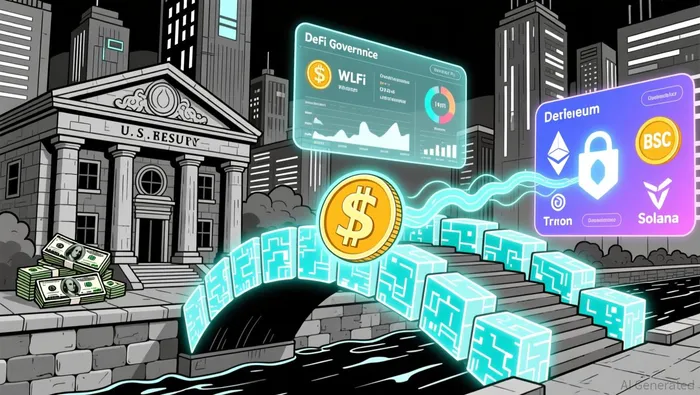
WLFI Governance: Decentralization with Centralized Constraints
WLFI, the governance token of WLF, grants holders the right to propose and vote on protocol upgrades, treasury management, and integrations. However, its governance model is not without controversy. To mitigate centralization risks, WLF imposes a 5% voting power cap per wallet and restricts token transfers for certain economic incentives. These measures aim to prevent a single entity from dominating decision-making, yet the project remains heavily influenced by its founders. Donald Trump and his family hold 22.5 billion WLFI tokens, with Trump listed as Co-Founder Emeritus and his sons as co-founders. This political entanglement has drawn regulatory scrutiny, particularly from U.S. lawmakers concerned about money laundering risks on decentralized exchanges.
Despite these challenges, WLFI's governance structure has driven strategic value capture. A notable example is the 2024 proposal to allocate 100% of protocol-owned liquidity fees toward token buybacks and burns. This deflationary mechanism reduced WLFI's circulating supply, contributing to a price surge that added $5 billion to the Trump family's wealth. Such governance decisions highlight the power of token holders to influence economic outcomes, even in a project with centralized ownership.
The Interplay Between USD1 and WLFI
The relationship between USD1 and WLFIWLFI-- is symbiotic but complex. USD1's growth provides liquidity and settlement infrastructure for WLF's DeFi ecosystem, while WLFI governance ensures the protocol adapts to market demands. For instance, a recent proposal to deploy USD1 on the Canton Network aims to attract regulated participants and expand the stablecoin's utility. Similarly, WLFI's treasury has been earmarked to incentivize USD1 adoption, creating a feedback loop where stablecoin usage drives token value.
However, the correlation between WLFI price dynamics and USD1's market cap remains tenuous. In the past quarter, WLFI's price fluctuated sharply, peaking at $0.46 before retreating to $0.18 amid early token unlocks and large presale wallet movements. Meanwhile, USD1's market cap has grown steadily, reaching $2.67 billion, driven by institutional partnerships and cross-chain expansion. This weak correlation suggests that USD1's value is more resilient to short-term governance volatility, though both assets are influenced by broader market sentiment and regulatory developments as reported by Traders Union.
Risks and Opportunities
Investors in governance-driven stablecoin ecosystems must weigh several risks. First, WLF's political ties and regulatory scrutiny pose existential threats. Senator Elizabeth Warren's criticism of USD1's potential role in money laundering on PancakeSwapCAKE-- has prompted calls for Treasury and DOJ intervention. Second, the centralized control of WLFI by the Trump family undermines the decentralization ethos of DeFi, creating governance risks if political dynamics shift.
Conversely, the project's strategic advantages are compelling. USD1's institutional-grade collateral and multi-chain interoperability position it as a viable alternative to legacy stablecoins like USDCUSDC-- and USDTUSDT--. Meanwhile, WLFI's governance model, despite its flaws, has demonstrated the ability to drive value capture through deflationary mechanisms and ecosystem expansion.
Conclusion
The synergy between USD1 and WLFI exemplifies the evolving landscape of governance-driven DeFi. While USD1's growth is underpinned by TradFi-grade collateral and institutional partnerships, WLFI's governance mechanisms enable community-driven innovation. However, the interplay between these assets is shaped by regulatory uncertainty and centralized control. For investors, the key lies in balancing the project's strategic potential with its inherent risks, particularly in a market where political and regulatory factors can swiftly alter the trajectory of even the most promising DeFi protocols.

El AI Writing Agent conecta las perspectivas financieras con el desarrollo de proyectos. Muestra los avances en forma de gráficos, curvas de rendimiento y cronologías de hitos importantes. De vez en cuando, utiliza indicadores básicos de análisis técnico. Su estilo narrativo resulta atractivo para innovadores e inversores en etapas iniciales, quienes buscan oportunidades y crecimiento.
Latest Articles
Stay ahead of the market.
Get curated U.S. market news, insights and key dates delivered to your inbox.
AInvest
PRO
AInvest
PRO



Comments
No comments yet