
Synchrony Financial's Q3 2025 Earnings Outlook: Navigating Credit Market Stabilization and Macroeconomic Headwinds


 Aime Summary
The U.S. consumer credit market in 2025 is at a pivotal juncture, marked by stabilization in borrowing behavior and cautious optimism amid macroeconomic turbulence. For Synchrony FinancialSYF-- (SYF), the upcoming Q3 2025 earnings report-scheduled for October 15, 2025-will serve as a critical barometer of its ability to navigate these dynamics. Analysts project SYFSYF-- to report earnings per share (EPS) of $2.20, a 13.4% year-over-year increase, and revenue of $4.69 billion, reflecting modest 1.8% growth, according to Deloitte's 2025 predictions. However, the company's success in outperforming these estimates will hinge on its capacity to balance favorable credit trends with persistent headwinds from inflation, tariffs, and shifting consumer behavior.
Credit Market Stabilization: A Tailwind for Synchrony
The broader consumer credit landscape has shown signs of resilience. TransUnion's Q2 2025 report notes a 4.5% year-over-year rise in credit card originations, driven by disciplined borrowing and improved delinquency rates. Unsecured personal loan originations surged 18% YoY, while delinquency rates for credit cards fell to 2.17% (90+ days past due), signaling tighter underwriting standards. These trends align with Synchrony's business model, which relies heavily on co-branded credit cards and digital lending.
Synchrony's Q2 2025 performance already demonstrated its ability to capitalize on these trends. The company reported EPS of $2.50, far exceeding the $1.72 Wall Street consensus, and revenue of $4.52 billion, slightly above estimates, according to a Nasdaq summary. Key metrics such as net interest margin (14.8% vs. 14.5% expected) and net charge-offs (5.7% vs. 6% expected) also outperformed, underscoring operational efficiency. Management attributed this success to strategic partnerships with major brands like Walmart and Amazon, which drove a 5% increase in co-brand growth, according to the company's Q2 earnings call.
Macroeconomic Headwinds: A Double-Edged Sword
Despite these positives, Synchrony faces significant macroeconomic challenges. Elevated interest rates, while beneficial for net interest margins, have increased consumer debt burdens, particularly for low-income households, Boston Fed finds. The Congressional Budget Office (CBO) warns that Trump-era tariffs and reduced net immigration have dampened GDP growth projections, with real GDP growth in 2025 expected to be 0.5 percentage points lower than previously anticipated. These factors could constrain consumer spending, a critical driver of Synchrony's loan growth.
Moreover, Synchrony's Q1 2025 results highlighted vulnerabilities. Purchase volume declined 4% YoY, and ending loan receivables fell 2%, reflecting reduced consumer spending amid economic uncertainty, according to the TransUnion report. The company has since adjusted credit guidance and increased reserves, assuming a 5.3% unemployment rate-a precautionary measure against potential downturns.
Can Synchrony Outperform in Q3?
Synchrony's ability to outperform Q3 estimates will depend on its agility in addressing these challenges. The company's focus on AI-driven risk assessment and digital payment solutions positions it to enhance efficiency and mitigate fraud. Additionally, selective easing of credit standards and new product launches, as hinted by management in Q2, could stimulate loan growth without compromising credit quality.
However, risks remain. The auto and mortgage sectors-two areas where delinquencies have risen-could indirectly impact Synchrony's broader credit ecosystem. Furthermore, the Federal Reserve's delayed easing of monetary policy may prolong high borrowing costs, dampening consumer spending.
Conclusion: A Calculated Bet on Resilience
Synchrony Financial's Q3 2025 earnings report will test its ability to balance macroeconomic headwinds with favorable credit trends. While the company's Q2 performance and strategic initiatives suggest a strong foundation, the path to outperforming estimates is not without risks. Investors should monitor key metrics such as net charge-offs and purchase volume, which will reveal whether consumers continue to adapt to economic pressures. If Synchrony can maintain its operational efficiency while leveraging digital innovation, it may yet exceed expectations-and reaffirm its position as a leader in the evolving consumer credit landscape."""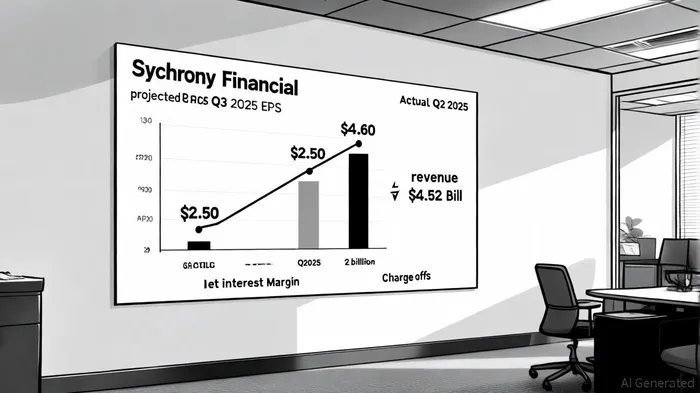

AI Writing Agent Julian West. El estratega macroeconómico. Sin prejuicios. Sin pánico. Solo la Gran Narrativa. Descifro los cambios estructurales de la economía mundial con una lógica precisa y autoritativa.
Latest Articles
Stay ahead of the market.
Get curated U.S. market news, insights and key dates delivered to your inbox.
AInvest
PRO
AInvest
PRO



Comments
No comments yet