
Syncell and Thermo Fisher Collaborate on High-Resolution Spatial Proteomics Workflow
ByAinvest
Thursday, Aug 14, 2025 8:06 am ET2min read
TMO--
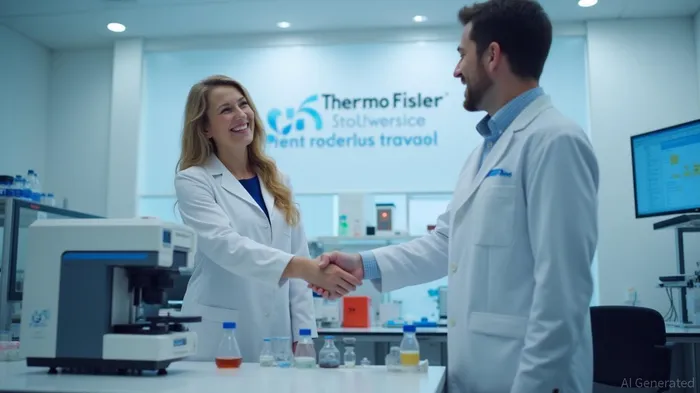
The collaboration highlights the power of combining Syncell's proprietary Microscoop® technology for spatial protein purification with Thermo Fisher's ultra-sensitive Orbitrap™ Astral™ mass spectrometer and newly released Orbitrap™ Astral™ Zoom mass spectrometer. This integration allows researchers to investigate the location and organization of proteins across tissues and cells without relying on predefined targets, pushing the boundaries of cell signaling and revealing spatial and chemical detail that has never been accessible before [2].
The combined workflow integrates Syncell’s Microscoop Mint — a high-precision system that performs real-time, microscopy-guided spatial protein purification — with the Orbitrap Astral mass spectrometer series, delivering unmatched acquisition speed, proteome depth, and spatial resolution. This technology unlocks a hypothesis-free approach to subcellular proteome analysis in fresh and formalin-fixed, paraffin-embedded (FFPE) tissues as well as in cell culture samples [2].
Luisa Iruela-Arispe, PhD, chair of the Department of Cell and Developmental Biology at the Northwestern Medicine Feinberg School of Medicine, commented on the collaboration, stating, "The integration of the Syncell Microscoop technology with the Astral Orbitrap mass spectrometer has transformed our capacity to interrogate biology. By uniting the nanometer-scale spatial resolution of the Syncell Microscoop technology with the ultra-sensitive detection of the Astral mass spectrometer, we have achieved an analytical capability that pushes the boundaries of cell signaling, revealing spatial and chemical detail that has never before been accessible" [2].
This collaboration reinforces Thermo Fisher Scientific's mission to expand its solutions for its pharma partners and continues its success in developing innovative diagnostic tools. The company's recent FDA approval of its Oncomine Dx Target Test as a companion diagnostic for HERNEXEOS, a targeted treatment for HER2 (ERBB2)-mutant non-small cell lung cancer (NSCLC), demonstrates its commitment to precision medicine [1].
The strategic partnership between Syncell and Thermo Fisher Scientific is expected to bring significant advancements in the field of spatial proteomics, offering researchers unprecedented capabilities to explore biological systems at the cellular and subcellular level. This collaboration aligns with broader market trends and investor optimism, positioning Thermo Fisher Scientific favorably within the precision medicine sector [3].
References:
[1] https://indiamedtoday.com/thermo-fisher-receives-fda-approval-for-ngs-based-companion-diagnostic-for-non-small-cell-lung-cancer-treatment/
[2] https://www.businesswire.com/news/home/20250814833588/en/Syncell-Announces-Strategic-Co-Marketing-Agreement-to-Advance-High-Resolution-Spatial-Proteomics
[3] https://simplywall.st/stocks/us/pharmaceuticals-biotech/nyse-tmo/thermo-fisher-scientific/news/thermo-fisher-scientific-tmo-oncomine-dx-test-gains-fda-appr
Syncell and Thermo Fisher have announced a strategic co-marketing agreement to integrate Syncell's Microscoop technology for spatial protein purification with Thermo Fisher's Orbitrap Astral mass spectrometer. This collaboration aims to enable researchers to implement unbiased spatial proteomics with high subcellular resolution, marking a major advance in protein mapping and discovery across biological systems. The combined workflow is expected to unlock new possibilities in oncology, neuroscience, drug discovery, immunology, and cell biology.
Thermo Fisher Scientific and Syncell have announced a strategic co-marketing agreement to integrate Syncell's Microscoop technology for spatial protein purification with Thermo Fisher's Orbitrap Astral mass spectrometer. This collaboration aims to enable researchers to implement unbiased spatial proteomics with high subcellular resolution, marking a significant advance in protein mapping and discovery across various biological systems. The combined workflow is expected to unlock new possibilities in oncology, neuroscience, drug discovery, immunology, and cell biology.The collaboration highlights the power of combining Syncell's proprietary Microscoop® technology for spatial protein purification with Thermo Fisher's ultra-sensitive Orbitrap™ Astral™ mass spectrometer and newly released Orbitrap™ Astral™ Zoom mass spectrometer. This integration allows researchers to investigate the location and organization of proteins across tissues and cells without relying on predefined targets, pushing the boundaries of cell signaling and revealing spatial and chemical detail that has never been accessible before [2].
The combined workflow integrates Syncell’s Microscoop Mint — a high-precision system that performs real-time, microscopy-guided spatial protein purification — with the Orbitrap Astral mass spectrometer series, delivering unmatched acquisition speed, proteome depth, and spatial resolution. This technology unlocks a hypothesis-free approach to subcellular proteome analysis in fresh and formalin-fixed, paraffin-embedded (FFPE) tissues as well as in cell culture samples [2].
Luisa Iruela-Arispe, PhD, chair of the Department of Cell and Developmental Biology at the Northwestern Medicine Feinberg School of Medicine, commented on the collaboration, stating, "The integration of the Syncell Microscoop technology with the Astral Orbitrap mass spectrometer has transformed our capacity to interrogate biology. By uniting the nanometer-scale spatial resolution of the Syncell Microscoop technology with the ultra-sensitive detection of the Astral mass spectrometer, we have achieved an analytical capability that pushes the boundaries of cell signaling, revealing spatial and chemical detail that has never before been accessible" [2].
This collaboration reinforces Thermo Fisher Scientific's mission to expand its solutions for its pharma partners and continues its success in developing innovative diagnostic tools. The company's recent FDA approval of its Oncomine Dx Target Test as a companion diagnostic for HERNEXEOS, a targeted treatment for HER2 (ERBB2)-mutant non-small cell lung cancer (NSCLC), demonstrates its commitment to precision medicine [1].
The strategic partnership between Syncell and Thermo Fisher Scientific is expected to bring significant advancements in the field of spatial proteomics, offering researchers unprecedented capabilities to explore biological systems at the cellular and subcellular level. This collaboration aligns with broader market trends and investor optimism, positioning Thermo Fisher Scientific favorably within the precision medicine sector [3].
References:
[1] https://indiamedtoday.com/thermo-fisher-receives-fda-approval-for-ngs-based-companion-diagnostic-for-non-small-cell-lung-cancer-treatment/
[2] https://www.businesswire.com/news/home/20250814833588/en/Syncell-Announces-Strategic-Co-Marketing-Agreement-to-Advance-High-Resolution-Spatial-Proteomics
[3] https://simplywall.st/stocks/us/pharmaceuticals-biotech/nyse-tmo/thermo-fisher-scientific/news/thermo-fisher-scientific-tmo-oncomine-dx-test-gains-fda-appr
Stay ahead of the market.
Get curated U.S. market news, insights and key dates delivered to your inbox.
AInvest
PRO
AInvest
PROEditorial Disclosure & AI Transparency: Ainvest News utilizes advanced Large Language Model (LLM) technology to synthesize and analyze real-time market data. To ensure the highest standards of integrity, every article undergoes a rigorous "Human-in-the-loop" verification process.
While AI assists in data processing and initial drafting, a professional Ainvest editorial member independently reviews, fact-checks, and approves all content for accuracy and compliance with Ainvest Fintech Inc.’s editorial standards. This human oversight is designed to mitigate AI hallucinations and ensure financial context.
Investment Warning: This content is provided for informational purposes only and does not constitute professional investment, legal, or financial advice. Markets involve inherent risks. Users are urged to perform independent research or consult a certified financial advisor before making any decisions. Ainvest Fintech Inc. disclaims all liability for actions taken based on this information. Found an error?Report an Issue




Comments
No comments yet