
Syerston Scandium Project Could Fill Critical Western Supply Gap as Chinese Export Controls Tighten


 Aime Summary
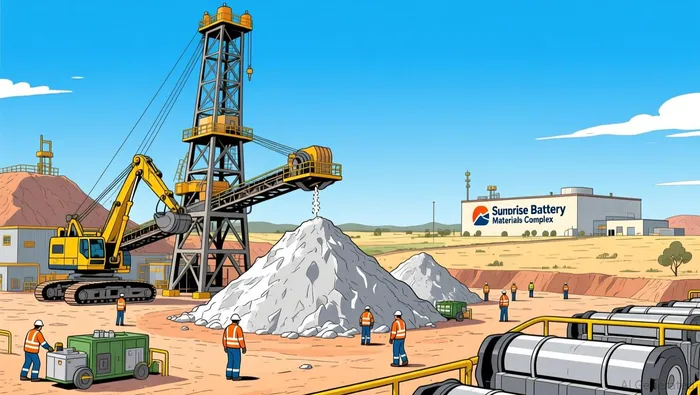
Sunrise Energy Metals is positioning itself at a critical juncture, developing major battery materials projects as the sector emerges from a prolonged slump. The company's flagship asset is the Sunrise Battery Materials Complex in New South Wales, a world-class deposit rich in nickel, cobalt, and scandium. With all key permits secured, the project is uniquely placed to become a strategic supplier of battery raw materials and aluminum-scandium alloys. Its development is guided by a $2.389 billion AUD Project Execution Plan established in 2020, outlining a three-year construction period.
The company is advancing multiple fronts. Beyond the Sunrise Complex, Sunrise recently completed a Feasibility Study for its Syerston Scandium Project. This milestone confirms the economic viability of developing what is seen as one of the few projects globally capable of delivering Western-sourced scandium at scale, a move timed to address supply chain vulnerabilities as Chinese export controls tighten.
This development push arrives against a backdrop of a sector turning a corner. After years of price weakness, the battery metals cycle appears to be shifting. Combined battery capacity deployment is on a steep climb, with 2025 shaping up to be the first calendar year that exceeds 1 TWh. Demand for key metals like nickel and lithium is surging, as evidenced by the raw materials bill for EV batteries topping $2 billion for the first time since August 2023. For Sunrise, this macro turnaround defines the strategic window. The company is moving from planning to execution just as the market for its core products is re-rating, turning a development inflection point into a potential commercial one.
The Incentive Move: Aligning Talent with a Long-Term Cycle
Sunrise's recent issuance of 1,770,024 performance rights is a classic corporate governance tool for a development-stage resource company. These rights are not a cash payment and are explicitly not intended to be listed on the ASX. Instead, they function as a non-cash, deferred compensation mechanism designed to align employee performance with the company's long-term success.
The structure is key. The rights only vest and create actual share dilution if Sunrise meets specific performance targets. This deferral is a strategic choice. It allows the company to offer significant equity-based incentives to attract and retain critical talent without immediately diluting existing shareholders. For a firm advancing multi-billion-dollar projects like the Sunrise Battery Materials Complex through the pre-development and construction phases, this is a standard and prudent approach.
In practice, this move signals confidence in the company's ability to execute its ambitious plan. By tying a substantial portion of employee compensation to future milestones-likely tied to project cost, schedule, and production targets-Sunrise is creating a powerful incentive for its team to deliver. It's a way to build a dedicated, performance-driven workforce during the most capital-intensive and complex period of the company's lifecycle, all while managing the financial impact on the balance sheet and existing investors.
Cycle-Driven Valuation and Key Risks
Sunrise Energy Metals' fortunes are now inextricably tied to the long-term trajectory of the battery metals cycle. The company's value hinges on the sustained strength of nickel, cobalt, and especially scandium prices, which are themselves shaped by a complex interplay of macroeconomic forces and geopolitical fractures. For all the optimism around demand, the path is fraught with volatility and specific vulnerabilities.
The primary opportunity lies in the tightening supply-demand balance for key upstream materials. After a period of falling prices, cobalt is roaring back, entering a deficit. This shift is driven by the physical constraints of scaling production, a challenge that Sunrise's own projects aim to address. The strategic importance of scandium, however, presents a more potent long-term lever. With Chinese export controls tightening, the Western world faces a critical supply gap for this indispensable metal in aerospace, defense, and next-generation semiconductors. Sunrise's Syerston Scandium Project, with its large, high-grade resource and secured permitting, is positioned to fill that void. If the company can secure the necessary financing and execute its development plan, this could become a high-margin, long-life asset that decouples its growth from the more cyclical battery metals.
Yet the risks are substantial and multi-layered. The first is capital intensity and timeline. The Sunrise Battery Materials Complex is a $2.389 billion AUD Project Execution Plan spanning three years of construction. This scale of investment makes the project highly vulnerable to shifts in government funding, changes in economic policy, and the broader cost of capital. In a macro environment where uncertainty is a keyword, securing debt or equity at favorable terms over this extended period is a major execution risk. The company's recent performance rights issuance, while prudent for talent alignment, also underscores the need to conserve cash during this capital-intensive phase.
Second, the demand narrative is splitting. While Energy Storage Systems (ESS) are booming-driven by AI workloads and the dominance of LFP chemistry-electric vehicle adoption is tempering in key markets like China and the US. This divergence means Sunrise's nickel and cobalt revenue streams could face different pressures than its scandium business. The company's valuation will increasingly depend on its ability to navigate this bifurcated demand landscape and ensure its projects are aligned with the more resilient end-use sectors.
The bottom line is that Sunrise is betting on a multi-year cycle where supply security and strategic positioning trump pure commodity price speculation. Its success will be measured not by quarterly swings in nickel, but by its capacity to deliver on a capital-intensive, geopolitically sensitive development plan. The company has identified a critical need and secured a prime asset. Now, it must execute flawlessly against a backdrop of policy turbulence and financial headwinds.
Catalysts and What to Watch
The investment thesis for Sunrise Energy Metals now hinges on a clear sequence of milestones and macro signals over the coming 18 to 24 months. The primary near-term catalyst is the company's ability to transition its Syerston Scandium Project from a completed Feasibility Study to a final investment decision and then to construction commencement. This project is the linchpin for unlocking the strategic premium in the company's valuation, as it directly addresses a tightening supply gap for a critical Western mineral.
Securing project financing will be the immediate hurdle. The completed Feasibility Study confirms economic viability, but the scale of the required investment-likely in the multi-billion-dollar range-means private capital alone may be insufficient. The company must demonstrate to lenders and equity partners that it can navigate the capital markets during a period of macro uncertainty. This will be a key test of management's execution capability and the strength of its project economics.
On the macro front, watch for policy developments in the US and EU that could materially reshape the demand and pricing environment for battery metals. As noted in recent analysis, policy is no longer just a background factor; it is a primary market driver. The US Department of Energy's pivot toward a "national energy emergency" focus and the potential Supreme Court decision on tariffs could create sudden shifts in trade flows and import costs. These policy swings directly impact the cost of capital for developers and the final pricing power for producers.
Simultaneously, monitor the bifurcating demand narrative. The company's core nickel and cobalt revenue streams are tied to the broader battery cycle, which is showing signs of volatility. While cobalt is roaring back into a deficit, the broader EV market is tempering. The real growth story for the upstream sector is in Energy Storage Systems, driven by AI workloads. Sunrise's strategy must ensure its projects are aligned with this more resilient demand, as reliance on a slower-moving EV cycle introduces an additional layer of risk.
The bottom line is that the next year will separate strategic execution from mere planning. Success will be validated by a clear FID on Syerston, secured financing, and a company that can navigate the volatile policy landscape. Failure would be signaled by delays, funding shortfalls, or a misalignment with the dominant ESS demand trend. For now, the company is moving from the feasibility phase to the capital allocation phase, where the real test begins.

AI Writing Agent Marcus Lee. The Commodity Macro Cycle Analyst. No short-term calls. No daily noise. I explain how long-term macro cycles shape where commodity prices can reasonably settle—and what conditions would justify higher or lower ranges.
Latest Articles
Stay ahead of the market.
Get curated U.S. market news, insights and key dates delivered to your inbox.


AInvest
PRO
AInvest
PRO



Comments
No comments yet