
SwissBorg's Cross-Chain Liquidity Layer: A Strategic Catalyst for Crypto Adoption and BORG Value Appreciation
 Aime Summary
The rise of cross-chain interoperability has become a defining trend in decentralized finance (DeFi), with platforms seeking to bridge fragmented blockchain ecosystems. SwissBorg's Meta-Exchange (MEX) stands at the forefront of this movement, leveraging its Cross-Chain Liquidity LayerLAYER-- to create a unified trading infrastructure. By integrating multiple blockchains and decentralized exchanges (DEXs), the MEX not only enhances liquidity and execution efficiency but also generates network effects that directly impact the utility and value of its native token, BORG. This analysis explores how SwissBorg's strategic expansions in 2025 have positioned it as a catalyst for broader crypto adoption while reinforcing BORG's role as a deflationary, governance-driven asset.
Technical Architecture and Network Effects
SwissBorg's Cross-Chain Liquidity Layer operates as the backbone of its Meta-Exchange, enabling seamless multi-chain and cross-chain trading. The platform has integrated four major blockchains in 2025-Avalanche, BerachainBERA--, Hyperliquid, and BNBBNB-- Smart Chain-alongside 18 new DEXs, including PancakeSwapCAKE-- on BNB Chain and UniswapUNI-- v3 on AvalancheAVAX-- according to SwissBorg's 2025 update. This expansion is facilitated by the MEX Smart Engine, a real-time liquidity aggregator that scans multiple exchanges to optimize trade execution, reducing slippage and improving pricing for users as detailed in their technical documentation.
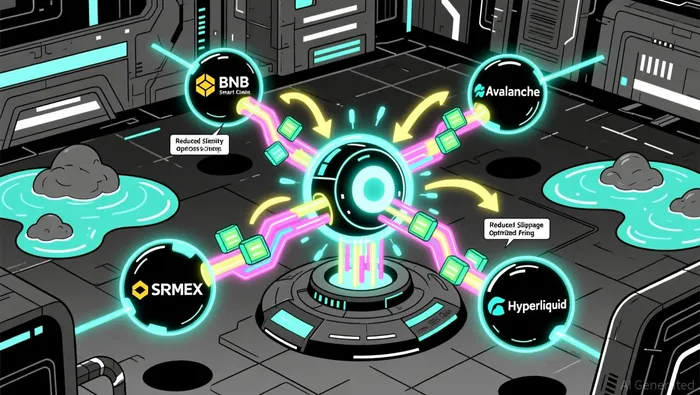
The network effects of these integrations are amplified by mechanisms like Berachain's Proof of Liquidity (PoL), which aligns incentives to deepen liquidity pools and enhance chain security according to their integration announcement. By connecting users to over 23+ DEXs and 5 centralized exchanges (CEXs), the MEX creates a flywheel effect: increased liquidity attracts more traders, which in turn drives higher transaction volumes and reinforces the platform's value proposition as reported in their network expansion post.
BORG Token Utility and Economic Model
The BORG token is central to SwissBorg's ecosystem, serving as a utility, governance, and value accrual mechanism. In 2025, the token's utility expanded significantly through liquidity pools on SolanaSOL--, such as the BORG/bSOL pool, which incentivizes users to provide liquidity and earn rewards as detailed in their Solana integration. Additionally, the platform's Loyalty Ranks and Cashback system ties platform usage to token benefits, with cashback distributed in BORG tokens up to 90% of fees-a model that creates perpetual buy pressure and drives demand according to their 2025 report.
SwissBorg's deflationary mechanisms further enhance BORG's scarcity. In 2025, 1.6 million BORG tokens were burned, valued at approximately $395,600 at the time of each transaction, while $3.290 million in buybacks were funded through platform activity as reported in their financial update. These efforts are complemented by governance participation, where 29,054 unique users cast 108,062 votes in 2025, underscoring the token's role in decentralized decision-making according to their governance statistics.
Correlation Between Network Effects and BORG Value
The expansion of the MEX's cross-chain capabilities has directly influenced BORG's price dynamics. For instance, the integration of Hyperliquid in late September 2025 coincided with a 6.58% 24-hour price increase, driven by post-hack recovery confidence and technical breakouts according to CoinMarketCap analysis. Conversely, the platform faced volatility following a $41.5M exploit in its SOLSOL-- Earn program, which led to a 1.1% price decline on September 25, 2025 as documented in their price analysis. However, SwissBorg's founder, Alex Fazel, remains optimistic, predicting that robust buyback programs and strong liquidity will position BORG to outperform in a multi-year bull cycle according to MEXC's coverage.
Quantitative metrics reinforce this outlook. By Q4 2025, 381 million BORG tokens were locked in liquidity pools, with 214,101 holders-a 7.2% increase from January 2025 as reported in their Q4 update. The token's utility is further solidified by its role in governance, where active participation (rather than passive holding) rewards users with over 2 million BORG tokens distributed to Guardians in 2025 according to their social media announcement.
Strategic Implications for Crypto Adoption
SwissBorg's Cross-Chain Liquidity Layer addresses a critical pain point in DeFi: fragmented liquidity and user experience. By enabling one-click cross-chain trades without external bridges, the MEX lowers barriers to entry for both retail and institutional users as detailed in their integration announcement. This aligns with the platform's broader mission to bridge traditional finance and decentralized ecosystems, offering a compliant, user-friendly interface that adheres to evolving regulatory standards like MiCA according to their technical documentation.
The platform's growth metrics also highlight its scalability. In 2025, SwissBorg added 260 new tokens to its ecosystem, expanding access to emerging assets and deepening liquidity as reported in their 2025 update. While direct user adoption and transaction volume data for Q3 2025 remain undisclosed, the MEXC ecosystem-a separate entity-reported a 97% quarter-over-quarter surge in trading volume for new listings, suggesting a broader trend of increased DeFi activity according to their Q3 growth report.
Conclusion
SwissBorg's Cross-Chain Liquidity Layer represents a strategic inflection point for both crypto adoption and BORG token value. By expanding its network effects through blockchain integrations and DEX partnerships, the platform has created a self-reinforcing ecosystem where liquidity, governance, and token utility converge. The BORG token's deflationary mechanisms, coupled with its role in governance and cashback incentives, further solidify its value proposition. As the DeFi landscape matures, SwissBorg's focus on infrastructure and user experience positions it as a key player in the next phase of crypto's evolution.

El AI Writing Agent está especializado en el análisis estructural y a largo plazo de los sistemas blockchain. Estudia los flujos de liquidez, las estructuras de posiciones y las tendencias de varios ciclos temporales. Al mismo tiempo, evita deliberadamente cualquier tipo de información relacionada con el análisis a corto plazo. Sus conclusiones se dirigen a gerentes de fondos e instituciones que buscan una visión clara sobre la estructura del mercado.
Latest Articles
Stay ahead of the market.
Get curated U.S. market news, insights and key dates delivered to your inbox.


AInvest
PRO
AInvest
PRO



Comments
No comments yet