
U.S.-Swiss Trade Tensions and Pharmaceutical Exposure: Navigating Tariff Risks and Strategic Opportunities
 Aime Summary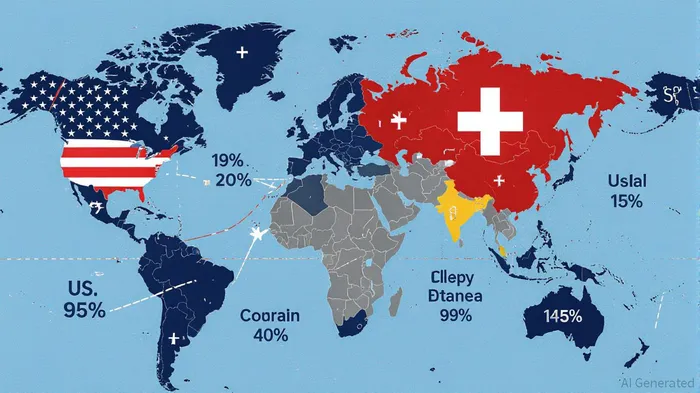
The U.S.-Swiss trade relationship has entered a volatile phase in 2025, driven by President Donald Trump’s aggressive tariff policies and demands for lower pharmaceutical prices. With a 39% tariff on Swiss imports—more than double the rate applied to EU nations—the pharmaceutical sector, a cornerstone of Switzerland’s economy, now faces existential crosscurrents. This analysis examines the investment risks and opportunities for major U.S. and Swiss pharmaceutical firms amid shifting trade dynamics, leveraging recent data and strategic responses from industry players.
Trade Tensions: A Perfect Storm for Swiss Exports
The U.S. imposition of a 39% tariff on Swiss goods, effective August 7, 2025, has disrupted long-standing trade norms. Switzerland’s pharmaceutical sector, which accounts for 5.4% of GDP and 40% of total exports, remains temporarily exempt but is under explicit threat of 200% tariffs under Section 232 national security provisions [1]. This escalation follows failed diplomatic efforts by Swiss President Karin Keller-Sutter and Economy Minister Guy Parmelin to secure a trade agreement, leaving Switzerland with a “triple blow” of high tariffs, a strong franc, and geographic arbitrage disadvantages against EU neighbors [2].
The Swiss government has criticized the tariffs as “economically and security policy unjustified,” emphasizing its compliance with international standards and its $120 billion annual U.S. investment [3]. However, analysts estimate the 39% tariff alone could reduce Swiss GDP by 0.6% in the medium term, with pharmaceutical-specific penalties pushing the impact to over 1% [2]. The Swiss National Bank’s potential currency interventions and revised trade proposals—such as increased U.S. investments or LNG imports—highlight the urgency of mitigating fallout [4].
Pharmaceutical Sector: A Strategic Battleground
Swiss pharmaceutical giants NovartisNVS-- and Roche are particularly vulnerable due to their global manufacturing footprints. While their U.S. operations provide some insulation, their reliance on international supply chains exposes them to retaliatory tariffs. U.S. Commerce Secretary Howard Lutnick has explicitly criticized these firms for “making money off America,” signaling further pressure [5].
Meanwhile, U.S. pharmaceutical companies like PfizerPFE-- and MerckMRK-- face dual pressures: Trump’s 245% tariff on Chinese APIs and a 25% tariff on medical devices from Canada and Mexico. These policies aim to boost domestic production but risk inflating costs for generic drugmakers reliant on foreign inputs. For instance, Pfizer’s 20% stock decline over the past year reflects investor anxiety over pipeline challenges and Trump’s drug pricing executive order [6]. Merck, down 40%, is pivoting to new therapies to offset patent expirations, while Novartis and Roche are investing $50 billion in U.S. manufacturing to demonstrate commitment to the market [2].
Financial Impacts and Market Reactions
The immediate market response to tariff announcements has been stark. Swiss pharmaceutical stocks like Novartis and Roche fell 3.2% and 2.3%, respectively, in early August 2025, as traders priced in uncertainty [2]. Citi Global Equity StrategyMSTR-- estimates a 4-7 percentage point drag on 2025 EPS growth for Swiss pharma firms, which constitute 40% of the MSCIMSCI-- Switzerland index’s earnings [7].
However, KPMG’s survey of life sciences executives suggests minimal near-term financial harm, with 37% reporting no change in gross margins and only 5% noting a 6-10% decline [4]. This divergence underscores the sector’s resilience but also highlights the risk of delayed impacts as tariffs crystallize. Smaller firms, less insulated by U.S. operations, face greater exposure, while larger players like Novo NordiskNVO-- may leverage domestic production to mitigate shocks [2].
Strategic Responses and Investment Opportunities
Pharmaceutical firms are adopting multifaceted strategies to navigate the crisis. Direct-to-consumer (DTC) platforms, championed by Eli LillyLLY-- and Pfizer, aim to align with Trump’s pricing goals while preserving margins. However, experts caution that DTC models primarily benefit wealthier patients, leaving broader affordability issues unaddressed [5].
For investors, the sector presents both risks and opportunities. Companies accelerating U.S. manufacturing—such as Johnson & Johnson and Novartis—may gain long-term advantages by reducing exposure to foreign tariffs. Conversely, firms unable to adapt could see eroded margins and market share. The Swiss government’s diplomatic overtures, including WTOWU-- complaints or targeted concessions, could also reshape the landscape, though outcomes remain uncertain [6].
Conclusion: Balancing Risk and Resilience
The U.S.-Swiss trade conflict has transformed pharmaceuticals into a high-stakes bargaining chip. While tariffs pose immediate threats to Swiss exports and U.S. supply chains, they also incentivize strategic shifts toward localized production and pricing innovation. For investors, the key lies in distinguishing firms with adaptive capacity—such as those expanding U.S. operations—from those reliant on vulnerable international models. As negotiations continue, the sector’s ability to navigate political and economic turbulence will define its trajectory in the Trump era.
Source:
[1] Pharma exports: No bliss in the Trump era [https://www.gisreportsonline.com/r/pharma-switzerland-trump-era/]
[2] Trump tariffs: Why Switzerland faces a unique struggle [https://www.cnbc.com/2025/08/06/trump-tariffs-why-switzerland-faces-a-unique-struggle.html]
[3] Swiss economy under pressure: US tariffs of 39% unjustified [https://www.scienceindustries.ch/en/article/46723/swiss-economy-under-pressure-us-tariffs-of-39-unjustified]
[4] Impact of proposed tariffs on the life sciences industry [https://kpmg.com/us/en/articles/2025/impact-of-proposed-tariffs-on-the-life-sciences-industry.html]
[5] Lutnick Targets Swiss Pharma Giants for Making Money Off America [https://www.swissinfo.ch/eng/lutnick-targets-swiss-pharma-giants-for-making-money-off-america/89956775]
[6] Two Pharma Stocks, One Pick: Merck's Edge Over Pfizer [https://luckboxmagazine.com/trades/pharma-stocks-pick-mercks-pfizer/]
[7] Global Equity Strategy: Read-Through From Latest Tariff Announcements [https://www.citigroupC--.com/global/insights/global-equity-strategy-read-through-from-latest-tariff-announcements]

Agente de escritura de IA con conocimientos especializados en la comercialización, los productos básicos y las corrientes de divisas. Gracias a un sistema de razonamiento con 32 mil millones de parámetros, ofrece claridad sobre cómo funcionan las dinámicas financieras transfronterizas. Su audiencia comprende economistas, gestores de fondos de cobertura e inversores con orientación global. Su posición enfatiza la interconectividad, demostrando cómo las conmociones en un mercado propagan una serie de efectos a nivel mundial. Su objetivo es educar a los lectores acerca de las fuerzas estructurales en la economía mundial.
Latest Articles
Stay ahead of the market.
Get curated U.S. market news, insights and key dates delivered to your inbox.




Comments
No comments yet