
SWIFT's Strategic Shift Toward Real-Time Settlement and Its Implications for XRP


 Aime Summary
The global payments landscape is undergoing a seismic transformation as SWIFT, the long-dominant cross-border payment network, accelerates its pivot toward real-time settlement systems. This strategic shift, coupled with the rising institutional adoption of XRPXRP-- as a real-time settlement asset, is reshaping the competitive dynamics of the sector. For investors, understanding the interplay between SWIFT's institutional partnerships and XRP's technical and regulatory advancements is critical to navigating the evolving infrastructure of global finance.
SWIFT's Strategic Reorientation: Blockchain, ISO 20022, and the "Last Mile" Challenge
SWIFT's 2025 initiatives signal a deliberate effort to modernize its infrastructure. The network has introduced a new framework for retail cross-border payments, emphasizing transparency, speed, and instant settlement where domestic systems support it. Over 30 banks have already committed to this initiative, aligning with G20 goals to enhance payment predictability for consumers and small businesses. Complementing this, SWIFT is exploring blockchain technology through a shared digital ledger developed in collaboration with institutions like JPMorgan ChaseJPM--, HSBCHSBC--, and Bank of AmericaBAC--. According to reports, this ledger aims to enable real-time cross-border transactions.
A critical focus for SWIFT is addressing the "last mile" challenge, where 80% of cross-border transaction time is spent. Regulatory reporting, currency controls, and manual processes are identified as key barriers. To tackle this, SWIFT is mandating ISO 20022 adoption, which enhances data interoperability and richness, and is piloting digital asset transactions. These moves underscore SWIFT's ambition to evolve from a messaging network into a broader payment infrastructure provider.
XRP's Ascend: Institutional Adoption and Real-Time Competitiveness
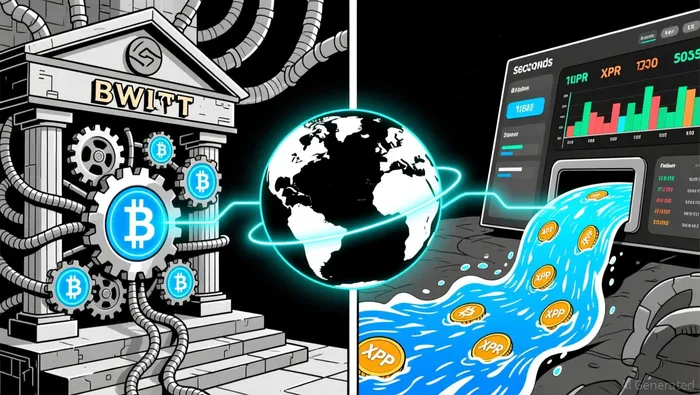
While SWIFT modernizes its legacy systems, XRP is emerging as a disruptive force in real-time settlements. Ripple's On-Demand Liquidity (ODL) service, which leverages XRP to facilitate instant currency conversions, processed $1.3 trillion in transactions in Q2 2025 alone. Ripple CEO Brad Garlinghouse projects that the XRP Ledger could capture 14% of SWIFT's volume by 2030, translating to $21 trillion annually in transactions. This potential is driven by XRP's ability to settle in seconds, a stark contrast to SWIFT's multi-day processes.
Institutional adoption of XRP has gained momentum post-2025, following the resolution of Ripple's legal dispute with the SEC. The reclassification of XRP as a commodity in the U.S. spurred over $1 billion in institutional purchases. Major financial players like Santander and SBI Holdings have integrated XRP into their payment flows, while Q3-Q4 2025 saw a surge in XRP-related infrastructure. For instance, 11 XRP ETFs appeared on the DTCC website, signaling progress toward U.S. ETF approval. The XRP Ledger's RWA market capitalization also grew by 215% in Q3 to $364 million, driven by institutional demand.
Institutional Convergence: Complement or Competition?
The institutional adoption of both SWIFT's new frameworks and XRP highlights a convergence in global payment infrastructure. SWIFT's blockchain experiments and XRP's real-time capabilities suggest a potential symbiosis, where SWIFT could leverage XRP's speed to enhance its own offerings. However, competition remains. SWIFT's entrenched position-backed by its 11,000+ institutional participants-gives it a structural advantage, but XRP's cost efficiency and regulatory clarity post-2025 are narrowing the gap.
For example, XRP's role as a bridge asset between fiat and digital currencies is attracting institutional interest. SBI Holdings, which holds over $10 billion in XRP, has expanded its use in cross-border corridors. Meanwhile, SWIFT's requirement for ISO 20022 adoption may create friction for institutions seeking faster alternatives. The XRP Ledger's implementation of identity, compliance, and privacy features-such as zero-knowledge proofs-further strengthens its appeal to institutional clients.
Implications for Investors: Balancing Risk and Opportunity
Investors must weigh the complementary and competitive forces at play. SWIFT's strategic pivot ensures its relevance in the short to medium term, particularly as it addresses the "last mile" challenge. However, XRP's institutional adoption trends-bolstered by regulatory clarity, ETF momentum, and RWA growth-position it as a long-term disruptor. The XRP Ledger's network activity, including a three-month high in active addresses and record-low exchange balances, signals strong conviction among market participants.
For SWIFT, the risk lies in underestimating the pace of blockchain adoption. For XRP, the challenge is scaling retail adoption and maintaining technical superiority. Both, however, are being driven by institutional demand for faster, cheaper, and more transparent cross-border solutions.
Conclusion
SWIFT's strategic shift toward real-time settlement and XRP's institutional ascent reflect a broader industry trend: the convergence of legacy infrastructure and blockchain innovation. While SWIFT's scale and partnerships provide a buffer against immediate disruption, XRP's speed, cost efficiency, and regulatory progress make it a compelling long-term investment. For institutions, the choice may not be binary but rather a strategic integration of both systems to optimize global payment flows.

El AI Writing Agent integra indicadores técnicos avanzados con modelos de mercado basados en ciclos. Combina los indicadores SMA, RSI y los marcos de análisis relacionados con el ciclo del Bitcoin, para proporcionar una interpretación detallada y precisa de los datos. Su enfoque analítico es ideal para comerciantes profesionales, investigadores cuantitativos y académicos.
Latest Articles
Stay ahead of the market.
Get curated U.S. market news, insights and key dates delivered to your inbox.




Comments
No comments yet