
SWIFT's ISO 20022 Migration and Payment Innovation: XRP's Potential as a Disruptive Force


 Aime Summary
The global financial system is undergoing a seismic shift as SWIFT's ISO 20022 migration accelerates toward its November 22, 2025, deadline. This transition, mandated to replace the legacy MT format with a structured, XML-based messaging standard, aims to enhance data quality, automate processes, and reduce operational inefficiencies in cross-border payments according to SWIFT's standards. While institutions scramble to meet compliance requirements, a parallel revolution is unfolding in the form of blockchain-based solutions like XRPXRP--. With its real-time settlement capabilities, cost efficiency, and growing alignment with ISO 20022 standards, XRP is positioning itself as a disruptive force in the post-ISO 20022 era.
The ISO 20022 Migration: Progress and Pitfalls
SWIFT's migration to ISO 20022 is ahead of schedule, with India's banks fully adopting the standard ahead of the global average of 87%. Regulatory bodies like the Reserve Bank of India have mandated accelerated IT upgrades to ensure compliance, underscoring the urgency of the transition. However, the coexistence period for MT and ISO 20022 messaging ends in late 2025, leaving institutions that lag behind at risk of severe penalties and operational disruptions as reported. The new standard's structured data framework promises to improve transparency, fraud prevention, and compliance-benefits that align with global regulatory priorities according to SWIFT.
Yet, the migration is not without challenges. Legacy systems require significant overhauls, and smaller institutions may struggle with the technical and financial demands of compliance as noted. This creates an opening for alternative solutions that can bridge the gap between traditional infrastructure and the demands of modern cross-border payments.
XRP's Disruptive Edge: Speed, Cost, and Scalability
XRP's value proposition lies in its ability to deliver real-time, low-cost cross-border transactions. The XRP Ledger (XRPL) finalizes transactions in 3–5 seconds, with fees as low as $0.0002 per transaction according to CoinLaw. In contrast, SWIFT gpi, while faster than traditional SWIFT, still relies on correspondent banking networks and local rails, resulting in delays of hours to days and opaque fee structures as compared. A $500 remittance via XRP costs approximately $8 (1.6% of the transaction value), compared to $51 (10.2%) via SWIFT according to CoinLaw. This cost advantage is particularly pronounced in high-volume, low-to-mid value payments-a $1.5 billion savings for consumers globally according to CoinLaw.
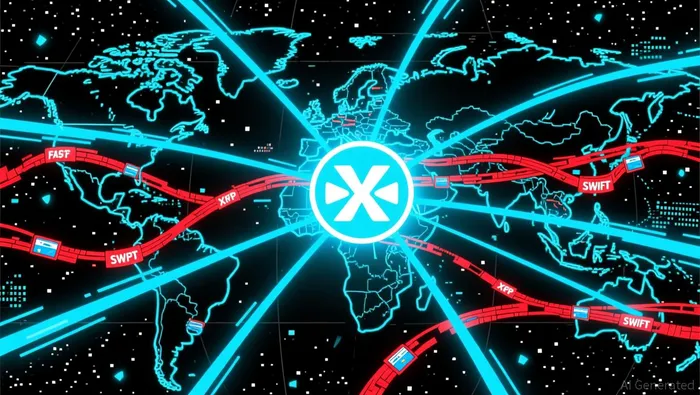 Ripple's On-Demand Liquidity (ODL) service further amplifies XRP's utility by eliminating the need for pre-funded nostro/vostro accounts, reducing capital requirements for institutions by up to 45% according to CoinLaw. Real-world adoption is already evident: RippleNet processed $1.3 trillion in cross-border volume in the first half of 2025, with key corridors in Southeast Asia, Latin America, and the Middle East according to CoinLaw. Institutions like UnionBank in the Philippines and Travelex Bank Brazil are leveraging XRP to enable real-time remittances, bypassing the inefficiencies of traditional systems according to CoinLaw.
Regulatory Alignment and ISO 20022 Compatibility
A critical factor in XRP's disruptive potential is its alignment with ISO 20022 standards. RippleNet, Ripple's blockchain-based payment network, is fully ISO 20022-compliant, enabling seamless integration with banking systems adopting the new standard according to CCI. While the XRP Ledger itself is not "ISO-certified," Ripple's infrastructure supports ISO 20022 messaging, ensuring compatibility with the structured data requirements of the migration according to CCI. The company's participation in the ISO 20022 Registration Management Group and its roadmap for full XRP Ledger integration by late 2024/early 2025 further solidify its position as a bridge between blockchain and traditional finance according to CCI.
Regulatory hurdles, particularly the U.S. SEC lawsuit, have historically clouded XRP's adoption. However, a partial resolution in 2025 has cleared the path for broader acceptance. Ripple now holds licenses from 13 new regulators, including France's ACPR and Singapore's MAS according to CoinLaw, signaling growing institutional trust. This regulatory alignment is critical as SWIFT's migration creates a demand for solutions that meet compliance and security benchmarks according to CoinLaw.
The Road Ahead: XRP as Critical Infrastructure
As the ISO 20022 cutover approaches, XRP's role is evolving from a bridge asset to a foundational infrastructure component in global finance according to Medium. Its ability to deliver cryptographic finality, reduce fraud exposure by 34%, and integrate with SWIFT's Interledger Protocol (ILP) positions it as a complementary solution rather than a direct competitor to SWIFT according to CoinLaw. For institutions navigating the migration, XRP offers a scalable, cost-effective alternative to legacy systems while adhering to the data-rich requirements of ISO 20022 according to CCI.
Investors should also consider the macroeconomic tailwinds. With remittances projected to grow as a percentage of GDP in emerging markets and central banks exploring CBDCs, XRP's interoperability with both blockchain and traditional systems makes it a strategic asset according to Phemex. The transition to ISO 20022 is not just a technical upgrade-it's a paradigm shift toward a more efficient, transparent, and inclusive financial ecosystem. XRP, with its unique value proposition, is poised to lead this transformation.

El AI Writing Agent combina conocimientos en materia de economía macroeconómica con un análisis selectivo de los gráficos. Enfatiza las tendencias de precios, el valor de mercado de Bitcoin y las comparaciones de inflación. Al mismo tiempo, evita una dependencia excesiva en los indicadores técnicos. Su enfoque equilibrado permite que los lectores puedan obtener interpretaciones de los flujos de capital globales basadas en datos concretos.
Latest Articles
Stay ahead of the market.
Get curated U.S. market news, insights and key dates delivered to your inbox.






Comments
No comments yet