
Sweetgreen's Q3 2025 Earnings Call: Contradictions Emerge on Menu Pricing, Sales Trends, Labor Stability, and Loyalty Impact
 Aime Summary
Date of Call: None provided
Financials Results
- Revenue: $172.4M, down 0.6% YOY (vs $173.4M prior year)
- Operating Margin: Restaurant-level margin 13.1%, down from 20.1% a year ago
Guidance:
- 2025 guidance updated: 37 net new restaurants; revenue $682M–$688M; negative same-store sales -8.5% to -7.7%; restaurant-level margin 14.5%–15%; adjusted EBITDA -$13M to -$10M.
- Q4 2025: expect 17 openings and entry into Sacramento, Cincinnati and NW Arkansas.
- 2026 plan: ~15–20 net new restaurants (≈50% with Infinite Kitchen), 2–3 new markets including Salt Lake City, focus on cash-on-cash >40%.
- Spyce sale to Wonder expected to provide ~ $100M cash and ~$86M stock and ~$8M annual G&A savings.
Business Commentary:
* Sales and Same-Store Sales Decline: - Sweetgreen reportedsales of $172.4 million for Q3 2025, with a same-store sales decline of 9.5%. - The decline was attributed to softer sales trends in the Northeast and Los Angeles markets, which account for about 60% of their comp base, as well as lighter spending among younger guests, particularly those aged 25-35.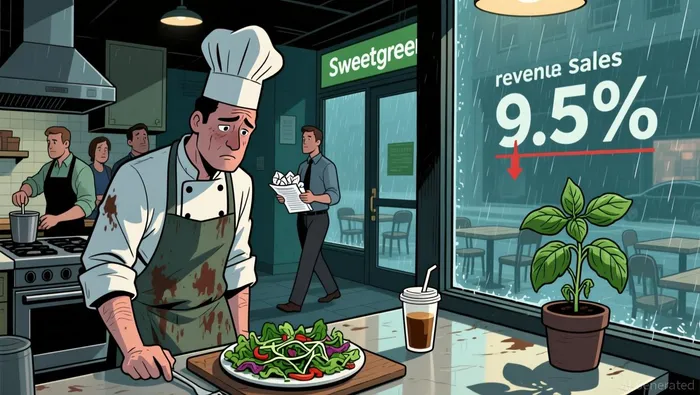 * Restaurant Performance and Operational Excellence: - Approximately
 60% of Sweetgreen's restaurants now meet or exceed internal operational standards, up from 33% previously. - This improvement is due to the appointment of a new COO, Jason Cochran, who has implemented operational excellence initiatives like Project One Best Way and introduced new restaurant scorecards. * Strategic Sale of Spyce: - The company announced the sale of Spyce, its business unit responsible for developing the Infinite Kitchen, to Wonder. - This strategic move is expected to infuse Sweetgreen's balance sheet with approximately $100 million in cash, strengthening its financial position and allowing it to focus resources on core restaurant growth.- Pricing Strategy and Menu Innovation:
- Sweetgreen is evaluating its menu and pricing architecture, with plans to create more entry price points and enhance value perceptions.
- The company aims to better communicate its value proposition through increased protein portions and quality ingredients, such as made from scratch and antibiotic-free proteins.
Sentiment Analysis:
Overall Tone: Neutral
- Management reported a same-store sales decline of 9.5% and adjusted EBITDA loss of $4.4M, but announced a strategic Spyce sale expected to infuse ~ $100M cash and $86M in stock and outlined a five-point 'Sweet Growth Transformation Plan' focused on ops, menu, loyalty and disciplined investment.
Q&A:
- Question from Brian Mullan (Piper Sandler): Can you give a sense of the scope of the menu and pricing architecture review and what you're hoping to accomplish?
Response: Reworking pricing ladders and entry price points to improve value perception; leveraging menu innovation and clearer price presentation; emphasizing increased protein portions (~25%) with a campaign; changes will go through the stage‑gate testing process.
- Question from Jon Tower (Citi): The guidance implies a step down in Q4 — what are you seeing in the current environment, and how are Northeast/LA and dayparts being affected?
Response: Sales weakened through August/September into low double‑digit negatives; 25–35 age cohort down ~15%; Northeast and L.A. (~60% of comp base) are ~800bps worse than the rest of the fleet; dinner showing the largest decline.
- Question from Jon Tower (Citi): Regarding the Infinite Kitchen agreement, will there be incremental costs like a royalty going forward?
Response: Spyce sale yields ~ $100M cash + $86M Wonder stock and ~$8M G&A savings; IK units will be provided at around cost plus 5% with maintenance/delivery/install costs similar to today, reducing Sweetgreen's capital burden while keeping access to the tech.
- Question from Andrew Charles (TD Cowen): On the 15–20 net openings for 2026, what closures are contemplated, and what were the key operational unlocks to bring the handheld to market test?
Response: Plan assumes ~2 identified closures to target net ~15; handheld is entering market tests after consumer and internal testing to validate operationalization, throughput impacts and to unlock new dayparts and customer acquisition.
- Question from Rahul Krotthapalli (JPMorgan): What are the net cash proceeds after tax from the Spyce sale and does the cost‑plus 5% affect future IK mix?
Response: Tax and final cash calculations are being finalized but not expected to be material; Spyce deal should lower unit cost via Wonder's scale and R&D, and cost-plus-5% plus scale benefits should reduce future IK per‑unit cost over time.
- Question from Sara Senatore (Bank of America): Is the slowdown concentrated in dinner vs lunch, and why sell Spyce now versus retaining tech in‑house?
Response: Dinner is where softness is appearing; lunch stable quarter‑over‑quarter. Spyce was sold to access scale, reduce G&A, unlock cash now and benefit from Wonder's manufacturing/R&D to reduce unit costs while retaining licensed access to the technology.
- Question from Logan Reich (RBC Capital Markets): Is there flexibility to increase next year's unit growth if same‑store sales recover?
Response: Yes — the pipeline allows flexibility to modestly increase 2026 openings if comps inflect, with plans to reaccelerate development in 2027 if operational and comp trends improve.
- Question from Kelly Anne Merrill (Morgan Stanley): Update on loyalty — was the Q3 uplift sustained?
Response: SG Rewards at six months is showing traction: ~20,000 activations/week with increased frequency among members; loyalty is early but expected to be a comp driver over the next six months as program refinements roll out.
- Question from Anisha Datt (Barclays): What's driving the significant cut to restaurant‑level margins — labor deleverage, commodities, or other?
Response: About half of the margin decline is sales deleverage; major contributors include a ~140bps impact from increased protein portions, tariffs ~50bps, plus higher labor deleverage and other operating cost pressure.
- Question from Edward Farley (Goldman Sachs): Does the pricing/menu architecture review include rewards redemption mechanics for SG Rewards?
Response: Yes — the review includes rewards redemption, tiers and personalized offers; Scan to Pay rollout has increased in‑store loyalty usage and helps throughput, and loyalty will be leveraged more via targeted, disciplined promos.
Contradiction Point 1
Menu and Pricing Architecture Review
It involves changes in strategic focus, specifically regarding menu and pricing architecture, which are key to product positioning and pricing strategy.
Can you elaborate on the scope and expected outcomes of Sweetgreen's menu and pricing review? - Brian Mullan (Piper Sandler)
20251107-2025 Q3: We're evaluating menu and pricing architecture with a focus on creating clearer entry price points and logical trade-up opportunities. Key areas include pricing ladders, new entry menus, and communication of value. - Jonathan Neman(CEO)
Can you clarify the 2Q trends? You noted margin compression due to higher restaurant-level advertising spend, but no corresponding transaction growth. Is the issue that portion investments and marketing efforts weren't effective? Why wasn’t there the expected sequential improvement? - Sara Senatore (Bank of America)
2025Q2: The protein increase was made in July, and since then, there has been sequential improvement due to both the protein portioning and loyalty frequency increases. - Jonathan Neman(CEO)
Contradiction Point 2
Sales and Consumer Demand Trends
It involves differing details about the current sales trends and consumer demand, which are crucial for understanding the company's performance and growth prospects.
What trends are impacting Sweetgreen's operations in the Northeast and due to the government shutdown? - Jon Tower (Citi)
20251107-2025 Q3: We've seen a step-down in sales since July, with August and September each showing about a 200 basis point decline. Impacts include softer sales in Northeast and L.A. markets, and reduced spending among 25- to 35-year-olds. - Jamie McConnell(CFO)
How is the current market environment affecting consumer demand, and are you observing shifts in spending patterns or dayparts? - Jon Tower (Citigroup Inc.)
2025Q3: We're seeing a step down in sales starting in August, with September exhibiting a further decline. The consumer is under pressure, especially the 25-35 age group, which accounts for 30% of our base. The Northeast and L.A. markets are under additional pressure. Dinner sales are experiencing a decrease, while lunch remains stable. - Jamie McConnell(CFO)
Contradiction Point 3
Labor Stability and Productivity
It highlights differing perspectives on labor stability and productivity, which are critical for operational efficiency and cost management.
What are the current trends impacting Sweetgreen, especially in the Northeast and during the government shutdown? - Jon Tower (Citi)
20251107-2025 Q3: We're happy with improvements in labor productivity, with no increase in turnover since COVID, and our workforce management is working well. Our headcount stability is at an all-time high. - Jamie McConnell(CFO)
Why were labor costs per store week down year-over-year, and can you explain the reasons and whether this trend is expected to continue this year and next, along with the key drivers? - Jon Tower (Citi)
2025Q2: We're focusing on people and culture, and our head coach stability is up to 57%. There's a focus on internal development and Project One Best Way to elevate operational excellence. - Jonathan Neman(CEO)
Contradiction Point 4
Menu Pricing Strategy
It involves a shift in strategy regarding the introduction of mid to lower-priced items on the menu, which can impact consumer spending and company financials.
Can you elaborate on the scope and expected outcomes of the Sweetgreen menu and pricing architecture review? - Brian Mullan (Piper Sandler)
20251107-2025 Q3: We're evaluating menu and pricing architecture with a focus on creating clearer entry price points and logical trade-up opportunities. - Jonathan Neman(CEO)
How will you address the need for more mid-to-low-priced menu items, and how will you communicate this to customers? - Sara Senatore (Bank of America)
2025Q1: We plan to introduce mid to lower priced items through seasonal menus, anchoring more of the menu in lower price tiers. - Jonathan Neman(CEO)
Contradiction Point 5
Loyalty Program Impact
It concerns the expected impact of the loyalty program on sales and customer behavior, which are crucial for revenue growth and customer retention.
Can you update the loyalty program's status and impact? - Kelly Anne Merrill (Morgan Stanley)
20251107-2025 Q3: We're pleased with loyalty, seeing increased frequency among members. - Jonathan Neman(CEO)
How did the Ripple Fries launch perform against expectations, and what impact did it have on sales? - Logan Reich (RBC Capital Markets)
2025Q1: We expect to return to revenue growth in the second half of this year with the launch of seasonal menus and the acceleration of our SG Rewards program. - Mitch Reback(CFO)

Discover what executives don't want to reveal in conference calls
Latest Articles
Stay ahead of the market.
Get curated U.S. market news, insights and key dates delivered to your inbox.
AInvest
PRO
AInvest
PRO



Comments
No comments yet