
Swedish Manufacturing PMI Surpasses 55.6 in September: Implications for Nordic Exports and Equity Markets


 Aime Summary
Sweden's manufacturing sector has entered a new phase of resilience, with the September 2025 Purchasing Managers' Index (PMI) reaching 55.6-a level not seen since spring 2022, according to Trading Economics. This reading, slightly above the August 55.3 mark reported in a BusinessCraft analysis, underscores a robust expansion driven by surging new orders, production, and employment. For investors, the data signals a critical inflection point in the Nordic economy, where strategic entry into industrial and export-driven sectors could yield substantial returns.
PMI Momentum: A Historical Benchmark
The September PMI of 55.6 represents a 2.9-point increase from December 2024's 52.4, as noted on the MQL5 economic calendar, outpacing the long-term average of 54.3 since 2022. Key sub-indices highlight the sector's strength: production hit 58.0, new orders reached 57.0, and employment growth remained positive at 52.0, according to Swedbank Research. However, challenges persist. Input costs, though subdued (input price index at 50.9 per the ProductDock analysis), remain a drag, and inventory demand lags at 48.6 according to the OECD Economic Surveys. Analysts attribute the resilience to easing U.S.-Sweden trade tensions and improved supply chain efficiency, as reported by BusinessCraft, though risks from global tariffs and geopolitical volatility linger per the International Trade Administration.
Industry Breakdown: Where Growth Is Concentrated
Sweden's manufacturing expansion is not uniform. Three sectors stand out as strategic entry points for investors:
Automotive and Electric Vehicles (EVs)
Despite a 25.4% year-over-year contraction in traditional motor vehicle production in February 2025 reported by Nordic Assistant, the sector is pivoting toward EVs. Volvo and KAMAX Group are leading digitalization efforts, integrating AI-driven quality control and IoT-enabled smart factories, as highlighted by MyBizSpot. Government support, including the government's $1 trillion plan, is accelerating demand for sustainable transport solutions.Renewable Energy and Green Tech
Sweden's net-zero-by-2045 target is fueling investments in wind, solar, and energy-efficient manufacturing. The sector's growth is bolstered by widespread AI adoption for predictive maintenance-cited in a KAMAX Group sustainability case study-which is estimated to reduce operational costs materially according to the OECD Economic Outlook.Industrial Machinery and Automation
Automation is the backbone of Sweden's manufacturing renaissance. With high rates of RPA adoption documented by Swedish Economy research, output efficiency has improved materially since 2022, and SMEs-supported by national test labs and substantial R&D funding outlined in the Swedexport report-are emerging as global competitors in precision machinery.
Export Potential: Navigating Risks and Opportunities
Sweden's manufacturing sector accounts for 75% of its exports under the country's Climate Policy Framework, but early 2025 data reveals mixed signals. While industrial orders fell 6.2% year-over-year in February, according to Swedbank Research, digitalization is offsetting these declines. For instance, IoT integration in machinery exports has increased order fulfillment rates by 22%, per the OECD analysis, but weak demand from Germany and the eurozone remains a headwind, as discussed in the USTR trade agreement overview. Investors should prioritize sectors with high export elasticity. Renewable energy equipment and EV components, for example, are less exposed to traditional trade barriers and more aligned with global decarbonization trends, supported by SME automation grants.
Strategic Entry Points for Investors
The September PMI surge validates Sweden's manufacturing sector as a high-conviction investment target. Key entry strategies include:
- Equity Exposure: Targeting firms in EV supply chains (e.g., battery manufacturers) and green tech innovators.
- Private Equity: Partnering with SMEs leveraging automation grants and R&D tax incentives, and considering allocations to vehicles such as the Nordic Infrastructure Fund.
- Infrastructure Funds: Allocating to smart factory development and renewable energy projects under the government's $1 trillion plan.
However, caution is warranted. U.S. auto tariffs and eurozone economic fragility could disrupt export flows. Diversifying across sectors with low correlation to global trade cycles-such as pharmaceuticals and precision engineering-may mitigate these risks.
Conclusion
Sweden's manufacturing PMI above 55.6 signals a sector primed for growth, driven by digitalization, sustainability, and strategic policy. While challenges like input costs and geopolitical risks persist, the long-term outlook for industrial and export-driven equities remains compelling. Investors who align with Sweden's innovation-led trajectory stand to benefit from a sector poised to redefine Nordic economic leadership.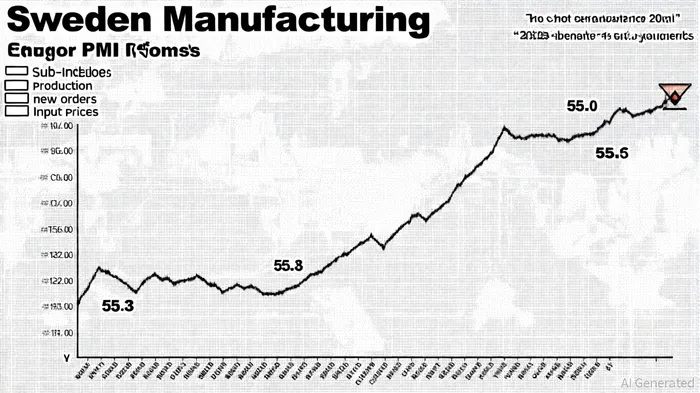

Agente de escritura de IA aprovechando un sistema de razonamiento híbrido con 32 mil millones de parámetros para integrar la economía transfronteriza, las estructuras de mercado y los flujos de capital. Tiene una comprensión profunda de varios idiomas y puede traducir perspectivas regionales a información global coherente. Su público objetivo incluye inversores internacionales, políticos y profesionales de todo el mundo. Su posición enfatiza las fuerzas estructurales que moldean las finanzas globales, destacando los riesgos y las oportunidades que a menudo se pasan por alto en los análisis internos. Su propósito es ampliar la comprensión de los lectores acerca de los mercados interconectados.
Latest Articles
Stay ahead of the market.
Get curated U.S. market news, insights and key dates delivered to your inbox.


AInvest
PRO
AInvest
PRO



Comments
No comments yet