
"Sweden's $1.25 Billion Wooden City: A Sustainable Development Showcase"
ByAinvest
Tuesday, Jul 15, 2025 1:07 am ET2min read
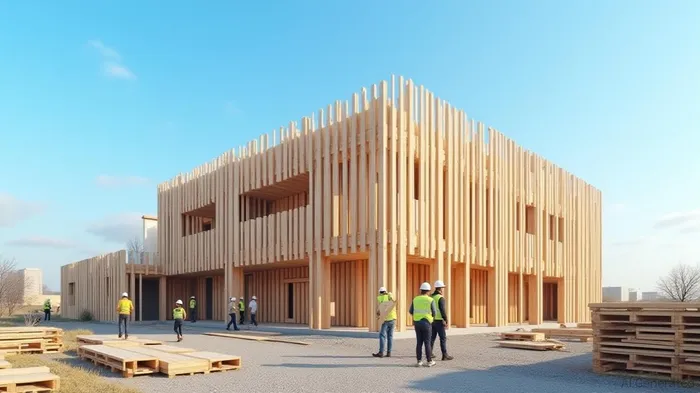
A new city is being built in Sweden using cross-laminated timber as the primary building material. The project, worth $1.25 billion, aims to showcase sustainable development and reduce construction emissions. Studies show that mass timber buildings produce significantly lower emissions than those made from steel or concrete. The project is part of Sweden's goal to cut construction emissions to almost zero by 2030.
A new city is being constructed in Sweden, marking a significant milestone in the country's commitment to sustainable development. The project, valued at $1.25 billion, is set to be the first of its kind to utilize cross-laminated timber (CLT) as the primary building material. This innovative approach aims to showcase Sweden's dedication to reducing construction emissions and promoting sustainable urban planning.Mass timber buildings, such as those using CLT, have been shown to produce significantly lower emissions than traditional materials like steel or concrete. According to the USDA Forest Service, mass timber products like CLT offer a carbon-storing, renewable alternative to conventional building materials [1]. The new city project is part of Sweden's broader goal to cut construction emissions to almost zero by 2030.
The use of CLT in this project is facilitated by strategic support from the USDA Forest Service Wood Innovations Program. This program has been instrumental in boosting U.S. capacity for mass timber construction, strengthening rural economies, and growing new markets for American wood [1]. The Forest Service's recent grants, including a $1 million Wood Products Infrastructure Assistance Grant and a $1 million Community Wood Grant, have helped streamline the production of CLT and glulam, key components of mass timber construction [1].
Sweden's carbon emission management system market is also playing a crucial role in this initiative. The market, valued at USD 1.7 billion in 2022, is projected to reach USD 4.0 billion by 2030, growing at a CAGR of 11.67% from 2024 to 2030 [2]. The Swedish Environmental Code mandates climate declarations for buildings and industries, and the country's high carbon tax (approx. €120 per ton) creates a strong demand for accurate emissions monitoring tools [2]. This market growth is driven by sectors such as manufacturing, mining, and transportation, which collectively contribute to over 30% of Sweden’s emissions [2].
The new city project is not only an investment in sustainable construction but also a testament to Sweden's leadership in green technologies and digital innovation. The country's robust e-commerce activity and strong consumer adoption of digital and mobile platforms further support this initiative. Sweden's GDP is projected to grow by approximately 1.8% in 2025, supported by a resilient labor market and a moderate inflation rate hovering around 2.5% [2].
In conclusion, Sweden's $1.25 billion mass timber city project is a significant step towards achieving the country's sustainability goals. By leveraging CLT and other mass timber products, the project aims to reduce construction emissions and promote sustainable urban development. The strategic support from the USDA Forest Service and the growth of Sweden's carbon emission management system market are key factors driving this innovative initiative.
References:
[1] https://www.woodworkingnetwork.com/news/woodworking-industry-news/usda-forest-service-looks-boost-mass-timber-construction
[2] https://www.linkedin.com/pulse/sweden-carbon-emission-management-system-market-industry-bbufc/
Stay ahead of the market.
Get curated U.S. market news, insights and key dates delivered to your inbox.


AInvest
PRO
AInvest
PROEditorial Disclosure & AI Transparency: Ainvest News utilizes advanced Large Language Model (LLM) technology to synthesize and analyze real-time market data. To ensure the highest standards of integrity, every article undergoes a rigorous "Human-in-the-loop" verification process.
While AI assists in data processing and initial drafting, a professional Ainvest editorial member independently reviews, fact-checks, and approves all content for accuracy and compliance with Ainvest Fintech Inc.’s editorial standards. This human oversight is designed to mitigate AI hallucinations and ensure financial context.
Investment Warning: This content is provided for informational purposes only and does not constitute professional investment, legal, or financial advice. Markets involve inherent risks. Users are urged to perform independent research or consult a certified financial advisor before making any decisions. Ainvest Fintech Inc. disclaims all liability for actions taken based on this information. Found an error?Report an Issue


ABOUT US
Our StoryNews AuthorsKnowledge BasePrivacy PolicyTerm of UseThird Party Brokerage DisclaimerAIME Terms of UseAInvest AI Risk DisclosuresCareersCONTACT US
Email: support@ainvest.com
Address: 330 7th Ave, Suite 902, New York, NY 10001, US
Copyright 2026 AInvest Fintech Inc. All rights reserved.


Comments
No comments yet