
The Sustained Rise of U.S. Stocks: Is the Nasdaq's Momentum Sustainable?
 Aime Summary
The Nasdaq Composite's meteoric rise in 2025 has captivated investors, with the index surging 17.93% year-to-date as of September and closing at 22781 on October 3, 2025, according to the Benchmark Review. However, as the market enters Q4, the critical question looms: Is this momentum sustainable? To answer this, we must dissect the interplay of sector rotation dynamics, institutional investment flows, and liquidity trends shaping the Nasdaq's trajectory.
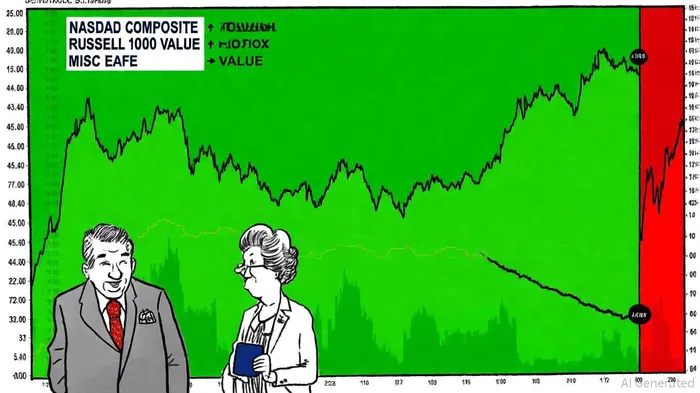
Sector Rotation: From Magnificent 7 to Global Diversification
The Nasdaq's dominance by large-cap tech stocks-led by the "Magnificent 7"-has given way to a more diversified landscape in 2025. While technology and communication services remain the strongest performers, cyclical sectors like industrials, energy, and financials have surged, outpacing the growth-centric names that defined earlier years, according to a Nasdaq review. This shift is not merely speculative but rooted in macroeconomic recalibration.
The Federal Reserve's rate-cut cycle, initiated in response to a weaker-than-expected job market, has incentivized capital to flow toward sectors offering immediate cash flows. For instance, the Russell 1000 Value index rose 1.9% in early 2025, while the MSCIMSCI-- EAFE index-representing international equities-jumped 11%, according to an EBC analysis. This rotation reflects a broader search for yield in a low-interest-rate environment, with investors rebalancing portfolios to capitalize on undervalued cyclicals and global opportunities.
However, the Nasdaq's structural reliance on AI-driven tech firms remains a double-edged sword. NVIDIA, Meta, and Amazon have fueled the index's gains, with AI and cloud computing demand accounting for over 40% of the S&P 500's market cap, per a Morningstar review. While this concentration underscores innovation-led growth, it also introduces valuation risks. The equity risk premium for U.S. equities is at a 20-year low, and surging capital expenditures in AI infrastructure are straining free cash flows for megacap firms, as noted in a Future Standard report.
Market Structure: ETF Flows and Institutional Behavior
The Nasdaq's momentum is further amplified by robust institutional investment flows and ETF activity. Global ETF/ETP inflows reached $377 billion in Q3 2025, the strongest quarter of the year, with tech and large-cap equities dominating, according to an iShares flow report. That report also noted active fixed-income ETFs captured 44% of flows, signaling a shift toward active management amid yield-starved environments.
Institutional investors have also pivoted toward AI-related sectors, with first-order adopters like semiconductors and data center power generation outperforming. Second-order beneficiaries, such as retail and agriculture, are beginning to show potential as AI adoption broadens, as highlighted in a Natixis report. Meanwhile, Natixis found unicorns-privately held companies valued at $1 billion or higher-have outpaced public market returns, with U.S. unicorns beating the S&P 500 by 18% year-to-date. This suggests a growing appetite for high-growth, innovation-driven assets, even as public markets face valuation scrutiny.
Liquidity and Fed Policy: A Delicate Balance
Liquidity trends in 2025 have been a mixed bag for the Nasdaq. While the Fed's rate cuts and accommodative policy have bolstered equity valuations, episodes of volatility-such as the April 2025 tariff announcement-have exposed fragilities in Treasury market liquidity, according to a New York Fed speech. Bid-ask spreads widened, and market depth deteriorated, particularly in longer-term securities. That speech also noted the Treasury repo market's resilience, supported by tools like the Standing Repo Facility (SRF), has mitigated systemic risks.
Looking ahead, the Fed's ability to manage rate expectations will be pivotal. Analysts project the Nasdaq Composite to close at 23916 in October 2025, a 5.1% increase from prior months, according to a LongForecast projection. Yet, this optimism hinges on the Fed avoiding over-tightening and maintaining a balance between curbing inflation and supporting growth.
Risks to Sustainability
Despite the Nasdaq's resilience, several risks threaten its momentum:
1. Valuation Stretches: The S&P 500's earnings concentration in tech and media firms leaves the index vulnerable to profit shortfalls or AI adoption lags, as Morningstar warns.
2. Concentration Risks: Overreliance on a handful of sectors and companies could amplify downside volatility if AI-driven growth falters.
3. Global Uncertainties: Trade policy shifts and economic slowdowns in key markets could dampen cross-border flows, which have been a tailwind for Nasdaq liquidity, according to an Investing.com recap.
Conclusion: A Tenuous Equilibrium
The Nasdaq's momentum in 2025 is underpinned by a confluence of factors: sector rotation toward value and cyclicals, robust ETF inflows, and Fed-driven liquidity. However, sustainability will depend on navigating valuation risks, diversifying growth drivers, and maintaining policy stability. For investors, a balanced approach-combining exposure to innovation-led sectors with defensive holdings-may be the key to capitalizing on this bull market while mitigating downside risks.
As the year closes, the Nasdaq stands at a crossroads. Its ability to adapt to evolving macroeconomic and structural dynamics will determine whether its rise remains a sustained phenomenon or a fleeting surge.

Crypto market researcher and content strategist with 3 years of experience in digital asset analysis and market commentary. Skilled at transforming complex blockchain data and trading signals into clear, actionable insights for investors. Experienced in covering Bitcoin, Ethereum, and emerging ecosystems including DeFi, Layer2, and AI-related projects. Passionate about bridging professional market research with accessible storytelling to empower readers and investors in the fast-evolving crypto landscape.
Latest Articles
Stay ahead of the market.
Get curated U.S. market news, insights and key dates delivered to your inbox.
AInvest
PRO
AInvest
PRO



Comments
No comments yet