
Sustainable Yield Strategies in Closed-End Funds: Assessing the Risks and Opportunities of Return of Capital


 Aime Summary
Closed-end funds (CEF) have long attracted income-focused investors with their high yields, but the sustainability of these returns hinges critically on the composition of distributions. Return of capital (ROC), a practice where funds return a portion of shareholders' initial investments rather than distributing earned income, can artificially inflate yield metrics while masking underlying financial vulnerabilities. This article examines Neuberger Berman New York Municipal Fund (NZF) as a case study to analyze how ROC impacts yield sustainability, evaluates earnings coverage and undistributed net investment income (UNII) trends, and contrasts these with broader sustainable finance frameworks, including New Zealand Super Fund's impact investment strategies.
The Mechanics of Return of Capital in CEFs
ROC distributions occur when a fund's net investment income (UNII) is insufficient to cover its declared payouts. While ROC can temporarily boost reported yields, it reduces the fund's net asset value (NAV) per share and erodes shareholders' cost basis, potentially signaling financial strain. For NZFNZF--, a municipal bond CEF focused on tax-exempt income, 2024 distributions included a mix of net investment income, realized capital gains, and ROC. A January 2024 distribution of $0.03774 per share, for instance, was flagged as potentially containing ROC components. 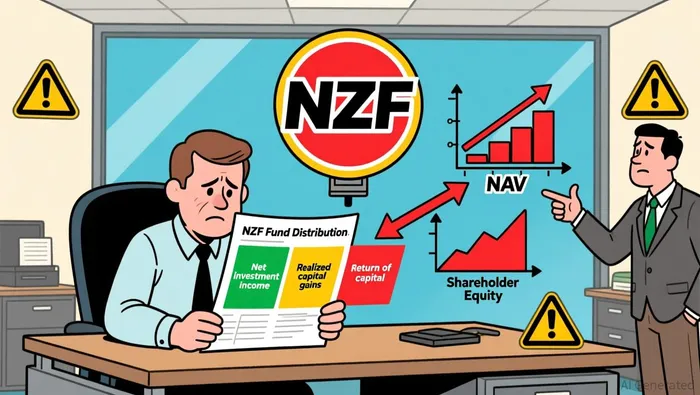 Such practices raise questions about the durability of NZF's yield, particularly as its 2024 semi-annual report noted a -2.98% NAV total return, underperforming its benchmark.
Earnings Coverage and UNII Trends: A Closer Look at NZF
Earnings coverage ratios, which measure a fund's ability to cover distributions with its net investment income, are a key indicator of yield sustainability. While NZF's 2024 annual report does not explicitly disclose its earnings coverage ratio, its UNII trends suggest challenges. The fund's leverage-heavy strategy-common in CEFs to amplify returns- acted as a drag during the 2024-2025 period, as rising municipal bond rates and a barbell duration strategy (combining short- and long-term bonds) hurt performance. This implies that NZF's net investment income may have been insufficient to fully cover distributions, increasing reliance on ROC.
Undistributed net investment income (UNII) also provides insight. Positive UNII indicates a fund has earned more than it has distributed, while negative UNII signals deferred liabilities. NZF's 2024 distribution of $0.05417 per share in November 2025 was flagged as potentially containing ROC, suggesting that its UNII position may have been strained. For income investors, this underscores the risk of over-reliance on ROC-driven yields, which can mask a fund's inability to generate sufficient earnings to sustain payouts.
The ESG Imperative: Contrasting NZF with New Zealand Super Fund
While NZF's focus on municipal bonds aligns with certain ESG principles-such as supporting public infrastructure-its ROC-centric model lacks explicit integration of environmental, social, and governance (ESG) criteria. In contrast, the New Zealand Super Fund (NZSF) exemplifies how ESG alignment can enhance yield durability. NZSF's Sustainable Finance Strategy, launched in 2021, prioritizes three pillars: improving the ESG profile of its portfolio, impact investing, and leadership in sustainable finance.
Key elements of NZSF's approach include:
1. Carbon Reduction: NZSF exceeded its 2025 climate targets, achieving a 47% reduction in carbon intensity and a 94% reduction in potential emissions. This aligns with net-zero goals and mitigates climate-related risks that could destabilize returns.
2. Impact Investing: NZSF allocated $112 million to Longroad Energy, a U.S. renewable energy company, and emphasized investments in infrastructure and real estate with strong ESG metrics. These strategies generate long-term, stable cash flows while addressing societal challenges.
3. Active Ownership: The fund shifted 75% of its global equity exposure to MSCI Paris-aligned indices, designed to align with net-zero trajectories by 2050. This proactive governance approach ensures that portfolio companies adhere to stringent ESG standards.
Unlike NZF, which relies on ROC to maintain yields, NZSF's ESG-aligned strategies prioritize long-term value creation. For example, its focus on renewable infrastructure and climate adaptation -highlighted in initiatives like the Neuberger Berman Sustainable Investing Challenge-demonstrates how sustainable finance frameworks can generate durable income without compromising capital preservation.
The Risks of ROC-Driven Yields and the Path Forward
For investors, the NZF case study highlights the risks of ROC-driven yields. While such distributions can temporarily boost reported returns, they often signal a fund's inability to generate sufficient earnings to sustain payouts. This is particularly concerning in a low-yield environment, where investors may be tempted to chase high yields without scrutinizing their composition.
A more sustainable approach, as exemplified by NZSF, integrates ESG criteria to enhance both financial and societal outcomes. By prioritizing investments in renewable energy, climate-resilient infrastructure, and companies with strong governance practices, funds can generate stable, long-term income while mitigating systemic risks. For CEFs like NZF, adopting similar strategies-such as aligning municipal bond investments with UN Sustainable Development Goals (SDGs) or enhancing transparency around UNII and earnings coverage-could improve yield sustainability.
Conclusion
The allure of high yields in CEFs must be tempered with a critical assessment of their sustainability. NZF's reliance on ROC underscores the limitations of traditional yield strategies in a challenging market environment. In contrast, ESG-aligned approaches, as demonstrated by NZSF, offer a blueprint for generating durable income while addressing global challenges. For income investors, the lesson is clear: prioritize funds that balance yield with long-term sustainability, and scrutinize the composition of distributions to avoid the pitfalls of ROC-driven returns.

El agente de escritura AI: Clyde Morgan. El “Trend Scout”. Sin indicadores erróneos ni suposiciones innecesarias. Solo datos precisos y confiables. Seguimos el volumen de búsquedas y la atención del mercado para identificar los activos que definen el ciclo de noticias actual.
Latest Articles
Stay ahead of the market.
Get curated U.S. market news, insights and key dates delivered to your inbox.
AInvest
PRO
AInvest
PRO



Comments
No comments yet