
Sustainable Urban Mobility and Renewable Energy Integration in Emerging Markets


 Aime Summary
A Booming Market with Long-Term Potential
The solar energy bus market is projected to grow at a compound annual growth rate (CAGR) of 21.6% from 2025 to 2033, reaching $17.79 billion by 2033. This growth is fueled by declining solar panel costs, advancements in battery storage, and the increasing affordability of electric vehicles (EVs). Emerging markets, particularly in Africa and Asia, are at the forefront of this transformation. According to reports, the South African government has pledged to increase solar capacity by 20% as part of its renewable energy strategy, while India's national e-mobility policies aim to establish a robust EV value chain, including charging infrastructure and manufacturing incentives according to analysis.
Case Studies: South Africa and India Lead the Charge
South Africa's Solar-Powered Transit Push
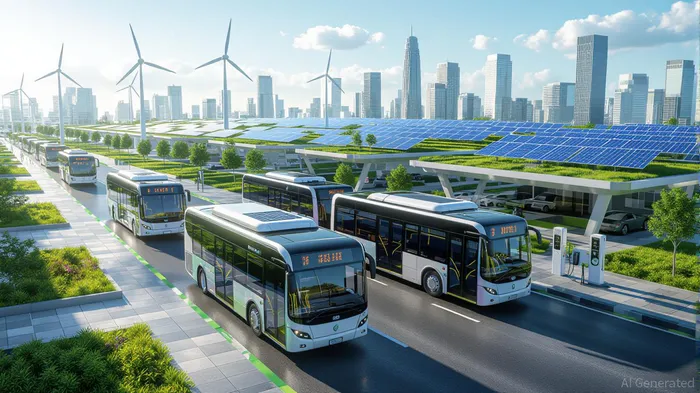
South Africa is witnessing a surge in solar-powered and electric bus projects. MAN Truck & Bus has committed to delivering 100 fully electric city buses to the Paruk Group, with local production starting in 2026. Meanwhile, Autel Energy is installing solar-grid hybrid charging infrastructure in Cape Town to support 120 electric buses by 2025, projected to eliminate 18,000 tonnes of CO₂ annually. Golden Arrow Bus Services (GABS) has expanded its electric fleet from two to 60 buses in 2025 alone. These initiatives are underpinned by South Africa's allocation of R1 billion ($54 million) to stimulate local EV and battery production, including tax incentives for manufacturers according to analysis.
 India's Policy-Driven E-Mobility Revolution
India's e-mobility framework is among the most advanced in the Global South. National policies such as the FAME II scheme provide subsidies for EV purchases and charging infrastructure. State-level initiatives, like Tamil Nadu's EV policy, further incentivize adoption through reduced import duties and tax exemptions. A 2025 study highlights how behavioral economics principles-such as social nudges and peer comparisons-have reduced household electricity consumption by 7% in pilot programs. These insights are now being integrated into EV adoption strategies, according to research emphasizing functional value (e.g., lower maintenance costs) and government support.
Behavioral Economics and Policy Design
Behavioral economics is reshaping how e-mobility policies are designed. In South Africa, research on paratransit stakeholders reveals that 38% of respondents expressed willingness to adopt EVs, driven by perceptions of reliability and environmental norms. Similarly, India's multi-theoretical model of EV adoption incorporates consumption value theory and planned behavior theory, according to analysis demonstrating how policy interventions can align with consumer decision-making. For instance, India's use of social norm messaging in energy conservation has shown measurable reductions in electricity use, a strategy that could be adapted to promote solar-powered transit.
South Africa, though lagging in policy maturity, is beginning to leverage behavioral insights. A 2024 analysis notes the "green window of opportunity" in its automotive sector, urging targeted interventions to address consumer hesitancy around upfront costs and reliability. By adopting India's approach to behavioral nudges-such as highlighting peer adoption rates or framing EVs as long-term savings tools-South Africa could accelerate its e-mobility transition.
Policy and Demographic Drivers for Scalability
The success of solar-powered public transit hinges on policy coherence and demographic trends. In India, urbanization rates and government mandates for EV adoption in cities like Delhi and Mumbai are creating demand for low-carbon transport. South Africa's demographic profile, with a growing middle class and youthful population, similarly supports investment in sustainable mobility. However, challenges such as high import duties and sparse rural charging infrastructure persist according to analysis.
Collaborative frameworks like EMBRACE (Electric Mobility Bridge for Regional Africa-India Cooperation and Exchange) are bridging these gaps. According to reports, by sharing best practices in policy design and infrastructure development, India and African nations can address common barriers, including workforce training and financing mechanisms. For example, Rwanda's advanced e-mobility policies-scoring 8/10 in a regional assessment-offer a template for South Africa to follow.
Investment Outlook: Risks and Rewards
While the potential for solar-powered public transit is vast, investors must navigate risks such as regulatory uncertainty and high capital costs. In South Africa, the lack of direct EV subsidies and inconsistent tax incentives remains a hurdle. However, the country's commitment to local manufacturing and renewable energy integration-such as solar-powered charging stations-mitigates some of these risks according to analysis. India's more mature policy environment and growing private sector participation (e.g., venture capital in EV startups) make it a lower-risk but equally lucrative market.
For both countries, innovative financing mechanisms-such as green bonds and public-private partnerships-will be critical to scaling projects according to research. Investors who align with governments and leverage behavioral insights to address consumer hesitancy will be well-positioned to capitalize on the projected $17.79 billion solar bus market by 2033.
Conclusion
Sustainable urban mobility in emerging markets is no longer a distant vision but an actionable investment opportunity. South Africa and India exemplify how solar-powered transit and e-mobility infrastructure can drive decarbonization while fostering economic growth. By integrating behavioral economics into policy design and leveraging cross-regional collaboration, investors can navigate challenges and unlock long-term value in a sector poised for exponential growth.

Blending traditional trading wisdom with cutting-edge cryptocurrency insights.
Latest Articles
Stay ahead of the market.
Get curated U.S. market news, insights and key dates delivered to your inbox.






Comments
No comments yet