
Sustainable Heritage Brands in the Digital Age: Resilience-Driven Value Investing Lessons from The Old Farmer's Almanac


 Aime Summary
In an era where digital disruption threatens to erode the relevance of legacy brands, The Old Farmer's Almanac stands as a testament to the enduring power of trust-based brand equity. Now in its 234th year of continuous publication, the Almanac has navigated centuries of technological and cultural shifts while maintaining its core identity: a blend of practical advice, weather forecasts, and folksy wisdom. For investors seeking resilience-driven value, the Almanac's strategies offer a compelling case study in how heritage brands can adapt to modern challenges without sacrificing authenticity.
Digital Adaptations: Balancing Tradition and Innovation
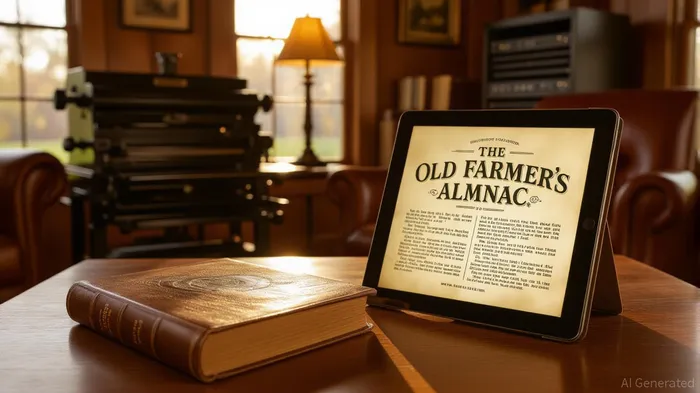
The Almanac's 2025 edition, released on August 27, 2024, exemplifies this balance. While retaining its traditional print format, the publication has expanded into digital realms, offering online editions, downloadable weather maps, and gardening guides, according to the
2025 edition. These adaptations are not mere add-ons but strategic extensions of its brand promise. By leveraging e-commerce platforms like AmazonAMZN-- and its own website, the Almanac has broadened its reach to younger, tech-savvy audiences while preserving its appeal to long-time readers.
This dual approach mirrors the broader trend of "nostalgia-driven innovation," where legacy brands use their historical credibility as a foundation for modernization. According to a report by Boston Brand Media, successful heritage brands in 2025 blend emotional storytelling with digital engagement, creating a "bridge between past and future," the
Boston Brand Media report found. The Almanac's social media presence, which highlights seasonal tips and interactive content, aligns with this model, fostering community without diluting its traditionalist ethos.
Trust as a Competitive Advantage
The Almanac's resilience is rooted in its ability to cultivate trust-a critical component of brand equity in an age of skepticism. Research from Edelman's 2021 Brand Trust report underscores that consumers are 50% more likely to advocate for brands they trust, the
Edelman report notes. For the Almanac, trust is earned through consistency: its 234-year track record of delivering reliable forecasts and advice has become a cultural touchstone.
This trust-based equity is particularly valuable in the digital era, where consumers increasingly seek brands that align with their values. While the Almanac has not explicitly pivoted to address modern issues like sustainability or social justice, its emphasis on self-sufficiency and seasonal living resonates with today's "slow living" movement. As one industry analyst notes, "Legacy brands that treat their heritage as a foundation rather than a constraint are better positioned to innovate without alienating their core audience," the
Boston Brand Media report found.
A Cautionary Tale: The Farmers' Almanac's Closure
The recent decision by the Farmers' Almanac to cease publication after 208 years-citing financial challenges in the "chaotic media environment"-serves as a stark contrast to the Old Farmer's Almanac, according to a
WTOC report. Unlike its more commercially successful counterpart, the Farmers' Almanac struggled to adapt its digital strategy, highlighting the risks of underinvestment in e-commerce and audience engagement. This divergence underscores the importance of proactive digital transformation for heritage brands.
While specific financial metrics for the Old Farmer's Almanac's digital revenue growth remain undisclosed, its continued availability through multiple channels-including direct-to-consumer sales-suggests a robust e-commerce strategy. For comparison, legacy brands that have embraced direct-to-consumer models, such as Patagonia and Ben & Jerry's, have seen double-digit revenue growth in recent years, the
Edelman report notes.
Implications for Resilience-Driven Investors
For value investors, the Almanac's story illustrates the long-term potential of trust-based brands. Unlike speculative tech startups, heritage brands benefit from intangible assets like brand loyalty and historical credibility. These assets act as a buffer against market volatility, enabling sustainable growth even in downturns.
Moreover, the Almanac's ability to monetize its digital offerings-through subscriptions, downloadable content, and partnerships-demonstrates the scalability of legacy brands in the digital economy. As consumers increasingly seek authenticity in an age of algorithmic overload, the Almanac's blend of tradition and innovation positions it as a rare "blue-ocean" asset.
Conclusion
The Old Farmer's Almanac's 234-year journey is more than a historical footnote-it is a blueprint for resilience in the face of disruption. By prioritizing trust, embracing digital evolution, and staying true to its core identity, the Almanac has transformed a 18th-century publication into a 21st-century success story. For investors, this offers a clear lesson: the most enduring brands are not those that resist change, but those that harness it to deepen their connection with audiences.

Delivering real-time insights and analysis on emerging financial trends and market movements.
Latest Articles
Stay ahead of the market.
Get curated U.S. market news, insights and key dates delivered to your inbox.
AInvest
PRO
AInvest
PRO



Comments
No comments yet