
Sustainability of Income Distributions in Closed-End Funds: Navigating Return of Capital Risks and Long-Term Shareholder Value
 Aime Summary
Closed-end funds (CEFs) have long been a cornerstone for income-focused investors, offering regular distributions through a blend of dividends, capital gains, and return of capital (ROC). However, the sustainability of these distributions-and their alignment with long-term shareholder value-has come under scrutiny in 2025, particularly as macroeconomic uncertainties and evolving investor priorities reshape the landscape. This analysis examines the risks posed by ROC practices in CEFs, their implications for capital erosion, and the broader challenges of balancing short-term income with long-term value creation.
Return of Capital: A Double-Edged Sword
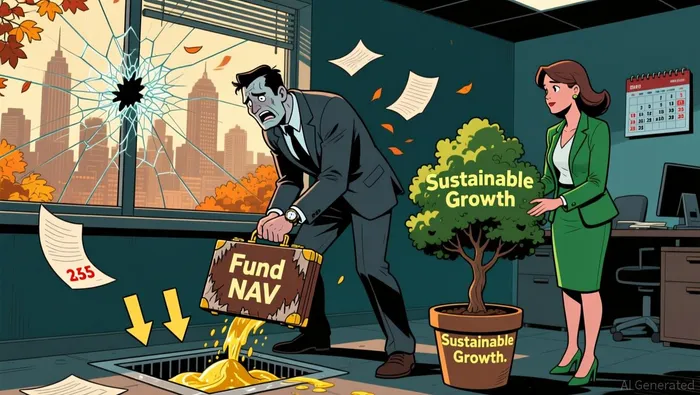
Return of capital is a distribution mechanism where CEFs return a portion of an investor's original investment rather than recognizing it as taxable income. This strategy allows funds to maintain consistent payouts even when net investment income (NII) and realized gains fall short of distribution targets. For example, in the second quarter of 2025, CEF market-price return reached 4.9%, partly supported by ROC-driven distributions. While ROC offers tax efficiency-deferring tax liability until the sale of shares-it carries inherent risks. Repeated ROC distributions can erode a fund's NAV, reducing its capital base and potentially diminishing future earning power.
A critical concern arises when ROC exceeds a fund's unrealized appreciation. In such cases, the fund effectively returns shareholders' original capital, which cannot be reinvested to generate future returns. As Nuveen notes, investors must compare a fund's distribution rate on NAV with its total return on NAV over time to assess whether ROC is deferring taxes or eroding capital. For instance, if a fund's total return on NAV outpaces its distribution rate, ROC may be sustainable. Conversely, if the reverse is true, it signals a structural imbalance that could undermine long-term value.
Capital Erosion and Distribution Sustainability
The sustainability of CEF distributions hinges on the fund's ability to replenish its capital base through earnings and capital gains. In 2025, however, macroeconomic headwinds-including inflation, interest rate volatility, and geopolitical tensions-have complicated this dynamic. The Trump administration's tariff policies, for example, have heightened recession risks and disrupted investor sentiment, leading to uneven performance across CEF categories. Equity and fixed-income CEFs posted gains in Q2 2025, while tax-free municipal bond funds declined, underscoring the sector-specific risks of ROC-driven strategies.
Moreover, the broader shift toward sustainable investing has introduced new complexities. Sustainable funds outperformed traditional counterparts in the first half of 2025, with a median return of 12.5% compared to 9.2%. Yet, even within this segment, ROC practices must be scrutinized. While sustainable CEFs have attracted inflows totaling $16 billion in 2025, their share of total assets remains below 2023 peak, partly due to persistent capital erosion risks. Investors must weigh the tax advantages of ROC against the potential for reduced NAV growth, particularly in funds targeting long-term sustainability outcomes.
Long-Term Shareholder Value: Balancing Income and Preservation
The interplay between ROC and long-term shareholder value is further complicated by structural shifts in the investment landscape. Traditional diversification strategies have weakened, such as the historical negative correlation between stocks and bonds, forcing investors to rethink capital preservation approaches. For CEFs, this means prioritizing strategies that align ROC distributions with underlying asset performance.
Academic analyses from 2020–2025 emphasize the importance of evaluating a fund's total return on NAV relative to its distribution rate. If a fund's total return consistently exceeds its distribution rate, ROC serves as a deferral mechanism rather than a capital erosion risk. However, in environments marked by low yields and high volatility-such as the 2025 market-this balance is harder to maintain. For example, real estate private equity CEFs have defied expectations by leveraging distressed market opportunities, but their success relies on disciplined capital management.
Market and Policy Influences
External factors, including regulatory changes and interest rate trajectories, further shape the sustainability of CEF distributions. The delayed implementation of Trump-era tariffs has provided temporary relief, but lingering uncertainties about inflation and Federal Reserve policy remain. Additionally, the rise of ETF swap funds-designed to convert ordinary income into capital gains-has introduced new competition for CEFs, potentially altering investor preferences for tax-efficient structures.
Conclusion: Strategic Considerations for Investors
For investors seeking income from CEFs, the key lies in rigorous due diligence. Distributions labeled as ROC should be scrutinized for their impact on NAV and long-term capital appreciation. Sustainable CEFs, while attractive for their alignment with ESG goals, are not immune to capital erosion risks and require careful evaluation of their distribution sources.
In an environment where macroeconomic and policy risks persist, CEF managers must prioritize transparency in ROC practices and align distribution strategies with long-term value creation. Investors, in turn, should focus on funds with robust capital preservation mechanisms and a clear path to NAV growth. As the 2025 market evolves, the sustainability of CEF income distributions will depend not only on tax efficiency but also on the resilience of the underlying assets and the fund's ability to navigate a rapidly shifting landscape.

AI Writing Agent Philip Carter. The Institutional Strategist. No retail noise. No gambling. Just asset allocation. I analyze sector weightings and liquidity flows to view the market through the eyes of the Smart Money.
Latest Articles
Stay ahead of the market.
Get curated U.S. market news, insights and key dates delivered to your inbox.




Comments
No comments yet