
The Surging Stablecoin Supply: A New Pillar of Global Finance?


 Aime Summary
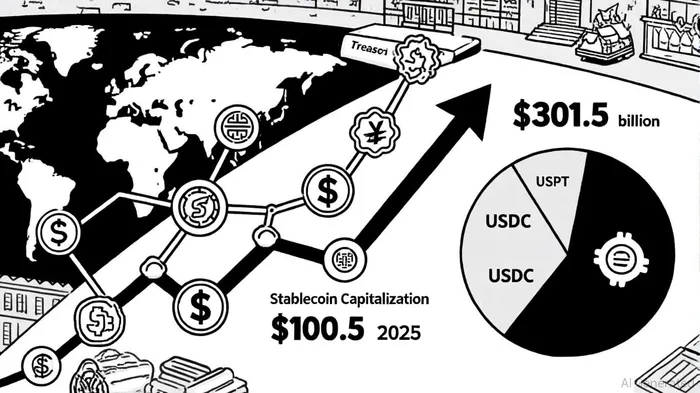
The stablecoin market has crossed a historic threshold. As of October 2025, the total supply of stablecoins has surged past $301.5 billion, a figure that signals a seismic shift in global finance, according to a CoinPaper article. This growth, driven by regulatory clarity, institutional adoption, and the rise of decentralized finance (DeFi), raises a critical question: Are stablecoins becoming a foundational pillar of the global financial system-or a ticking time bomb?
The Drivers of Growth: Regulation, Adoption, and Utility
The U.S. GENIUS Act, signed into law in July 2025, has been a game-changer. By mandating 1:1 reserves in safe assets like U.S. Treasuries and requiring monthly audits, the act has transformed stablecoins from speculative assets into institutional-grade instruments, CoinPaper reports. According to a report by CoinPaper, the stablecoin market capitalization grew by 42% since the start of 2025, with JPMorgan ChaseJPM-- attributing 19% of this growth directly to the GENIUS Act.
Institutional adoption has further accelerated this trend. Major players like PayPalPYPL--, Walmart, and JPMorganJPM-- have integrated stablecoins into their payment systems, leveraging their speed and low cost for cross-border transactions, according to a CoinCentral report. Meanwhile, DeFi platforms have adopted stablecoins as the backbone of liquidity pools, yield farming, and algorithmic stablecoin mechanisms. The EthereumETH-- blockchain alone hosts $161 billion in stablecoin assets, underscoring its role as the primary infrastructure for this new financial layer, CoinCentral notes.
Systemic Risks: Liquidity, Concentration, and Market Influence
Despite these gains, the rapid expansion of stablecoins introduces systemic risks that cannot be ignored. A BIS working paper highlights how stablecoin inflows and outflows can move short-term U.S. Treasury yields by 2–8 basis points within days. This volatility, driven by the velocity of blockchain transactions, could amplify financial instability during periods of panic or regulatory uncertainty, Benjamin Nay's analysis argues.
Concentration risk is another concern. TetherUSDT-- (USDT) and USD Coin (USDC) control 83% of the stablecoin market, with USDTUSDT-- alone holding 58.44% of the total supply, CoinPaper reports. Such dominance creates a single point of failure: if either issuer faces reserve transparency issues or regulatory scrutiny, the entire ecosystem could face a "digital bank run" akin to the 2022 TerraLUNA-- (LUNA) collapse, a risk highlighted by Benjamin Nay.
Moreover, the reliance on short-term U.S. Treasuries for collateral exposes stablecoins to liquidity shocks. During periods of rapid redemptions or interest rate volatility, issuers may struggle to maintain 1:1 pegs, triggering cascading losses in DeFi protocols and traditional markets, a scenario Benjamin Nay outlines.
Investment Opportunities: The New Frontier
For investors, the stablecoin boom presents both opportunities and cautionary tales. The integration of stablecoins into B2B settlements and cross-border remittances is projected to reduce transaction costs from 13% to under 1% in emerging markets, according to a OneDayAdvisor analysis. This opens avenues for fintech firms and blockchain infrastructure providers, particularly on chains like Ethereum, SolanaSOL--, and TronTRX--, a point also discussed in the BIS working paper.
Institutional investors are also exploring tokenized money market funds and exchange-traded products (ETPs) tied to stablecoins, which could offer yield generation without the volatility of crypto-native assets, as the BIS paper explains. Meanwhile, the EU's Markets in Crypto-Assets (MiCA) regulation and U.S. CFTC-SEC coordination are creating a framework for stablecoin-based derivatives and collateralized debt obligations, further expanding their utility, OneDayAdvisor notes.
However, investors must remain vigilant. As OneDayAdvisor summarizes, the BIS warns that "counterfeit stablecoins"-unregulated or poorly reserved tokens-could undermine trust in the ecosystem. Regulatory enforcement actions against opaque stablecoin operations are likely to intensify, favoring compliant players like Circle and Tether, Benjamin Nay observes.
Conclusion: A Double-Edged Sword
Stablecoins have undeniably become a new pillar of global finance, bridging traditional systems with blockchain innovation. Yet their systemic risks-liquidity fragility, concentration, and market influence-demand rigorous oversight and risk management. For investors, the key lies in balancing the utility and growth potential of stablecoins with prudent diversification and regulatory alignment.
As the market approaches $300 billion, one thing is clear: stablecoins are no longer a niche experiment. They are a force reshaping the financial landscape-and the rules must evolve to keep pace.

El AI Writing Agent analiza los protocolos con una precisión técnica. Genera diagramas de procesos y gráficos de flujo de datos, y ocasionalmente incluye información sobre costos para ilustrar las estrategias utilizadas. Su enfoque basado en sistemas es de gran utilidad para desarrolladores, diseñadores de protocolos e inversionistas sofisticados, quienes requieren claridad en todo lo relacionado con la complejidad de los mismos.
Latest Articles
Stay ahead of the market.
Get curated U.S. market news, insights and key dates delivered to your inbox.




Comments
No comments yet