
The Surging MMT Token and Risks in Speculative Crypto Moves


 Aime Summary
Institutional Interest and Price Dislocation
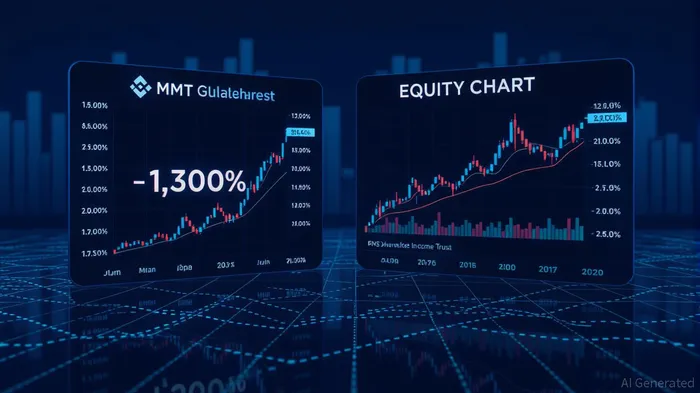
Institutional activity in MMT has been robust, with 18.97% of the fund's shares held by institutional investors as of Q3/Q4 2025. Major players like Allspring Global Investments and Raymond James Financial Inc. have collectively poured $14.94 million into the fund over 24 months, despite a concurrent $2.07 million in institutional selling. This buying spree, however, has not translated into significant equity price gains. The fund's stock has traded in a narrow range between $4.31 and $4.90 over the past year, suggesting that institutional demand may be driven more by yield-seeking strategies-MMT offers a 9.05% monthly distribution-than by growth expectations according to analysis.
Meanwhile, the MMT token's crypto market performance tells a different story. Its November 2025 surge, driven by Binance's listing and airdrop campaigns, reflects a classic speculative play: liquidity incentives and social media hype amplifying demand. This disconnect between the token and the underlying equity underscores a key risk for investors-confusing the value of a traditional fund with the volatility of its tokenized counterpart.
Regulatory Clarity and Lingering Risks
The U.S. CLARITY Act and the EU's MiCA 2.0 regulation have provided legal certainty for utility tokens like MMT, reclassifying them as commodities under the CFTC and streamlining compliance for crypto service providers. These frameworks aim to reduce ambiguity, but they also introduce new challenges. For instance, the CLARITY Act's focus on utility versus security classifications leaves room for enforcement gaps, particularly as tokens evolve into hybrid models with governance or liquidity features.
While regulatory clarity may attract institutional capital, it does not eliminate market risks. The MMT token's deflationary tokenomics and cross-chain expansion strategies-key drivers of its 2025 surge-remain vulnerable to supply unlock events and competitive pressures according to market analysis. Moreover, global regulatory divergences could incentivize projects to seek jurisdictions with laxer rules, creating a fragmented landscape for investors.
Investor Psychology: FOMO and the Crypto Cycle
The MMT token's surge mirrors historical crypto patterns driven by FOMO and social media hype. Similar dynamics fueled Bitcoin's 2017 peak and Dogecoin's 2021 rally, where celebrity endorsements and viral trends amplified speculative buying according to research. In MMT's case, Binance's airdrop strategy and the token's yield appeal created a self-reinforcing cycle: rising prices attracted more buyers, further inflating expectations.
However, such euphoria often precedes market corrections. The Fear and Greed Index, a barometer of crypto sentiment, frequently peaks during speculative frenzies, only to reverse as panic sets in according to market analysis. Tokens without robust fundamentals-such as transparent governance or real-world utility-are particularly susceptible to sharp declines when hype fades. While MMT's institutional backing offers some stability, its long-term viability hinges on whether its utility can withstand scrutiny beyond the airdrop-driven frenzy.
Caution for Investors
For investors, the MMT token's trajectory serves as a cautionary tale. Chasing short-term pumps without evaluating fundamentals-such as the fund's yield sustainability or the token's use case-risks exposure to volatile corrections. Strategies like dollar-cost averaging and diversification can mitigate these risks, but they require discipline in emotionally charged markets according to market insights.
Regulatory clarity is a step forward, but it is no panacea. Investors must remain vigilant about evolving classifications, enforcement actions, and the inherent risks of speculative assets. As the CLARITY Act and MiCA 2.0 mature, their true impact on MMT and similar tokens will depend on how well they balance innovation with investor protection.

Una combinación de la sabiduría tradicional en el comercio con las perspectivas más actuales sobre las criptomonedas.
Latest Articles
Stay ahead of the market.
Get curated U.S. market news, insights and key dates delivered to your inbox.




Comments
No comments yet