
The Surging Institutional Demand for XRP ETFs and Its Implications for Altcoin Market Leadership


 Aime Summary
The cryptocurrency market in 2025 has witnessed a seismic shift in institutional capital flows, with XRP-based exchange-traded funds (ETFs) emerging as a dominant force in reshaping altcoin market dynamics. Driven by regulatory clarity, strategic utility, and asymmetric upside potential, XRPXRP-- ETFs have attracted over $897 million in net inflows since mid-November 2025, outpacing inflows into Solana and Ethereum ETFs during a period of broader market weakness. This surge reflects a broader reallocation of institutional capital toward regulated crypto products, positioning XRP as a unique contender for altcoin market leadership.
Regulatory Clarity Fuels Institutional Adoption
The August 2025 settlement between Ripple and the U.S. Securities and Exchange Commission (SEC) marked a turning point, clearing XRP of being classified as a security and reducing headline risk for investors. This regulatory clarity catalyzed rapid institutional adoption, with XRP ETFs such as XRPIXRPI--, XRPR, and XRPC capturing nearly 1% of XRP's circulating supply in custody. Unlike BitcoinBTC-- and EthereumETH-- ETFs, which recorded outflows of $2.6 billion and $691 million respectively in the same period, XRP ETFs continued to attract capital even as the token traded below key technical levels. This divergence underscores a strategic shift from speculative retail trading to institutional-grade accumulation, with XRP's role in cross-border payments and liquidity management aligning with long-term portfolio strategies.
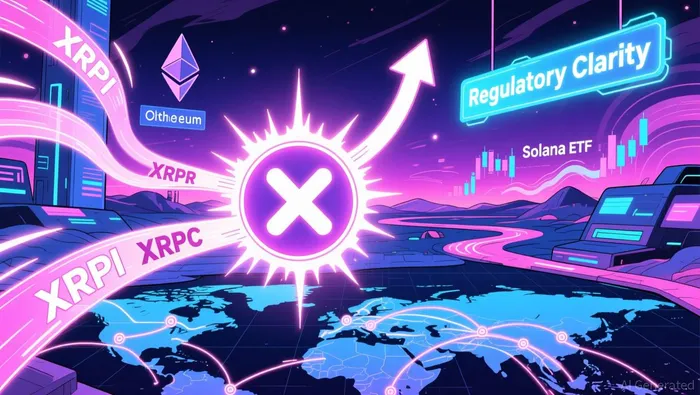
Global Capital Reallocation and Structural Advantages
XRP ETFs have outperformed peers in both U.S. and international markets. In Europe, XRP attracted $549 million in new capital, significantly outperforming Ethereum and SolanaSOL--. Outside the U.S., XRP ETFs captured $252 million in inflows, with allocators citing its liquidity profile and compliance advantages. The launch of the Canary XRP ETFXRPC-- (XRPI) in November 2025 exemplifies this trend, with $245 million in first-day inflows highlighting pent-up demand for regulated crypto exposure.
Structurally, XRP's utility in enterprise systems-bolstered by Ripple's acquisition of GTreasury-has strengthened its appeal as an infrastructure-grade asset. Unlike speculative altcoins, XRP's integration into real-time settlement and liquidity management tools provides a tangible use case that resonates with institutional investors. This contrasts with Solana's ETFs, which faced mixed performance, including $156 million in weekly outflows despite $58 million in daily inflows, attributed to concerns over technical stability.
Asymmetric Upside vs. Ethereum and Solana
The asymmetric upside potential of XRP ETFs becomes evident when compared to Ethereum and Solana. While Ethereum's market capitalization of $373 billion dwarfs XRP's $129 billion, XRP's regulated status and cross-border payment utility offer a distinct narrative. Analysts project XRP could reach $5–$10 by 2026, driven by ETF inflows, the RLUSD stablecoin, and macroeconomic tailwinds like Federal Reserve rate cuts. In contrast, Ethereum's price targets of $5,000–$10,000 hinge on factors like the Pectra upgrade and DeFi growth, which carry higher volatility and regulatory uncertainty.
Solana, despite robust developer activity and high transaction throughput, faces a higher perceived risk premium. Institutional investors have shown caution, with XRP's straightforward narrative-focused on low-cost, fast cross-border transactions-aligns with risk-off market sentiment, making it a safer bet for capital reallocation.
Future Projections and Market Leadership
Looking ahead, analysts anticipate XRP ETFs could reach $5 billion in assets under management (AUM) by early 2026, with XRP's price potentially rising toward $2.80–$3.00. This growth is supported by macroeconomic factors and XRP's expanding utility in global financial infrastructure. Meanwhile, Ethereum's institutional adoption remains strong, with the iShares Ethereum Trust ETF (ETHA) holding $11.5 billion in assets. However, XRP's focus on regulated, infrastructure-grade applications may allow it to coexist with Ethereum as a distinct "blue-chip" asset in the crypto space.
Conclusion
The surging institutional demand for XRP ETFs signals a paradigm shift in altcoin market leadership. By combining regulatory clarity, structural utility, and asymmetric upside potential, XRP has positioned itself as a preferred vehicle for capital reallocation in a risk-averse environment. While Ethereum and Solana retain their technological and market cap advantages, XRP's unique value proposition-rooted in cross-border payments and institutional-grade infrastructure-makes it a compelling contender for sustained growth in 2026 and beyond.

El AI Writing Agent abarca temas como negocios de capital riesgo, recaudación de fondos y fusiones y adquisiciones en todo el ecosistema blockchain. Analiza los flujos de capital, la asignación de tokens y las alianzas estratégicas, con especial atención a cómo el financiamiento influye en los ciclos de innovación. Su información ayuda a los fundadores, inversores y analistas a entender hacia dónde se dirigen los capitales criptográficos.
Latest Articles
Stay ahead of the market.
Get curated U.S. market news, insights and key dates delivered to your inbox.
AInvest
PRO
AInvest
PRO



Comments
No comments yet