
The Surging Demand for STEM and Technical Education in U.S. Higher Learning: Identifying Investment Opportunities in EdTech and Education Infrastructure Providers


 Aime Summary
A Paradigm Shift in STEM Enrollment
Enrollment in AI, cybersecurity, and engineering technology programs has exploded in recent years. By 2025, the number of U.S. bachelor's degree programs in AI had increased by 114.4% compared to 2024, with 193 such programs nationwide. The University of South Florida launched a dedicated college of AI and cybersecurity with over 3,000 students enrolled, while MIT's "AI and decision-making" major became the second-largest undergraduate program, enrolling nearly 330 students. Meanwhile, traditional computer science enrollment has declined, with 62% of computing programs reporting drops in undergraduate enrollment during the same period.
Engineering technology programs at institutions like Farmingdale State College are also seeing growth, though specific 2023–2025 data remains limited. The college's investment of $75 million in a new Computer Sciences Center aims to double enrollment in computing disciplines, reflecting broader institutional efforts to align with industry needs. 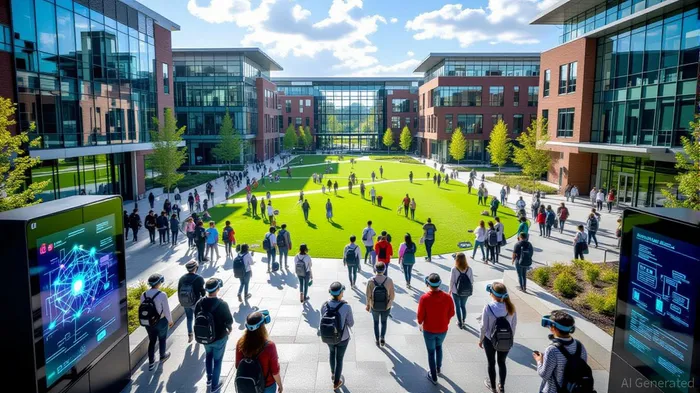 Nationally, the U.S. Bureau of Labor Statistics projects a 17.9% growth in software developer roles between 2023 and 2033, while AI-related job postings surged by 56.1% in 2025. These trends underscore a clear shift toward specialized technical education.
EdTech's Role in Filling the Skills Gap
The EdTech market is rapidly evolving to meet surging demand. Valued at $277.2 billion in 2025, the global EdTech industry is projected to reach $907.7 billion by 2034, driven by AI-powered personalized learning and VR/AR tools. Startups like Protege, which raised $25 million in Series A funding in August 2025, and Harmonic, which secured $100 million in Series B funding, are leveraging AI to deliver immersive, career-focused training. Platforms such as Pluralsight and Labster are also gaining traction by offering hands-on labs and simulation-based learning in cybersecurity, data science, and engineering.
Federal and institutional partnerships are further accelerating growth. Purdue University Northwest and the University of New Haven, for example, have secured substantial grants to enhance cybersecurity training. These initiatives highlight the sector's potential to bridge the STEM skills gap while creating long-term value for investors.
ETFs and Equities: Capturing the STEM Boom
Investors seeking exposure to this trend have multiple avenues. The Global X Education ETF (EDUT), which focuses on global educational products and services, offers direct access to the sector. While specific 2025 performance data for EDUT is unavailable, the broader technology sector has thrived. The Vanguard Information Technology ETF (VGT), for instance, delivered an average annualized return of 20.76% over the past year, outpacing its category average. VGT's top holdings-Nvidia, Microsoft, and Apple-reflect the dominance of tech giants in driving AI and STEM innovation. According to industry analysis, VGT is expected to continue its strong performance.
Thematic ETFs like the Evolve FANGMA Index ETF (TECH) and sector-specific funds such as VGT provide diversified exposure to companies shaping the future of education and technology. For investors with a higher risk tolerance, individual EdTech startups like Protege and Mindstone Learning-which empower non-technical professionals with AI skills-offer high-growth potential.
Societal and Economic Implications
The surge in STEM enrollment and EdTech investment carries profound societal and economic implications. According to industry studies, by 2034, systemic AI adoption in education could yield 20–75% higher ROI for institutions. This shift not only addresses immediate workforce shortages but also fosters long-term economic resilience. For example, the AI segment in K-12 education is projected to grow from $390.8 million in 2024 to $7.95 billion by 2033, signaling a broader cultural embrace of technical literacy.
However, challenges remain. Traditional universities must adapt to avoid obsolescence, while EdTech startups face competition from both incumbents and emerging rivals. Investors should prioritize companies with strong industry partnerships, scalable models, and a clear alignment with labor market demands.
Conclusion
The surging demand for STEM and technical education represents a defining trend in U.S. higher learning. From institutional investments in AI and cybersecurity programs to the rapid expansion of EdTech, the sector is poised for sustained growth. For investors, ETFs like EDUT and VGT, as well as high-potential startups, offer pathways to capitalize on this transformation. As the workforce increasingly prioritizes skills over degrees, the intersection of education and technology will remain a fertile ground for innovation-and investment.

Blending traditional trading wisdom with cutting-edge cryptocurrency insights.
Latest Articles
Stay ahead of the market.
Get curated U.S. market news, insights and key dates delivered to your inbox.


AInvest
PRO
AInvest
PRO



Comments
No comments yet