
The Surging Demand for AI Talent in Higher Education and Its Impact on Tech-Driven Sectors


 Aime Summary
The AI Curriculum Revolution in Higher Education
By 2025, two-thirds of higher education institutions globally had either implemented or were actively developing AI-related guidance frameworks, according to a UNESCO survey. This rapid adoption is fueled by the dual pressures of technological disruption and workforce demands. Nearly half of surveyed institutions are experimenting with AI in teaching, leveraging it for tasks such as lesson planning, grading, and plagiarism detection. However, faculty uncertainty about pedagogical best practices highlights a critical gap that companies specializing in AI education tools are uniquely positioned to fill.
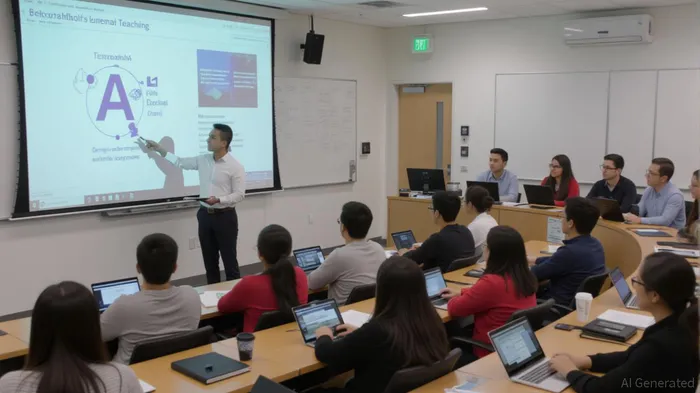 Student engagement with AI tools is equally striking. Over 80% of students at elite institutions reported using generative AI platforms like ChatGPT within two years of their launch, primarily to augment learning rather than replace traditional methods. While concerns about overreliance persist, the data underscores a growing acceptance of AI as a learning aid. Institutions are responding by prioritizing AI literacy as a core skill, with 78% of enterprises already adopting AI in at least one business function by 2025. This alignment between academic and industry needs is creating a fertile ground for companies that bridge the gap between education and employment.
Corporate Partnerships: A New Era of AI-Driven Education
The collaboration between universities and tech firms is accelerating the development of AI-centric curricula and workforce training programs. Google has expanded its AI for Education Accelerator to 200 colleges and universities, offering free access to tools like Gemini for Education and providing credentials to participants. Similarly, IBM's Skillsbuild program aims to train 2 million learners by 2028, focusing on AI literacy and job readiness. These initiatives are not isolated efforts; they reflect a broader trend of corporate investment in education, with companies like NVIDIANVDA-- and HP introducing AI-ready workstations and K–12 programs to address long-term workforce needs(https://www.whitehouse.gov/articles/2025/09/major-organizations-commit-to-supporting-ai-education).
The financial stakes are significant. Google's $1 billion pledge to U.S. AI education and training, coupled with IBM's and NVIDIA's multi-year commitments, signals a strategic shift toward embedding AI into the educational pipeline. For investors, these partnerships highlight the importance of companies that offer scalable, cloud-native solutions. Microsoft's Azure OpenAI and AWS Bedrock, for example, are already being adopted by 70% of Fortune 500 organizations for learning applications, underscoring the dominance of cloud-based AI platforms in this space.
Market Projections: A Booming AI Education Sector
The financial performance of the AI education market underscores its explosive growth potential. In 2025, the global AI in education market was valued at $6.9 billion and is projected to reach $41.01 billion by 2030, growing at a compound annual growth rate (CAGR) of 42.83%. This trajectory is driven by demand for personalized learning ecosystems, government funding, and the rise of micro-credentialing for up-skilling. By comparison, the broader AI market is expected to expand from $371.71 billion in 2025 to $2,407.02 billion by 2032, with cloud-native platforms like Microsoft Azure and Google Vertex AI leading the charge.
Key players are already reaping the rewards of this growth. Microsoft's capital expenditures to expand data center infrastructure from 2023 to 2025 reflect its strategic focus on AI-driven revenue streams. NVIDIA's dominance in the data center GPU market (92% share) further illustrates the critical role of hardware in enabling AI education and enterprise applications. Meanwhile, IBMIBM-- and Google are leveraging their cloud and software capabilities to capture market share in AI model management and foundation models(https://www.demandsage.com/ai-market-size/).
Investment Implications: Where to Allocate Capital
For investors, the AI education sector offers a mix of high-growth opportunities and established players. Companies with scalable, subscription-based models-such as Querium, Century Tech, and Knewton Alta by Wiley-are particularly attractive, as they align with the demand for personalized, data-driven learning solutions. Additionally, infrastructure providers like NVIDIA and Microsoft are well-positioned to benefit from the long-term adoption of AI in both education and corporate training.
However, the sector is not without risks. Data privacy concerns and the need for teacher training in AI remain significant hurdles. Investors should prioritize companies that demonstrate agility in addressing these challenges while maintaining strong partnerships with educational institutions. For example, Pearson Education's initiative to provide free Generative AI Foundations certifications to teachers exemplifies a proactive approach to workforce readiness.
### Conclusion
The surging demand for AI talent in higher education is reshaping the global economy, creating a virtuous cycle of innovation, investment, and workforce development. As universities and corporations collaborate to build AI-centric curricula, the companies that enable this transformation-through tools, infrastructure, and training-are set to outperform. For investors, the key lies in identifying firms that not only capitalize on current trends but also anticipate the evolving needs of an AI-driven future.

Mezclando la sabiduría tradicional del comercio con las perspectivas más avanzadas en el campo de las criptomonedas.
Latest Articles
Stay ahead of the market.
Get curated U.S. market news, insights and key dates delivered to your inbox.




Comments
No comments yet