
The Surging AI-Storage Synergy: Why Pure Storage's Meta Partnership Is a Green Light for Long-Term Growth


 Aime Summary
In the ever-evolving landscape of technology, the intersection of artificial intelligence and infrastructure has become a defining battleground for innovation—and opportunity. At the heart of this transformation lies a critical but often overlooked enabler: storage. As AI models grow in complexity and scale, the demand for high-performance, energy-efficient storage solutions has surged. Enter Pure StoragePSTG-- (NYSE: PSTG), a company that has long been a quiet innovator in the data storage space, now thrust into the spotlight by a landmark partnership with MetaMETA-- (NASDAQ: META). This collaboration is not just a win for Pure—it's a masterclass in leveraging AI-driven infrastructure tailwinds and strategic corporate alliances to unlock undervalued tech plays.
The Strategic Catalyst: Flash Meets Hyperscale
Meta's decision to partner with Pure Storage is rooted in a simple yet profound insight: flash storage is the linchpin of next-generation AI infrastructure. Traditional hard disk drives (HDDs) are ill-suited for the power-hungry, high-throughput demands of AI training and inference. Pure's DirectFlash Modules (DFMs), which utilize QLC NAND flash, offer a compelling alternative. These modules deliver 300 TB of capacity per unit, reduce rack space by up to 80%, and slash power consumption compared to HDDs. For Meta, which operates data centers the size of cities, these metrics translate into tangible cost savings and operational efficiency.
The partnership's scale is staggering. Pure expects to deploy 1–2 exabytes of storage for Meta by the end of fiscal 2026, with the potential to exceed that target. An exabyte is 1 billion gigabytes—enough to store the entire Library of Congress over 100,000 times. This isn't just a one-off deal; it's a blueprint for how hyperscalers will modernize their storage architectures in the AI era.
Financials That Justify the Hype
Pure Storage's financials have already begun to reflect the partnership's potential. In Q2 2026, the company reported revenue of $861 million, surpassing analyst estimates by $14 million. Gross margins for the Meta deal are projected to exceed 90%, a figure that underscores the profitability of flash-based solutions in hyperscale environments. Pure has raised its full-year revenue guidance to $3.6–3.63 billion, a 3% increase from previous forecasts, and its stock price has surged 28% since the partnership's announcement, pushing its market cap to $26 billion.
But the numbers tell only part of the story. Pure's CFO, Tarek Robbiati, has hinted at “increased interest from other hyperscalers,” suggesting that the Meta deal could be the first domino in a broader industry shift. Analysts at Wedbush and Raymond James have raised price targets for Pure, citing the long-term upside of flash storage adoption. For investors, this is a rare combination of near-term revenue visibility and long-term secular growth.
The Bigger Picture: Flash as the New Standard
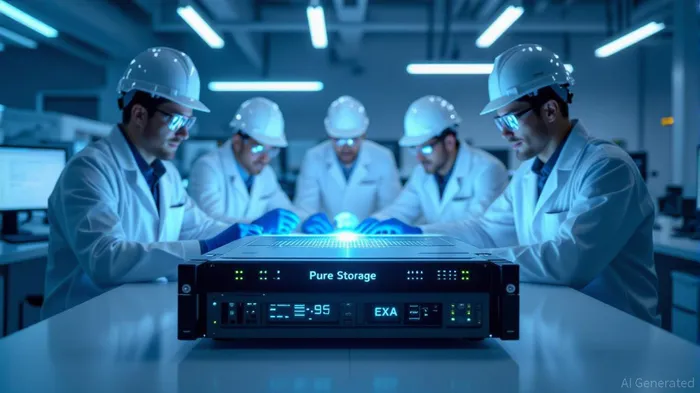
Meta's preference for QLC NAND flash is emblematic of a larger trend. Hyperscalers are increasingly prioritizing storage solutions that balance performance, cost, and energy efficiency. Pure's technology aligns perfectly with this demand. Its FlashBlade//EXA platform, designed for AI and high-performance computing (HPC), allows for independent scaling of data and metadata—a critical feature for training large language models and processing multimodal datasets.
Moreover, Pure's recent launch of the GenAI Pod—a full-stack AI infrastructure solution—positions it as a one-stop shop for enterprises and hyperscalers alike. The GenAI Pod integrates with NVIDIA's DGX SuperPOD and supports use cases ranging from drug discovery to agentic AI frameworks. This product diversification, combined with Pure's hyperscaler-focused strategy, creates a flywheel effect: the more Pure scales with Meta, the more it refines its offerings for other clients.
Risks and Realities
No investment is without risk. While flash storage is gaining traction, HDDs are not disappearing overnight. Meta itself has acknowledged that HDDs will continue to play a role in its infrastructure, particularly for archival storage. Additionally, Pure's reliance on a single hyperscaler—Meta—could pose concentration risk. However, the company's CEO, Charles Giancarlo, has emphasized that the Meta partnership is a “model for broader industry adoption,” and early signs of engagement with other hyperscalers are encouraging.
Another concern is the competitive landscape. Western DigitalWDC-- (NASDAQ: WD), SeagateSTX-- (NASDAQ: STX), and even cloud providers like AWS and MicrosoftMSFT-- are investing in flash-based solutions. But Pure's edge lies in its proprietary DirectFlash architecture and its ability to deliver tailored, high-density storage at scale. For now, it's the only vendor with a proven hyperscale deployment under its belt.
A Green Light for Long-Term Growth
For investors seeking exposure to the AI infrastructure boom, Pure Storage offers a compelling case. The company is not just a supplier to Meta—it's a partner in redefining the architecture of AI itself. With its flash-first strategy, strong gross margins, and expanding hyperscaler pipeline, Pure is well-positioned to capitalize on the multi-trillion-dollar AI storage market.
The key question for investors is timing. Pure's stock has already appreciated significantly since the Meta announcement, but analysts argue that the full impact of the partnership is still underpriced. For those with a long-term horizon, this is a rare opportunity to invest in a company that is not only riding the AI wave but helping to build its foundation.
In the end, the Pure-Meta partnership is more than a business deal—it's a glimpse into the future of computing. As AI becomes the backbone of the digital economy, the companies that enable it will reap the rewards. Pure Storage, with its innovative technology and strategic foresight, is one of those companies. And for investors, that's a green light.

Delivering real-time insights and analysis on emerging financial trends and market movements.
Latest Articles
Stay ahead of the market.
Get curated U.S. market news, insights and key dates delivered to your inbox.
AInvest
PRO
AInvest
PRO



Comments
No comments yet