
How the Supreme Court’s Tariff Ruling Shapes Long-Term Stock Outlook
Eric Parnell, Chief Market Strategist at Great Valley Advisor Group, said the Supreme Court’s decision to strike down President Trump’s global tariffs is likely to deliver a gradual boost to corporate profitability and economic growth—even as it complicates the federal government’s fiscal outlook.
“The market reaction initially after the announcement has been fairly muted, both for stocks and for bonds,” Mr. Parnell said in an interview with AInvest. But he argued that the effects will build over time because the tariffs had been “leading to higher inflation pressures, putting pressure on corporate profit margins,” and “leading higher costs to consumers.”
In a 6–3 decision, the Supreme Court ruled that the International Emergency Economic Powers Act does not authorize broad-based import taxes, concluding that such authority rests with Congress. The ruling leaves unresolved how previously collected duties will be handled, raising the prospect of refund claims and administrative challenges.
Read: Supreme Court Strikes Down Trump's Tariffs
A Penn-Wharton Budget Model analysis estimated that more than $175 billion in tariff revenue could be at risk. Mr. Parnell said the decision “opened up a hole anywhere between $175 billion to $300 billion in the fiscal budget,” which will have to be financed. He added that increased short-term borrowing could ripple through funding markets and inject volatility into bonds via higher short-term rates.
The ruling also renews debate over who bore the cost of the tariffs. Economists at the Federal Reserve Bank of New York wrote on the Liberty Street Economics blog that “nearly 90 percent of the tariffs’ economic burden fell on U.S. firms and consumers,” based on import data through November 2025. Mr. Parnell pointed to Federal Reserve research indicating consumers absorbed the majority of costs and said households have felt higher prices regardless of political debate.
Even with tariffs eliminated, Mr. Parnell cautioned that consumers may not see immediate price declines. Companies that have already raised prices are unlikely to reverse them outright, he said, suggesting instead that firms may slow future increases: “Maybe it’s just like, ‘okay, we’re going to slow the rate of price increases.’”
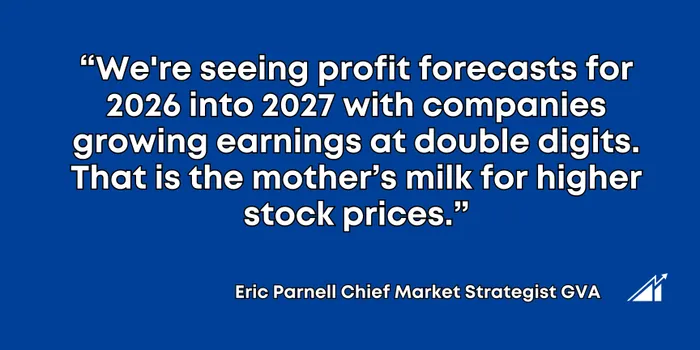
For equity investors, however, Mr. Parnell characterized the ruling as “a meaningful long-term positive...We're seeing profit forecasts for 2026 into 2027 with companies growing earnings at double digits. That is the mother’s milk for higher stock prices.” He pointed to an economy that “has been growing well and has shown consistent growth,” alongside “persistently reasonable” inflation readings.
With tariffs removed from corporate cost structures, analysts are recalculating assumptions around cost of capital and profit margins. Wider margins and stronger earnings trajectories, Mr. Parnell said, “implies higher stock prices” over time.
Meanwhile, Treasury markets have shown steady demand for long-term U.S. debt. The Treasury Department reported that its Feb. 12 auction of $25 billion in 30-year bonds drew a 2.66 bid-to-cover ratio at a high yield of 4.750%. Apollo Global Management Chief Economist Torsten Slok described the sale as attracting strong demand. Sustained appetite for long-dated Treasurys, Mr. Parnell said, supports financial stability and equity valuations by keeping long-term borrowing costs at reasonable levels.
The decision lands days before President Trump’s State of the Union address, scheduled for Feb. 24. Asked what message the president should deliver, Mr. Parnell urged empathy on affordability concerns: “Don’t tell your electorate that things are more affordable. Empathize with the fact that they’re struggling with the affordability,” he said, arguing that the repeal provides “a tailwind” that could ease pricing pressures over time. He nonetheless expects the president to adopt a combative tone, predicting “some fighting words.”
For investors, the longer-term calculus now centers on how quickly tariff relief flows through earnings statements and how the Treasury finances any revenue gap. If margin expansion materializes alongside stable long-term rates, Mr. Parnell’s assessment suggests the ruling could reinforce what he describes as a constructive backdrop for equities into 2026 and 2027.

Adam Shapiro is a three-time Emmy Award–winning content creator, former network news correspondent, and founder of the multimedia production company TALKENOMICS. At AInvest, he created and launched Capital & Power, a video podcast series designed to drive engagement and establish thought leadership, while also producing original live streams, financial articles, and investor-focused video content. Previously, as a correspondent at FOX Business, Shapiro established the network’s Washington, D.C. bureau, reported from the White House, Capitol Hill, and the Federal Reserve, and secured exclusive bipartisan interviews with influential leaders. His reporting helped solidify FOX Business as the most-watched business channel on television. At the same time, his original Talkenomics series drew tens of thousands of viewers per episode through insightful conversations with policymakers, economists, and thought leaders. At Yahoo Finance, he played a critical leadership role in expanding digital programming to eight hours of live, bell-to-bell financial news coverage, dramatically increasing traffic from 68M to 104M unique monthly visitors and growing ad revenue from zero to over $50 million annually. Yahoo Finance continues to benefit from the credibility of Shapiro’s exclusive interviews with former President Donald Trump and numerous Fortune 500 CEOs.
Latest Articles
Stay ahead of the market.
Get curated U.S. market news, insights and key dates delivered to your inbox.


AInvest
PRO
AInvest
PRO



Comments
No comments yet