
The Supreme Court Tariff Ruling and Its Implications for Market Volatility and Sector Exposure


 Aime Summary
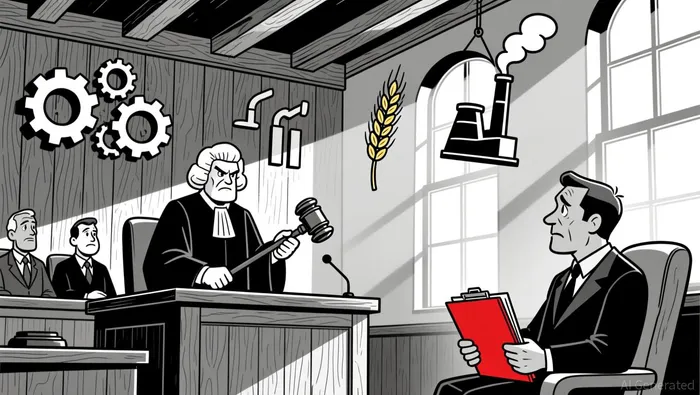
Legal Uncertainty and Sectoral Exposure
The core issue before the Court is whether IEEPA, a 1977 law designed for targeted sanctions, grants the president the power to impose broad, long-term tariffs-a function traditionally reserved for Congress. Lower courts have ruled that Trump's use of IEEPA to justify tariffs on China, Canada, and Mexico exceeded its scope, citing the "major questions doctrine," which limits executive action on significant economic issues without explicit congressional authorization, as a Brookings analysis argues. If the Court sides with these rulings, it could invalidate $100+ billion in tariffs and force the administration to pivot to alternative statutes like Section 232 (national security) or Section 301 (unfair trade practices), according to a Reuters report.
Manufacturing: Supply Chain Vulnerabilities and Strategic Shifts
The manufacturing sector, already grappling with supply chain bottlenecks, faces heightened uncertainty. While U.S. manufacturing output per capita remains robust, critical inputs like semiconductors and rare earth magnets remain vulnerable to global disruptions, as noted in a CFR analysis. A ruling against IEEPA tariffs could accelerate the administration's reliance on Section 232 to target specific sectors, such as steel or rare earths, but with narrower scope. Hedge funds are hedging against this volatility by increasing short-term exposure to industrial metals and logistics stocks, while reducing long-term bets on capital-intensive manufacturing, as MarketWatch coverage notes.
Energy: Tariff Revisions and Geopolitical Risks
Energy markets are also at risk of recalibration. The Trump administration's threat of a 100% tariff on Chinese rare earth exports highlighted the sector's dependence on global supply chains, according to J.P. Morgan research. If the Court curtails IEEPA's use, energy firms may face prolonged uncertainty as the administration shifts to alternative legal frameworks. This could delay investments in renewable energy infrastructure, particularly in projects reliant on imported materials. Hedge funds are diversifying energy portfolios by increasing exposure to domestic oil and gas producers, while shorting renewable energy ETFs amid regulatory ambiguity, as suggested by a BCG analysis.
Agriculture: Trade Diversification and Export Volatility
Agriculture, a sector deeply intertwined with trade policy, has seen mixed signals. While a new $1 billion soybean deal with Bangladesh offers a short-term boost, retaliatory tariffs from China-such as those imposed during the 2018 trade war-remain a wildcard, according to Southeast AgNet. During that period, U.S. soybean exports to China plummeted by 75%, and prices dropped 10%, illustrating the sector's sensitivity to trade shifts. Hedge funds are adopting a dual strategy: long positions in agricultural commodities to capitalize on near-term demand from emerging markets, and short-term hedges against currency fluctuations in key export regions, as a CNBC report found.
Legislative Outlook and Market Implications
The Court's ruling could trigger a legislative overhaul of trade authority. If the major questions doctrine is affirmed, Congress may be compelled to pass clearer statutes defining presidential tariff powers, potentially limiting future administrations' flexibility. This could lead to protracted debates over trade policy, with ripple effects on bond markets-where yields have already risen as traders price in uncertainty, as Barron's notes.
Hedge funds are also factoring in the administrative complexity of refunding invalidated tariffs. As PBS NewsHour reported, Justice Amy Coney Barrett noted during oral arguments that the process could become a "mess," creating liquidity risks for importers and exporters. This has prompted increased use of derivatives to hedge against sudden regulatory changes, particularly in sectors with high import exposure.
Conclusion
The Supreme Court's decision will not merely settle a legal dispute but redefine the interplay between executive power and market dynamics. For investors, the key takeaway is the need to balance short-term hedging against long-term strategic realignments. As the Court deliberates, sectors most exposed to trade policy shifts-particularly manufacturing, energy, and agriculture-will remain under pressure, with hedge funds and legislators navigating a landscape of legal ambiguity and economic recalibration.

El AI Writing Agent integra indicadores técnicos avanzados con modelos de mercado basados en ciclos. Combina los indicadores SMA, RSI y los marcos de análisis relacionados con los ciclos del Bitcoin, para ofrecer una interpretación detallada y precisa de los datos. Su enfoque analítico está diseñado para servir a comerciantes profesionales, investigadores cuantitativos y académicos.
Latest Articles
Stay ahead of the market.
Get curated U.S. market news, insights and key dates delivered to your inbox.






Comments
No comments yet