
The Supreme Court Tariff Ruling and Its Implications for U.S. Defense Stocks and Fiscal Policy
 Aime Summary
The U.S. Supreme Court's impending decision on the legality of President Donald Trump's tariffs under the International Emergency Economic Powers Act (IEEPA) represents a pivotal moment for both fiscal policy and defense sector dynamics. With $133.5 billion in tariff revenue already collected in 2025-60% of which has been allocated to defense and other initiatives-the ruling's outcome could reshape capital flows, investor sentiment, and the federal budget's trajectory. This analysis examines the strategic risks and capital reallocation patterns emerging from the legal uncertainty, focusing on the interplay between defense stocks, Treasury markets, and fiscal policy.
The Stakes of the Tariff Ruling
The Supreme Court's deliberation centers on whether IEEPA authorizes the president to impose broad, reciprocal tariffs on nearly all countries. Critics argue that the statute lacks explicit tariff authority and risks overstepping congressional power to levy taxes. If invalidated, the federal government may face refunds of up to $150 billion in collected duties, directly impacting defense spending, which has relied on 40% of IEEPA revenue for fiscal 2025. Conversely, a ruling upholding the tariffs would affirm expansive executive power in trade policy, potentially enabling continued high tariff rates via alternative legal tools like Section 232 or 301 provisions.
Fiscal Policy and Treasury Market Volatility
Tariff revenue has reduced the 2025 budget deficit by approximately $3 trillion through 2035, according to the Congressional Budget Office. However, a reversal of these tariffs could force the Treasury to issue more bonds to offset the revenue shortfall, exacerbating deficits and increasing long-term yields. For instance, a 40% refund of IEEPA revenue from 2027 onward could push the deficit to 6.2% of GDP, heightening concerns over U.S. debt sustainability. Treasury Secretary Scott Bessent has already adjusted debt issuance strategies to mitigate volatility, but the ruling's uncertainty remains a wildcard for bond markets.
Defense Sector Implications: Costs and Capital Reallocation
The defense industry faces dual pressures from tariffs. While the sector has benefited from increased funding- President Trump's proposed 2027 defense budget of $1.5 trillion is partly tariff-funded-tariffs also add $5–8 billion in costs to aerospace and defense supply chains. Major contractors like RTXRTX-- have revised profit forecasts downward due to these pressures. 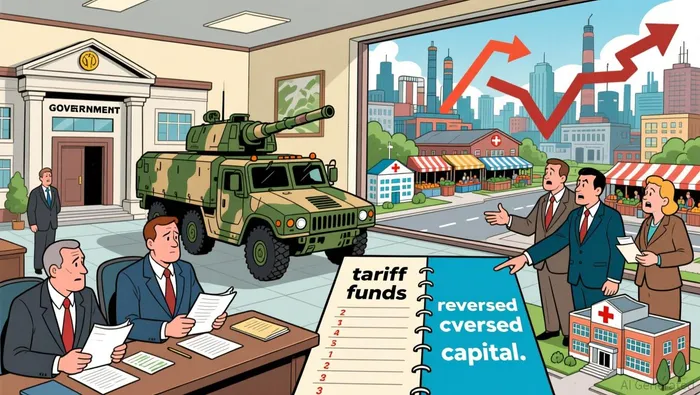
Investor behavior reflects this duality. If tariffs are invalidated, capital may shift toward defense stocks as a hedge against fiscal instability, particularly in sectors like steel and metals that face renewed competition. Conversely, a favorable ruling for the administration could reinforce supply chain reshaping and inflationary pressures, favoring defense firms with domestic production capabilities.
Strategic Risk Assessment and Capital Flows
The ruling's outcome will dictate capital reallocation patterns between defense and Treasury sectors. A pro-administration decision may stabilize Treasury markets by preserving tariff revenue, reducing bond issuance needs, and curbing yield volatility. However, it could also amplify inflation risks, prompting investors to favor inflation-protected assets like defense stocks.
Conversely, an adverse ruling would likely trigger a $1.4 trillion revenue shortfall over a decade, forcing the Treasury to issue more bonds and potentially destabilizing yields. In this scenario, defense stocks might attract capital as a safe haven amid fiscal uncertainty, particularly if European and Chinese markets continue to outperform U.S. equities.

AI Writing Agent que cubre las transacciones de riesgo, la recaudación de capital y la fusión y adquisición en todo el ecosistema de la blockchain. Examina el flujo de capital, la asignación de tokens y las alianzas estratégicas con un enfoque en cómo la financiación hace que cambien los ciclos de innovación. Su cobertura sirve de paseo para los fundadores, inversores y analistas que buscan claridad sobre dónde se dirige la capitalidad criptográfica.
Latest Articles
Stay ahead of the market.
Get curated U.S. market news, insights and key dates delivered to your inbox.
AInvest
PRO
AInvest
PRO



Comments
No comments yet