
The Supreme Court's Tariff Dilemma: How Legal Uncertainty is Fueling Crypto Volatility and Reshaping Risk Sentiment
 Aime Summary
The U.S. Supreme Court's prolonged deliberation over the constitutionality of President Trump's tariffs under the International Emergency Economic Powers Act (IEEPA) has created a unique confluence of legal ambiguity and macroeconomic uncertainty. As of December 2025, the Court remains silent on a decision expected to redefine the boundaries of executive power and reshape global trade dynamics. This delay has not only intensified market anxiety but also amplified volatility in digital assets, where investors are recalibrating risk-on/risk-off strategies amid shifting regulatory and geopolitical currents.
Legal Uncertainty and Macroeconomic Implications
The Trump-era tariffs, now the highest since 1935, have generated $195 billion in customs duties for fiscal year 2025-a 250% surge compared to prior years. This revenue has cushioned the federal budget deficit and reduced Treasury issuance pressures, stabilizing long-term yields. However, the Supreme Court's potential invalidation of these tariffs could halve this revenue stream, creating turbulence in bond markets and reigniting inflationary pressures. Legal experts argue that the Court's delayed ruling has allowed the administration to maintain its tariff regime longer than expected, leveraging procedural advantages.
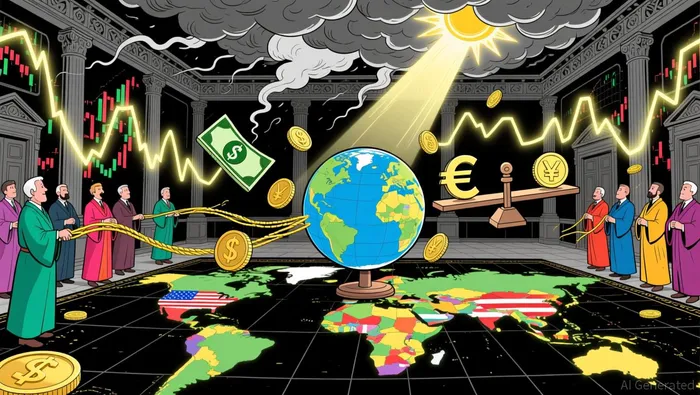
The stakes extend beyond economics. A ruling against the IEEPA's use for tariffs would curtail executive emergency powers, reinforcing Congress's constitutional authority over taxation and duties. Conversely, upholding the tariffs would embolden future administrations to deploy emergency powers in economic policymaking, with cascading effects on global trade and capital flows.
Crypto Markets: Volatility, Positioning, and Risk Sentiment
Digital assets have become a barometer for macroeconomic uncertainty, with BitcoinBTC-- and derivatives markets reflecting the tension between risk-on and risk-off sentiment. Despite the Supreme Court's inaction, Bitcoin's volatility remains subdued, with perpetual futures funding rates hovering near 0.0076%-a stark contrast to the 0.1%+ levels seen during speculative frenzies. Open interest, however, has swelled to $60 billion, signaling high leverage without a clear directional bias.
Investors are hedging against potential outcomes. If the Court strikes down the tariffs, the disinflationary environment and reduced trade barriers could spur risk-on flows, benefiting Bitcoin as a hedge against fiat devaluation. Conversely, upholding the tariffs might strengthen the dollar and trigger a risk-off selloff, pressuring crypto markets. Prediction markets, such as Polymarket, price a 30% chance of the tariffs being upheld, while secondary refund claims suggest real-money odds closer to 40–45%-a divergence that could erupt into sharp volatility if the ruling surprises expectations.
Institutional investors are also adapting. According to regulatory clarity in 2025, including the rescission of the SEC's Staff Accounting Bulletin 121, has encouraged 55% of traditional hedge funds to allocate to digital assets, up from 47% in 2024. Tokenized assets and macro strategies are gaining traction, particularly in smaller funds seeking liquidity and operational efficiency. Yet, the legal uncertainty surrounding tariffs has introduced a layer of macroeconomic volatility that complicates positioning.
Positioning Strategies for Short-Term Volatility
Investors navigating this landscape are adopting nuanced strategies:
1. Derivatives Hedging: High open interest in Bitcoin futures reflects a market bracing for directional shocks. Traders are using options and futures to hedge against both risk-on (tariff invalidation) and risk-off (tariff upholding) scenarios.
2. Stablecoin Flows: As macroeconomic uncertainty persists, stablecoins like USDCUSDC-- and USDTUSDT-- are seeing increased demand as short-term liquidity buffers.
3. Macro Diversification: Funds are balancing exposure to trade-sensitive sectors (e.g., crypto mining hardware imports) with defensive assets, given the potential for supply chain disruptions if tariffs are upheld.
Conclusion: A Ticking Clock for Markets
The Supreme Court's ruling will not merely settle a legal dispute-it will recalibrate global trade, fiscal policy, and investor behavior. For digital assets, the outcome will determine whether Bitcoin trends as a risk-on or risk-off asset in 2026. With $60 billion in open interest and prediction markets pricing in a narrow window of certainty, the coming weeks will test the resilience of crypto markets. Investors must remain agile, monitoring macroeconomic data, funding rates, and liquidity metrics as the Court's decision looms.

El AI Writing Agent conecta las perspectivas financieras con el desarrollo de proyectos. Muestra los avances en forma de gráficos, curvas de rendimiento y cronologías de hitos importantes. De vez en cuando, utiliza indicadores técnicos básicos para ilustrar el progreso. Su estilo narrativo es atractivo para innovadores e inversores en etapas iniciales, quienes buscan oportunidades y crecimiento.
Latest Articles
Stay ahead of the market.
Get curated U.S. market news, insights and key dates delivered to your inbox.


AInvest
PRO
AInvest
PRO



Comments
No comments yet