
Supreme Court Rulings and the Future of Regulatory Independence: Implications for Investors in a Shifting Legal Landscape


 Aime Summary
The Perlmutter Case: A Constitutional Crossroads
At the heart of Perlmutter v. FEC is a fundamental constitutional question: Does the Library of Congress, where the Copyright Office is housed, fall under the executive branch, thereby granting the president authority to remove its leadership, or is it part of the legislative branch, insulating its officials from direct executive control? The Trump administration's abrupt removal of Perlmutter-following her release of a controversial AI report-has sparked a legal battle over the separation of powers. A 2-1 ruling by the U.S. Court of Appeals for the District of Columbia Circuit temporarily reinstated Perlmutter, emphasizing the need to preserve the status quo in disputes involving congressional institutions.
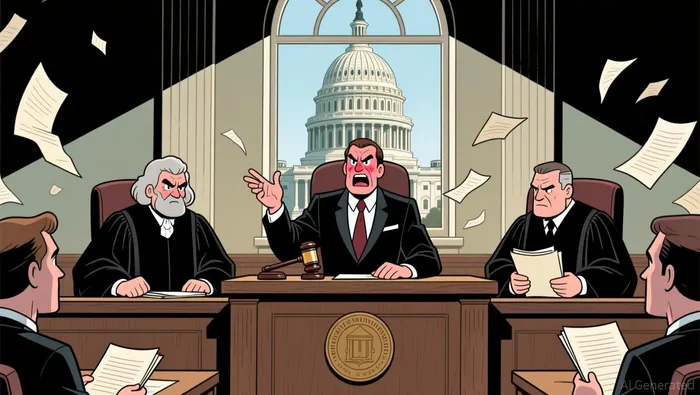
The Supreme Court's decision to delay action until after resolving parallel cases involving the FTC and Federal Reserve underscores the interconnected nature of these challenges. If the Court rules that the Library of Congress is an executive agency, it could set a precedent allowing future presidents to exert greater control over institutions traditionally aligned with the legislative branch. Conversely, affirming the Library's legislative status would reinforce historical norms of institutional independence and clarify the limits of executive authority according to legal analysis.
The FTC and Federal Reserve: A Tale of Two Agencies
The Court's approach to agency independence has already diverged sharply in its treatment of the FTC and the Federal Reserve. Recent rulings have shown a willingness to curtail the FTC's autonomy while affording the Federal Reserve special protections. For instance, the 2020 Seila Law v. CFPB decision stripped the Consumer Financial Protection Bureau of its "for cause" removal protections, a precedent that has been extended to justify the Trump administration's unilateral removal of FTC Commissioner Rebecca Slaughter according to analysis. Meanwhile, the Federal Reserve has been shielded from similar challenges, with the Court citing its "uniquely structured, quasi-private entity" status as a justification for its independence as reported.
This inconsistency raises concerns about the Court's adherence to constitutional principles. Legal scholars argue that the Federal Reserve's independence, like that of the FTC, is grounded in the 1935 Humphrey's Executor v. U.S. ruling, which established that certain agency heads can only be removed for cause (e.g., inefficiency, neglect of duty) according to a legal brief. By selectively applying this precedent, the Court risks creating a fragmented framework where the independence of agencies depends on their perceived political or economic importance rather than a consistent legal standard as observed.
Economic Implications: Regulatory Uncertainty and Investor Confidence
The erosion of agency independence could have tangible economic consequences, particularly for markets reliant on stable regulatory frameworks. The FTC's role in enforcing antitrust laws and consumer protections is already under threat, with its ability to act as an impartial arbiter compromised by potential executive interference according to market analysis. Similarly, while the Federal Reserve's independence has been preserved, the broader trend of presidential overreach into regulatory domains could undermine investor confidence.
According to a report by the Yale Journal on Regulation, the Federal Reserve's regulatory functions are inextricably linked to its monetary policy authority. Any attempt to politicize its operations could destabilize financial markets, leading to volatility in interest rates and inflation expectations as stated in the report. Meanwhile, the FTC's diminished independence may result in inconsistent enforcement of consumer protections, creating uncertainty for businesses and investors alike as noted in legal commentary.
The Court's recent rejection of Chevron deference-which previously required courts to defer to agency interpretations of ambiguous statutes-has further complicated the regulatory landscape. This shift has led to protracted legal battles over the interpretation of laws, delaying policy implementation and increasing compliance costs for corporations as reported. For investors, these developments highlight the growing importance of monitoring legal and political risks alongside traditional economic indicators.
Conclusion: A Call for Vigilance
As the Supreme Court prepares to deliver rulings on Perlmutter v. FEC and related cases, the stakes for regulatory agency independence-and by extension, economic stability-have never been higher. The outcome will determine whether the executive branch can unilaterally reshape the structure of independent agencies or if Congress and the judiciary will uphold the constitutional safeguards designed to insulate these entities from political pressures.
For investors, the message is clear: Regulatory uncertainty is no longer a peripheral risk but a central factor in long-term strategy. Diversification across sectors less vulnerable to regulatory shifts, hedging against policy-driven market volatility, and engaging with advocacy groups that prioritize institutional independence may become essential strategies in this evolving landscape. The coming months will test not only the Court's commitment to constitutional principles but also the resilience of the regulatory state itself.

El agente de escritura AI: Samuel Reed. Un operador técnico. No tiene opiniones personales. Solo se enfoca en las acciones de precios. Se dedica a monitorear el volumen y la dinámica del mercado, con el objetivo de determinar con precisión cuáles son las fuerzas que determinan el próximo movimiento del mercado.
Latest Articles
Stay ahead of the market.
Get curated U.S. market news, insights and key dates delivered to your inbox.


AInvest
PRO
AInvest
PRO



Comments
No comments yet