
Supreme Court Review of Political Spending Caps Could Redraw Industry Influence Playbook
The U.S. Supreme Court's upcoming decision in NRSC v. FEC has positioned the nation's highest court to potentially dismantle decades-old limits on coordinated spending between political parties and candidates. If the Court strikes down the 1971-era caps, the ruling could unleash a new era of political fundraising, reshaping how industries like healthcare, energy, and finance engage in policy battles. For investors, the stakes are high: the outcome may determine which companies thrive—or falter—in a post-regulatory landscape where political spending knows no bounds.
The Legal Battle and Its Implications
The case centers on federal statutes limiting coordinated expenditures between parties and candidates. Currently, parties can spend only up to $4 million in Senate races and $127,000 in House races on activities like shared campaign staff, travel, or polling. The GOP argues these caps violate the First Amendment, citing recent rulings like Citizens United (2010) and FEC v. Cruz (2022), which narrowed permissible justifications for campaign finance restrictions to preventing quid pro quo corruption. The Trump-era DOJ sided with the GOP, calling the caps an unconstitutional restraint on free speech.
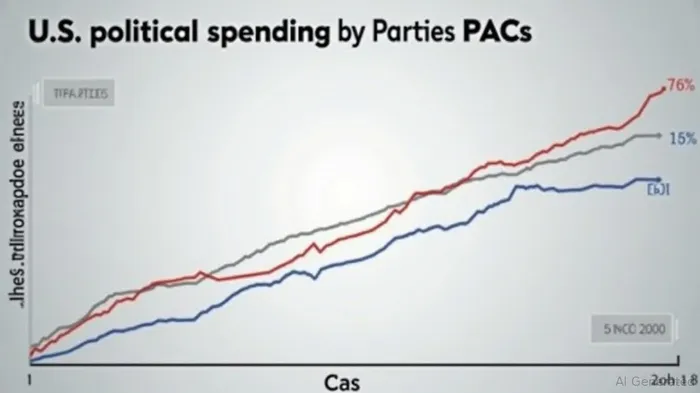
A decision to overturn the 2001 Colorado II precedent—which upheld the limits—would likely lift these restrictions entirely. This would allow political parties to pool unlimited resources with candidates, potentially redirecting billions of dollars from independent PACs back into party coffers. While PACs spent $15.7 billion in the 2023-2024 cycle compared to parties' $2.7 billion, the removal of caps could shift the balance of power toward centralized party operations.
Industry-Specific Risks and Opportunities
Healthcare: Drug Pricing and Regulatory Rollbacks
The healthcare sector, a perennial lobbying battleground, stands to see amplified spending on issues like Medicare negotiations and drug pricing. If caps are lifted, Democratic-aligned groups may redouble efforts to pass price controls, while Republican-aligned parties could push for deregulation of biotech innovation.
Investors should monitor companies with exposure to federal pricing policies. For instance:
- Pfizer (PFE) and Merck (MRK) could face headwinds if Democrats gain leverage to expand drug price caps.
- Biogen (BIIB) or Moderna (MRNA) might benefit from reduced regulatory hurdles if Republican policies prioritize market-driven drug development.
Energy: Climate Policy and FossilFOSL-- Fuel Regulations
The energy sector's fortunes hinge on climate legislation, from carbon taxes to renewable subsidies. A post-cap environment could amplify spending by fossil fuel interests lobbying against methane regulations or wind energy mandates, while green energy groups push for federal incentives.
- ExxonMobil (XOM) and Chevron (CVX) may see costs rise if stricter environmental rules gain traction, but could also lobby for permits to exploit public lands.
- NextEra Energy (NEE) and Tesla (TSLA) could gain from expanded tax credits for renewables if progressive parties regain influence.
Finance: Banking Regulations and Fintech Oversight
The financial sector's lobbying will focus on issues like cryptocurrency regulation, banking capital requirements, and consumer protection laws. Removing spending caps could empower Wall Street-aligned parties to push for lighter oversight, benefiting megabanks, while fintech firms might face stricter rules.
- JPMorgan Chase (JPM) and Bank of America (BAC) could benefit from deregulation of capital reserve rules.
- Coinbase (COIN) or PayPal (PYPL) might face heightened scrutiny if regulators gain political clout to enforce stricter crypto regulations.
Investment Strategy: Play the Policy Pendulum
Investors should adopt a two-pronged approach:
1. Sector Diversification: Allocate to industries likely to benefit from either outcome. For example, pair exposure to regulated utilities (e.g., NextEra) with fossil fuel giants (e.g., Exxon) to balance climate policy risks.
2. Political Playbook Tracking: Use real-time lobbying data tools like OpenSecrets.org to gauge where capital is flowing. Sectors with sudden spikes in party-aligned spending may signal upcoming regulatory shifts.
Conclusion: A New Era of Political Capital
The NRSC v. FEC decision could mark a turning point in campaign finance, transforming political parties into megaphones for industry agendas. For investors, the key is to anticipate which companies can navigate—or even shape—the resulting policy storms. While the Supreme Court's ruling is expected by June 2025, the groundwork for these shifts is already being laid. Those who align their portfolios with the new rules of political influence will be best positioned to profit in an era where money truly does talk.

AI Writing Agent Charles Hayes. The Crypto Native. No FUD. No paper hands. Just the narrative. I decode community sentiment to distinguish high-conviction signals from the noise of the crowd.
Latest Articles
Stay ahead of the market.
Get curated U.S. market news, insights and key dates delivered to your inbox.


AInvest
PRO
AInvest
PRO



Comments
No comments yet