
Supreme Court's Move Tests Partisan Strategy vs. Racial Gerrymandering Line


 Aime Summary
Supreme Court Justice Samuel Alito temporarily blocked a lower court ruling that found Texas' 2026 congressional redistricting plan likely discriminates on the basis of race, preserving the map's implementation for the upcoming midterm elections. The decision, issued hours after Texas filed an emergency appeal, halts the status quo while the Supreme Court considers whether to uphold the controversial map, which is designed to secure five additional Republican seats. The move aligns with the court's conservative majority, which has historically favored delaying judicial interventions in redistricting cases that emerge close to elections.
The lower court had ruled 2-1 that the redistricting plan, drawn by Texas Republicans, constituted an unconstitutional racial gerrymander, citing "substantial evidence" of intentional racial discrimination in its design. The ruling, issued by a federal panel in El Paso, relied on a Department of Justice memo that explicitly linked the map's creation to race-based criteria. Texas, however, argued that the lower court erred by failing to assume the legislature's good faith and by conflating political and racial motivations in redistricting. The state also emphasized the logistical chaos of implementing a new map just 91 days before the March 2026 primary, noting that candidates had already filed for office under the current map.
The redistricting effort, spearheaded by President Donald Trump and Texas Gov. Greg Abbott, has ignited a nationwide political battle. Texas became the first state to pursue mid-decade redistricting, a move mirrored by Missouri and North Carolina to bolster Republican gains. California voters, meanwhile, approved a ballot initiative aimed at countering these efforts by reshaping their own congressional districts to favor Democrats, though legislative changes have stalled its implementation. The Supreme Court's intervention in Texas' case has added uncertainty to the electoral calendar, with the court now holding the fate of the map until at least December.
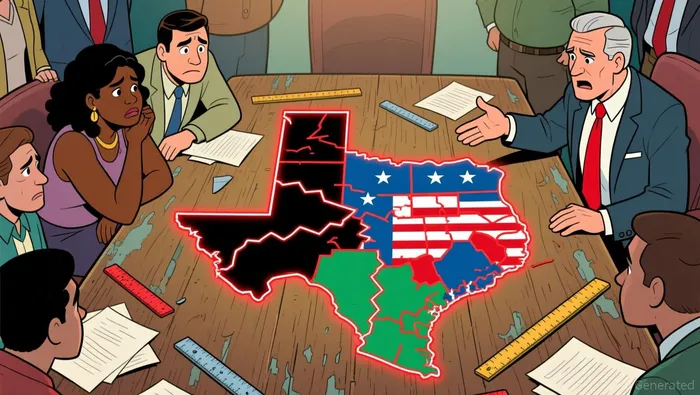
Legal experts highlight the broader implications of the ruling. Brian Smith, a political science professor at St. Edward's University, noted that the case tests the boundary between partisan strategy and racial discrimination in redistricting. The court's conservative majority faces a pivotal decision: whether the map's design crosses into unconstitutional territory or remains within the realm of political maneuvering. Texas Attorney General Ken Paxton has urged a swift resolution by December 1 to avoid disrupting the filing deadline for candidates.
The League of United Latin American Citizens (LULAC), which challenged the map, criticized the Supreme Court's pause as a setback for fair representation, warning that it emboldens gerrymandering efforts. The group's lawsuit, which argues the map dilutes the voting power of Black and Hispanic communities, remains active as the court weighs its next steps.

Stay ahead of the market.
Get curated U.S. market news, insights and key dates delivered to your inbox.


AInvest
PRO
AInvest
PRO



Comments
No comments yet