
Supply Chain Wars: How U.S.-China Tech Battles Create Asymmetric Opportunities
The collapse of the Lindsey refinery in 2024-2025, which once supplied 10% of the UK's fuel needs, is a stark microcosm of the fragility of global supply chains. Its insolvency—a result of debt-fueled mismanagement and delayed government intervention—exposed how critical infrastructure can crumble under financial strain, forcing nations to rely on volatile imports. This story, however, is not unique to energy. In the tech sector, U.S. export controls and trade tensions with China are reshaping global supply chains, creating asymmetric opportunities for investors in semiconductor manufacturing and AI. The key: identifying firms with dual-use technology resilience or cross-border diversification strategies.
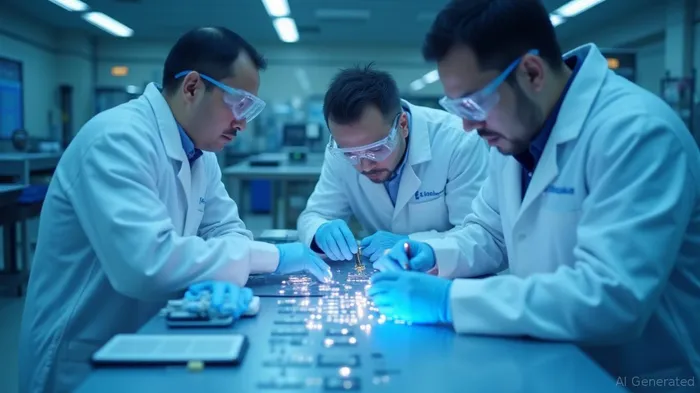
The U.S. Playbook: Export Controls as a Sword and Shield
Since 2022, the U.S. has weaponized its dominance in semiconductors and AI through increasingly stringent export controls. The Advanced Computing Final Rule (2022) and the Foundry Due Diligence Rule (2024) banned exports of advanced chips and manufacturing equipment to China, targeting entities like Huawei and SMIC. The goal: slow China's progress in AI and military tech.
The impact has been immediate:
- NVIDIA's H100/A100 chips were banned from sale to Chinese customers in 2023.
- ASML's EUV lithography machines—critical for advanced chip production—are now restricted to China under Dutch-U.S. alignment.
But these measures have also backfired. reveal that while U.S. firms face short-term headwinds, they retain monopoly power in critical technologies. Meanwhile, China's response has been to double down on self-reliance, accelerating innovation in dual-use technologies like AI chips and rare earth processing.
China's Countermove: Innovation Under Siege
Despite U.S. restrictions, China's tech sector is thriving in niche areas. Take SMIC, which has aggressively expanded mature-node (28nm+) capacity, now accounting for 25% of global supply by 2025. This shift has disrupted global pricing and forced competitors like GlobalFoundriesGFS-- to exit legacy nodes. Similarly, Huawei's HiSilicon is closing the gapGAP-- with NVIDIANVDA-- in AI chips, with its Ascend 910C targeting parity with U.S. restricted H20 GPUs by mid-2025.
The Lindsey refinery analogy applies here: just as the UK now faces diesel import dependency, the U.S. risks over-reliance on its own tech firms. For example, U.S. chipmakers like Intel remain vulnerable to supply chain bottlenecks in materials like polysilicon, where China holds 70% of global refining capacity.
Investment Opportunities: Where to Play
The U.S.-China tech war isn't just about losers—it's creating asymmetric winners. Here's how to capitalize:
1. Dual-Use Tech Champions
Firms with geographically diversified supply chains and military-civil fusion capabilities are best positioned.
- Taiwan Semiconductor (TSMC): Despite U.S. pressure, TSMC's $40B Arizona plant and cross-border R&D partnerships give it a stranglehold on advanced nodes.
- ASML: Its EUV machines remain irreplaceable, even with China's push for alternatives like Xinjiang Integrated Circuit's 294-layer NAND.
2. AI Infrastructure Plays
China's AI boom, driven by domestic demand, is creating opportunities in chip design and data centers.
- Cambricon: China's leading AI chipmaker, with designs powering Baidu's Kunlun series, offers exposure to the autonomous driving and cloud markets.
- NVIDIA (U.S.): Despite export bans, its software ecosystem (CUDA) remains unmatched, creating long-term licensing revenue streams.
3. Materials & Equipment Resilience
Control over rare earths, silicon wafers, and lithography tools is the new battleground.
- Rare Earths: Lynas Rare Earths (Australia) and MP Materials (U.S.) are critical for magnets used in EVs and semiconductors, bypassing China's dominance.
- Photoresists: JSR (Japan) and DuPont (U.S.) supply the chemicals for chip lithography, with no Chinese equivalents yet.
4. The Lindsey Refinery Lesson: Diversify or Perish
Just as energy markets are pivoting to strategic reserves and regional alliances, tech investors must favor firms with geographic flexibility. For example:
- AMD's x86 chip design licenses to Chinese foundries like SMIC allow it to bypass U.S. export rules while retaining IP control.
- Google Cloud's partnership with Alibaba's DAMO Academy on AI research underscores how cross-border collaboration thrives despite tensions.
Risks and the Path Forward
The Lindsey refinery's collapse reminds us that over-concentration in any supply chain is a vulnerability. For investors, the risks include:
- Regulatory Overreach: U.S. policies like the Inflation Reduction Act's EV subsidies could backfire by incentivizing over-Localization.
- Technological Surprise: China's AI advancements, as seen with DeepSeek's R1 model, may outpace expectations.
Investment Thesis:
- Buy ASMLASML-- and TSMCTSM-- for their irreplaceable tech.
- Hold NVIDIA and AMDAMD-- for their software/IP moats.
- Avoid pure-play U.S. semiconductor equipment firms exposed to China bans (e.g., Applied Materials).
The U.S.-China tech war isn't just a battle—it's a catalyst for innovation. The winners will be those who navigate the chaos with geographic diversification, technological uniqueness, and an eye for the next disruption. The Lindsey refinery's fate shows what happens when you don't.

Stay ahead of the market.
Get curated U.S. market news, insights and key dates delivered to your inbox.




Comments
No comments yet