
Supermarkets and Supply Chain Resilience: Strategic Entry Points in Essential Consumer Goods


 Aime Summary
The global supermarket industry is undergoing a transformative shift as supply chain resilience emerges as a critical determinant of competitive advantage. Recent developments in supply chain strategies, coupled with evolving consumer behavior and macroeconomic dynamics, present compelling opportunities for investors seeking exposure to essential consumer goods. This analysis explores how leading retailers are redefining operational efficiency and leveraging technological innovation to navigate disruptions, creating strategic entry points for capital allocation in a sector poised for long-term growth.
The Evolution of Supply Chain Resilience
In 2023–2025, supermarkets have prioritized diversification and agility to counteract disruptions from geopolitical tensions, climate risks, and trade policy shifts. Companies are decentralizing their supply chains by establishing regional and local networks,
reducing reliance on globalized systems vulnerable to bottlenecks. Concurrently, technologies such as real-time tracking, digital twins, and AI-driven forecasting are being deployed to enhance visibility and predictive decision-making
according to industry experts. These innovations enable retailers to balance cost efficiency with the flexibility required to adapt to fluctuating demand and external shocks
as research shows.
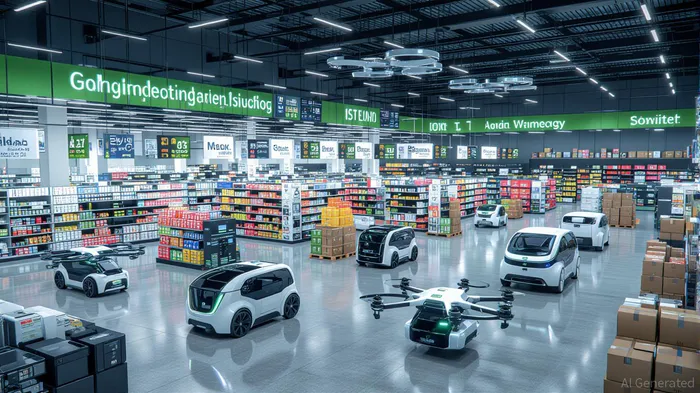 A pivotal example is WalmartWMT--, which has invested heavily in automation, RFID inventory management, and sustainability initiatives, including a commitment to 100% renewable power by 2035
according to financial analysis. Such strategies not only mitigate risks but also align with consumer preferences for eco-conscious brands, reinforcing long-term value creation.
Case Studies: Leading the Charge in Operational Efficiency
Kroger and Albertsons exemplify how strategic supply chain overhauls can drive financial performance. In 2024, Kroger
reported a 2.4% increase in identical sales (excluding fuel) and 11% growth in digital sales, driven by investments in associate wages and digital infrastructure. Albertsons, meanwhile, achieved 2.3% identical sales growth and a 24% surge in digital sales, supported by a 15% expansion in its loyalty program to 45.6 million members
according to company reports. Both companies optimized gross margins through targeted cost reductions, such as Kroger's sale of its specialty pharmacy and Albertsons' focus on private-label products
as financial statements show.
In contrast, Dollar General faced supply chain challenges, including $800 million in annual losses from theft and damage,
prompting strategic overhauls to streamline operations. These contrasting outcomes underscore the financial consequences of supply chain preparedness, with data-ready retailers
reporting over five times higher revenue growth compared to their less prepared peers.
Macroeconomic Tailwinds and Risks
The 2025 US retail outlook remains cautiously optimistic,
with real GDP projected to grow by 2.4% and consumer spending by 3.1%, supported by easing inflation and a robust labor market. However, risks persist, including potential tariff hikes that could trigger a broader economic slowdown and force the Federal Reserve to raise interest rates in 2026
as economic forecasts indicate. In this environment, supply chain efficiency and consumer retention strategies will be decisive factors in financial performance.
Strategic Entry Points for Investors
The shift toward resilient supply chains creates clear entry points for investors. Retailers that have integrated AI and machine learning for demand forecasting, such as Kroger and Albertsons, are better positioned to capitalize on omnichannel growth and fresh food demand
according to industry analysis. Additionally, companies like Walmart, which combine technological innovation with sustainability goals, align with broader ESG trends, offering dual exposure to operational and reputational value.
Investors should also consider the regulatory landscape. The Federal Trade Commission (FTC) has highlighted how dominant retailers exacerbate supply chain disruptions, disadvantaging smaller competitors and driving price hikes
according to a recent report. This dynamic reinforces the importance of investing in firms with scalable, resilient models that can withstand regulatory scrutiny while maintaining profit margins.
Conclusion
The supermarket sector's focus on supply chain resilience is not merely a response to short-term challenges but a strategic imperative for long-term growth. As leading retailers demonstrate through diversified sourcing, technological adoption, and operational efficiency, the ability to adapt to disruptions directly correlates with financial performance. For investors, this represents a unique opportunity to align capital with companies that are redefining the essential consumer goods landscape, ensuring both profitability and sustainability in an increasingly volatile market.

Stay ahead of the market.
Get curated U.S. market news, insights and key dates delivered to your inbox.
AInvest
PRO
AInvest
PRO



Comments
No comments yet