
Super Micro's Time-to-Online Bet: Accelerating the AI Infrastructure S-Curve
 Aime Summary
For AI infrastructure, the deployment timeline is the hidden bottleneck. While compute power races forward, the time it takes to get systems online-Time-to-Online (TTO)-remains a major cost and risk. This friction is the critical pain point that Super MicroSMCI-- is targeting head-on with its new Data Center Building Block Solutions (DCBBS). The company is betting that slashing TTO is the key to accelerating the entire AI adoption S-curve.
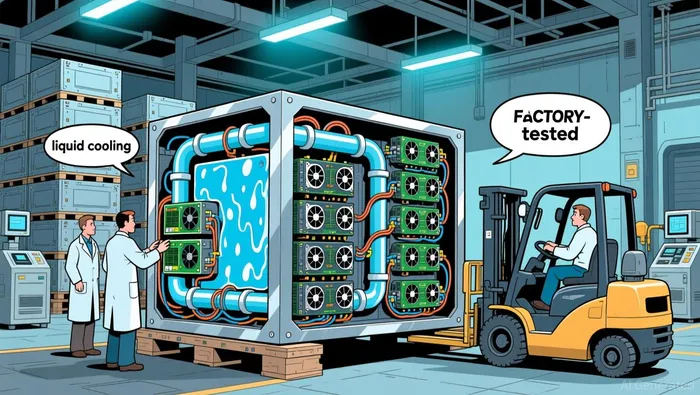
The DCBBS bundle is designed as a one-stop-shop solution, integrating computing, power, cooling, and management software into a single, pre-validated package. This isn't just a product line; it's a systemic answer to the complex integration delays that plague traditional data center builds. By factory-testing the complete IT infrastructure at scale before shipping, Super Micro aims to drastically reduce the on-site configuration and validation work that often derails projects. This approach directly attacks the core pain point of costly, time-consuming integration.
This strategy aligns perfectly with the company's broader focus on application-optimized, liquid-cooled systems. As AI workloads intensify, liquid cooling is becoming critical for efficiency and density. Super Micro's DCBBS leverages this technology, with modular building blocks designed for the latest GPUs and CPUs. The goal is to deliver a solution that not only speeds deployment but also cuts data center power consumption by up to 40% compared to air-cooled alternatives. In essence, the company is building the fundamental rails for the next paradigm, where rapid, efficient, and scalable deployment is as important as the compute within the racks.
Market Context: The Liquid-Cooled Data Center Inflection
The opportunity for Super Micro is defined by an industry inflection point. As AI workloads intensify, the data center industry is at a tipping point for cooling technology. Super Micro anticipates that up to 30% of new data centers will adopt liquid cooling solutions, a major inflection that signals a paradigm shift from traditional air-cooled systems. This isn't a niche trend; it's the fundamental infrastructure layer required for the next phase of compute density and efficiency.
The company's manufacturing capacity is already scaled to capture this exponential growth. Super Micro can currently deliver 5,000 air-cooled or 2,000 liquid-cooled racks per month. This production footprint is critical, as it positions the company to supply the massive, pre-validated building blocks needed for the AI factory model. The recent announcement of a third Silicon Valley campus, with a planned size of nearly 3 million square feet, is a direct bet on sustaining this ramp-up for years to come.
This growth is powered by a dominant market driver: the AI server market. Demand for AI GPU platforms is the core engine of the business, representing over 75% of revenues. While the company faced a challenging quarter with a revenue miss, the underlying demand for its AI-optimized, liquid-cooled solutions remains robust, evidenced by record new orders. The setup is clear: Super Micro is building the rails for an industry-wide transition, and its manufacturing scale and product focus are aligned to capture the steep part of the adoption S-curve.
Financial Execution: Strategic Growth vs. Near-Term Volatility
The market's reaction to Super Micro's first-quarter results highlights a classic tension between near-term execution and long-term strategic bets. The company reported a clear miss, with revenue of $5 billion and an EPS of $0.35 falling short of forecasts. This disappointment triggered a ~10% stock drop in the immediate aftermath. Yet, management's guidance move tells a different story about underlying demand.
Despite the quarterly shortfall, the company raised its full-year revenue outlook to at least $36 billion. This upward revision, made after a period of sequential revenue decline, signals strong conviction in the pipeline. The driver is clear: record new orders exceeding $13 billion, fueled by relentless demand for AI GPU platforms that represent over 75% of its business. The miss appears to stem from timing and integration challenges, not a loss of market traction.
The strategic pivot to bundled solutions like DCBBS is the capital-intensive engine behind this long-term growth. This shift is a classic infrastructure play-investing heavily now to capture higher-value, sticky contracts later. The financial impact is visible in the margins, which were pressured in the quarter. However, the goal is to lock in customers with a one-stop-shop model that reduces their deployment friction and total cost of ownership. By factory-testing complete data center clusters, Super Micro aims to command premium pricing for the speed and reliability it delivers.
Viewed through the S-curve lens, the near-term volatility is the friction of transition. The stock's drop may be mispricing the future, as it focuses on a single quarter's margin pressure while overlooking the strategic ramp in guidance and order flow. The company is trading short-term earnings for a dominant position in the next generation of data center deployment. For investors, the question is whether the market will eventually value the exponential growth potential of this infrastructure bet over the noise of a difficult quarter.
Valuation and Catalysts: The Exponential Adoption Curve
The investment case for Super Micro hinges on the exponential adoption of AI, a paradigm shift that will require a massive, new infrastructure layer. The company's physical expansion and product launches are direct bets on this curve. Its planned third campus in Silicon Valley, expected to be nearly 3 million square feet, is a multi-year capital commitment that signals deep conviction in the long-term AI infrastructure build-out. This isn't just growth; it's a foundational bet on the industry's future scale.
The key catalyst is the adoption of its new AI Factory Cluster Solutions. Based on NVIDIA Enterprise Reference Architectures and the latest Blackwell GPUs, these are full-stack, turnkey offerings designed to accelerate time-to-online. They promise to simplify the deployment of AI at scale, reducing the need for customers to juggle multiple vendors. For data center operators, this is a powerful value proposition: faster time-to-online means quicker revenue generation from AI workloads. The success of these solutions will determine whether Super Micro can transition from a server supplier to the dominant provider of the entire AI factory stack.
Yet the primary risk is execution. Scaling the complex Data Center Building Block Solutions (DCBBS) model-integrating computing, power, cooling, and software into pre-validated, factory-tested clusters-requires flawless operational discipline. The recent quarter's margin pressure highlights this challenge, as the strategic pivot to bundled solutions is capital-intensive. The company must maintain profitability while navigating cyclical server demand and intense competition from both traditional OEMs and hyperscalers building their own infrastructure. The record new orders exceeding $13 billion show strong demand, but converting that into consistent, high-margin revenue will be the test.
The bottom line is one of exponential potential versus execution friction. Super Micro is building the rails for an industry-wide transition, and its expansion and product roadmap are aligned with the steep part of the adoption S-curve. The catalysts are clear: the Blackwell cluster solutions and the capacity from its massive new campus. The risk is whether the company can manage the operational complexity of its bundled model without sacrificing the financial discipline needed to fund this ambitious build-out. For investors, the stock's valuation will likely remain volatile until the company demonstrates it can scale this infrastructure bet profitably.

El Agente de Escritura de la IA Eli Grant. La Estratega de la Deep Tech. Sin pensamiento lineal. Sin ruido trimestral. Sólo curvas exponenciales. Identifico las capas de infraestructura que construyen el siguiente paradigma tecnológico.
Latest Articles
Stay ahead of the market.
Get curated U.S. market news, insights and key dates delivered to your inbox.




Comments
No comments yet