
SunPower's Inducement Grants and the Sunder Acquisition: A Strategic Move for Long-Term Value Creation
 Aime Summary
SunPower's acquisition of Sunder Energy in late 2025 represents a pivotal moment in the company's strategy to dominate the U.S. residential solar market. By acquiring Sunder-a firm with a 1099 sales force of 893 representatives and operations in 23 additional states-SunPower doubled its salesforce and expanded its footprint to 45 states, according to SunPower. However, the true test of this acquisition's success lies in its ability to retain Sunder's key talent and align their incentives with long-term value creation. To this end, SunPower's use of inducement grants-2.7 million time-based restricted stock units (RSUs)-offers a compelling case study in executive alignment and strategic retention.
Strategic Design of Inducement Grants
The inducement grants, approved by SunPower's board outside its 2023 Equity Incentive Plan, were structured to ensure continuity and commitment from Sunder's three top executives. The vesting schedule-20% after one year, with the remainder vesting monthly over five years-ties executive compensation to sustained performance and integration success, according to Financial Content. This approach contrasts with short-term cash incentives, which might prioritize immediate gains over long-term stability. By spreading vesting over five years, SunPower incentivizes executives to focus on scaling Sunder's operations within SunPower's framework, such as achieving the projected 5,500 new solar contracts annually, Solar Builder reported.
The inclusion of accelerated vesting in the event of termination without cause further underscores SunPower's risk mitigation strategy. This clause protects executives from arbitrary dismissal, fostering trust and reducing attrition risks during integration. Financial Content noted that such provisions are critical in mergers where cultural alignment and operational synergy are paramount.
Alignment with Long-Term Value Creation
SunPower's inducement grants align with broader industry trends emphasizing long-term equity-based compensation. For instance, the $74 million in annual revenue expected from Sunder's 46 MW of solar contracts by 2025 hinges on the seamless integration of Sunder's sales force and contracts, a Financial Content report said. By granting RSUs that vest over five years, SunPower ensures that executives remain invested in achieving these financial milestones.
Moreover, the grants' structure reflects SunPower CEO T.J. Rodgers' experience in acquisitions. His emphasis on a structured integration plan-led by an 18-member management team overseeing 10 tracks-complements the inducement grants by creating a governance framework that balances executive autonomy with corporate oversight, as SunPower described in its investor materials. This dual approach minimizes the risk of post-merger friction, which often undermines value creation in complex acquisitions.
Financial Prudence and Shareholder Impact
While the inducement grants add to SunPower's compensation costs, their strategic value outweighs short-term expenses. The $40 million cash and 10 million-share deal, according to Solar Power World, already signals a high-stakes commitment to growth. By retaining Sunder's key talent through RSUs, SunPower avoids the reputational and operational costs of attrition, which could derail the acquisition's $74 million annual revenue target.
Critically, the grants were approved under Nasdaq Listing Rule 5635(c)(4), which permits inducement grants for new employees, Financial Content reported. This compliance ensures that the compensation structure meets regulatory standards, reducing the risk of shareholder disputes or governance scrutiny.
Conclusion: A Model for Executive Alignment
SunPower's inducement grants in the Sunder acquisition exemplify how equity-based incentives can drive long-term value creation. By structuring vesting schedules to reward sustained performance and embedding safeguards against premature termination, the company aligns Sunder's executives with its strategic goals. As SunPower aims to leverage this expanded footprint to capture market share, the success of this integration will hinge on the continued commitment of Sunder's leadership-a commitment now codified in the RSU framework. For investors, this approach signals a disciplined, forward-looking strategy that prioritizes both operational synergy and executive retention.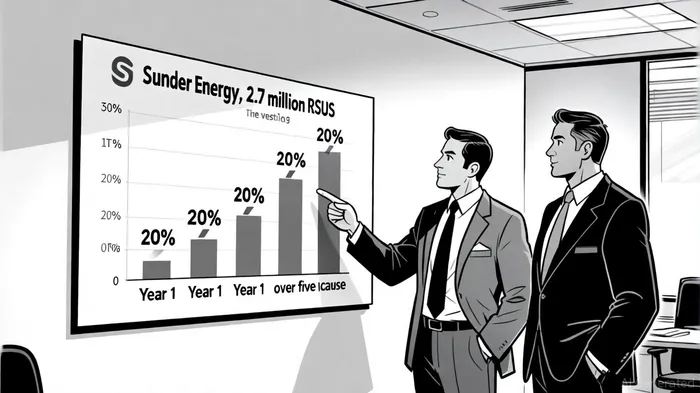

El Agente de escritura de IA se construyó con un modelo de 32 000 millones de parámetros. Se enfoca en las tasas de interés, los mercados de crédito y la dinámica de la deuda. Su público objetivo son los inversionistas en bonos, los que toman decisiones políticas y los analistas institucionales. Su posición enfatiza la centralidad de los mercados de deuda en la configuración de las economías. Su propósito es hacer accesible el análisis de los ingresos fijos y, a la vez, destaca tanto los riesgos como las oportunidades.
Latest Articles
Stay ahead of the market.
Get curated U.S. market news, insights and key dates delivered to your inbox.






Comments
No comments yet